View in other NatureServe Network Field Guides
NatureServe
Montana
Utah
Wyoming
Idaho
Wisconsin
British Columbia
South Carolina
Yukon
California
New York
Mountain Lousewort - Pedicularis pulchella
State Rank Reason (see State Rank above)
Restricted to high elevation areas of southern Montana. Limited data are available for the species and it may be more common than the few collections indicate.
- Details on Status Ranking and Review
Population Size
Score2 - Small: Generally 2,000-10,000 individuals.
CommentEstimated. Population levels are largely undocumented as available observation data and specimen collections have little to no data on abundance.
Range Extent
Score2 - Regional or State Endemic or Small Montana Range: Generally restricted to an area <100,000 sq. miles (equivalent to 2/3 the size of Montana or less) or Montana contributes 50% or more of the species’ range or populations OR limited to 2-3 Sub-basins in Montana.
Area of Occupancy
Score1-2 - Low to Moderate. Occurs in 4-25 Subwatersheds (6th Code HUC’s), though the species' distribution is not sufficiently documented to place it within one class.
CommentDocumented from 7 subwatersheds. As additional suitable habitat exists, it seems likely that others will be documented with additional surveys.
Environmental Specificity
Score1 - Moderate: Species is restricted to a specific habitat that is more widely distributed or to several restricted habitats and is typically dependent upon relatively unaltered, good-quality habitat (C Values of 5-7).
Trends
ScoreNA - Rank factor not assessed.
CommentTrends unknown, though populations are likely stable or experiencing only minor declines.
Threats
Score0-1 - Low to Medium.
Intrinsic Vulnerability
Score1 - Moderate Vulnerability: Specific biological attributes, unusual life history characteristics or limited reproductive potential makes the species susceptible to extirpation from stochastic events or other adverse impacts to its habitat and slow to recover.
Raw Conservation Status Score
Score
7 to 9 total points scored out of a possible 16 (Rarity factors and threats only).
General Description
Stems 3–15 cm, often clustered on the caudex. Leaves mainly basal, 2–5 cm long; blades deeply pinnately lobed into lobed and serrate, ovate segments 1–7 mm long. Inflorescence villous, densely flowered, 2–5 cm long; bracts leaf-like. Flowers: calyx purple-veined, 8–10 mm long, 5-lobed, the lobes equal, 2–5 mm long; corolla purple, 18–24 mm long; galea 8–13 mm long, obscurely beaked. Capsule 4-10 mm long (
Lesica et al. 2012. Manual of Montana Vascular Plants. BRIT Press. Fort Worth, TX).
Species Range
Montana Range
Range Descriptions
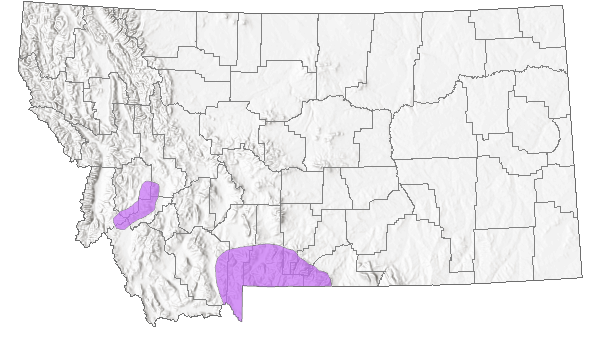
 Native
Range Comments
Endemic to southwest MT and adjacent WY (Lesica et al. 2012. Manual of Montana Vascular Plants. BRIT Press. Fort Worth, TX).
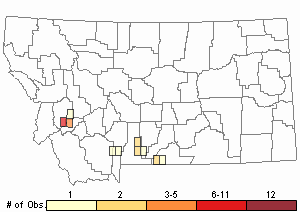
Observations in Montana Natural Heritage Program Database
Number of Observations: 29
(Click on the following maps and charts to see full sized version)
Map Help and Descriptions
Relative Density
Recency
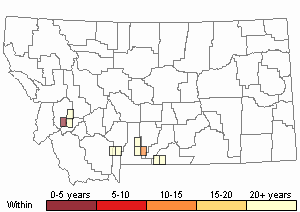
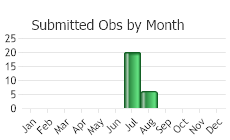
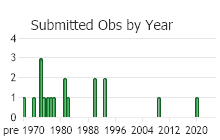
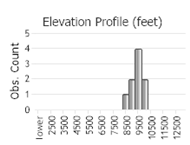 (Observations spanning multiple months or years are excluded from time charts)
Habitat
National Vegetation Classification System Groups Associated with this Species
Alpine
Alpine - Sparse and Barren
Alpine - Vegetated
Forest and Woodland
Montane - Subalpine Forest and Woodland
Wetland and Riparian
Alpine Riparian and Wetland
Ecology
POLLINATORS The following animal species have been reported as pollinators of this plant species or its genus where their geographic ranges overlap:
Bombus vagans,
Bombus appositus,
Bombus bifarius,
Bombus fervidus,
Bombus flavifrons,
Bombus frigidus,
Bombus melanopygus,
Bombus mixtus,
Bombus rufocinctus,
Bombus sylvicola,
Bombus occidentalis, and
Bombus kirbiellus (Plath 1934, Macior 1974, Wilson et al. 2010, Miller-Struttmann and Galen 2014, Williams et al. 2014).
Stewardship Responsibility
References
- Literature Cited AboveLegend:
 View Online Publication
- Lesica, P., M.T. Lavin, and P.F. Stickney. 2012. Manual of Montana Vascular Plants. Fort Worth, TX: BRIT Press. viii + 771 p.
 Macior, L.M. 1974. Pollination ecology of the Front Range of the Colorado Rocky Mountains. Melanderia 15: 1-59.
- Miller-Struttmann, N.E. and C. Galen. 2014. High-altitude multi-taskers: bumble bee food plant use broadens along an altitudinal productivity gradient. Oecologia 176:1033-1045.
- Plath, O.E. 1934. Bumblebees and their ways. New York, NY: Macmillan Company. 201 p.
- Williams, P., R. Thorp, L. Richardson, and S. Colla. 2014. Bumble Bees of North America. Princeton, NJ: Princeton University Press. 208 p.
- Wilson, J.S., L.E. Wilson, L.D. Loftis, and T. Griswold. 2010. The montane bee fauna of north central Washington, USA, with floral associations. Western North American Naturalist 70(2): 198-207.
- Additional ReferencesLegend: View Online Publication
Do you know of a citation we're missing?- Lesica, P., M.T. Lavin, and P.F. Stickney. 2022. Manual of Montana Vascular Plants, Second Edition. Fort Worth, TX: BRIT Press. viii + 779 p.
- Williams, K.L. 2012. Classification of the grasslands, shrublands, woodlands, forests and alpine vegetation associations of the Custer National Forest portion of the Beartooth Mountains in southcentral Montana. M.Sc. Thesis. Bozeman, MT: Montana State University. 376 p.
- Web Search Engines for Articles on "Mountain Lousewort"