View in other NatureServe Network Field Guides
NatureServe
Montana
Utah
Wyoming
Idaho
Wisconsin
British Columbia
South Carolina
Yukon
California
New York
Thimbleberry - Rubus parviflorus
Other Names:
Rubus nutkanus
Native Species
Global Rank:
G5
State Rank:
S5
(see State Rank Reason below)
C-value:
3
Agency Status
USFWS:
USFS:
BLM:
State Rank Reason (see State Rank above)
Rubus parviflorus is common to abundant in some forests and mesic habitats, especially in western Montana. No significant and widespread threats to the species are known.
General Description
Stems unarmed, 50–150 cm, puberulent and stipitate-glandular at first, older bark thin and shredding. Leaves undivided; the blade cordate-suborbicular, 5-lobed, 6–15 cm, glabrate, stipitate-glandular on the veins beneath. Flowers few in an open corymb; hypanthium stipitate-glandular; sepals ovate with acuminate tips, 1–2 cm long, glandular, pubescent on the margins; petals white, 15–25 mm long. Fruit a red, hemispheric, hairy raspberry 1–2 cm wide (
Lesica et al. 2012. Manual of Montana Vascular Plants. BRIT Press. Fort Worth, TX).
Species Range
Montana Range
Range Descriptions
 Native
Range Comments
AK to ON south to CA, NM, SD and Mexico (Lesica et al. 2012. Manual of Montana Vascular Plants. BRIT Press. Fort Worth, TX).
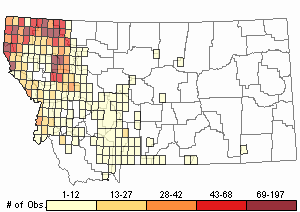
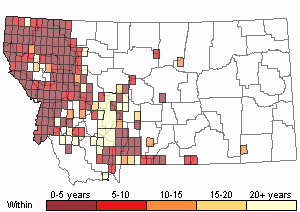
Observations in Montana Natural Heritage Program Database
Number of Observations: 4090
(Click on the following maps and charts to see full sized version)
Relative Density
Recency
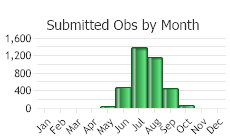
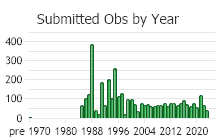
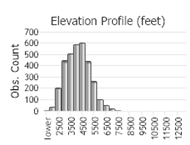 (Observations spanning multiple months or years are excluded from time charts)
Habitat
Ecological Communities Associated with this Species
Forest and Woodland
Montane - Subalpine Forest and Woodland
Shrubland
Foothills - Montane Shrubland
Ecology
POLLINATORS The following animal species have been reported as pollinators of this plant species or its genus where their geographic ranges overlap:
Bombus vagans,
Bombus auricomus,
Bombus bifarius,
Bombus borealis,
Bombus centralis,
Bombus melanopygus,
Bombus mixtus,
Bombus rufocinctus,
Bombus ternarius,
Bombus sitkensis,
Bombus occidentalis,
Bombus pensylvanicus,
Bombus bimaculatus,
Bombus griseocollis,
Bombus impatiens,
Bombus insularis,
Bombus bohemicus, and
Bombus flavidus (Heinrich 1976, Thorp et al. 1983, Mayer et al. 2000, Wilson et al. 2010, Colla and Dumesh 2010, Colla et al. 2011, Koch et al. 2012, Williams et al. 2014).
Stewardship Responsibility
References
- Literature Cited AboveLegend:
 View Online Publication
 Colla, S., L. Richardson, and P. Williams. 2011. Bumble bees of the eastern United States. Washington, DC: USDA Forest Service, Pollinator Partnership. 103 p.
- Colla, S.R. and S. Dumesh. 2010. The bumble bees of southern Ontario: notes on natural history and distribution. Journal of the Entomological Society of Ontario 141:39-68.
- Koch, J., J. Strange, and P. Williams. 2012. Bumble bees of the western United States. Washington, DC: USDA Forest Service, Pollinator Partnership. 143 p.
- Lesica, P., M.T. Lavin, and P.F. Stickney. 2012. Manual of Montana Vascular Plants. Fort Worth, TX: BRIT Press. viii + 771 p.
- Mayer, D.F., E.R. Miliczky, B.F. Finnigan, and C.A. Johnson. 2000. The bee fauna (Hymenoptera: Apoidea) of southeastern Washington. Journal of the Entomological Society of British Columbia 97: 25-31.
- Thorp, R.W., D.S. Horning, and L.L. Dunning. 1983. Bumble bees and cuckoo bumble bees of California (Hymenoptera: Apidae). Bulletin of the California Insect Survey 23:1-79.
- Williams, P., R. Thorp, L. Richardson, and S. Colla. 2014. Bumble Bees of North America. Princeton, NJ: Princeton University Press. 208 p.
- Wilson, J.S., L.E. Wilson, L.D. Loftis, and T. Griswold. 2010. The montane bee fauna of north central Washington, USA, with floral associations. Western North American Naturalist 70(2): 198-207.
- Additional ReferencesLegend: View Online Publication
Do you know of a citation we're missing?- Culver, D.R. 1994. Floristic analysis of the Centennial Region, Montana. M.Sc. Thesis. Montana State University, Bozeman. 199 pp.
- Dale, D. 1973. Effects of trail use under forests in the Madison Range, Montana. M.Sc. Thesis. Bozeman, MT: Montana State University. 96 pp.
- Eversman, S.T. 1968. A comparison of plant communities and substrates of avalanche and non-avalanche areas in south central Montana. M.Sc. Thesis. Bozeman, MT: Montana State University. 39 pp.
- Fogelsong, M.L. 1974. Effects of fluorides on Peromyscus maniculatus in Glacier National Park. M.Sc. Thesis. Bozeman, Montana: Montana State University. 52 p.
- Glazier, R.J. 1971. Ecological and morphological relationships of subspecies of Peromyscus maniculatus near St. Mary, Montana. M.Sc. Thesis. Bozeman, Montana: Montana State University. 41 p.
- Lesica, P., M.T. Lavin, and P.F. Stickney. 2022. Manual of Montana Vascular Plants, Second Edition. Fort Worth, TX: BRIT Press. viii + 779 p.
- Martinka, R.R. 1970. Structural characteristics and ecological relationships of male blue grouse (Dendragapus obscurus (Say)) territories in southwestern Montana. Ph.D Dissertation. Bozeman, MT: Montana State University. 73 p.
- Moore, R.L.K. 1987. Daily and seasonal activity patterns of the Pika in Southwestern Montana. M.Sc. Thesis. Bozeman, MT: Montana State University. 61 p.
- Morgan, J.T. 1993. Summer habitat use of white-tailed deer on the Tally Lake ranger district, Flathead National Forest. Ph.D. Dissertation. Montana State University, Bozeman. pp. 103.
- Simanonok, M. 2018. Plant-pollinator network assembly after wildfire. Ph.D. Dissertation. Bozeman, MT: Montana State University. 123 p.
- Simanonok, M.P. and L.A. Burkle. 2019. Nesting success of wood-cavity-nesting bees declines with increasing time since wildfire. Ecology and Evolution 9:12436-12445.
- Web Search Engines for Articles on "Thimbleberry"