View in other NatureServe Network Field Guides
NatureServe
Montana
Utah
Wyoming
Idaho
Wisconsin
British Columbia
South Carolina
Yukon
California
New York
Bitter Cherry - Prunus emarginata
Native Species
Global Rank:
G5
State Rank:
S4
(see State Rank Reason below)
C-value:
5
Agency Status
USFWS:
USFS:
BLM:
State Rank Reason (see State Rank above)
Prunus emarginata is occasional to locally common in some woodlands, shrub fields and riparian habitats in parts of western Montana. Populations appear to be relatively robust. Non-native species occupy some of the same habitats and may be having some negative impacts to the species and and its habitat, though the magnitude of impacts is probably low. No other significant and widespread threats to the species are known.
General Description
Shrub or small tree 2–5 m. Twigs purple, glabrous. Leaf blades oblong to oblanceolate, rounded to the tip, 2–8 cm long, glabrous or puberulent beneath. Inflorescence a hemispheric, 5- to 8-flowered corymb, appearing with the leaves. Flowers: hypanthium 2–3 mm long, obconic, glabrous or hairy; sepals ovate, reflexed, 2–3 mm long; petals 4–7 mm long. Drupe a red to black cherry, 6–8 mm long when dry (
Lesica et al. 2012. Manual of Montana Vascular Plants. BRIT Press. Fort Worth, TX).
Species Range
Montana Range
Range Descriptions
 Native
Range Comments
BC, MT south to CA, NV and UT (Lesica et al. 2012. Manual of Montana Vascular Plants. BRIT Press. Fort Worth, TX).
Observations in Montana Natural Heritage Program Database
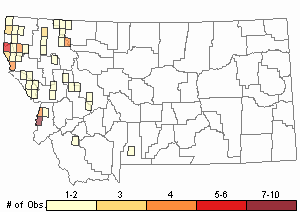
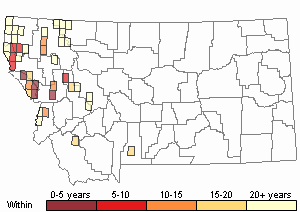
Number of Observations: 121
(Click on the following maps and charts to see full sized version)
Relative Density
Recency
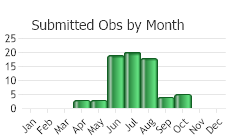
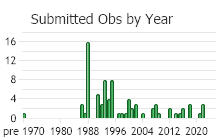
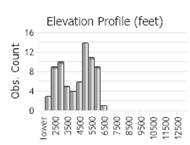 (Observations spanning multiple months or years are excluded from time charts)
Habitat
Ecological Communities Associated with this Species
Shrubland
Foothills - Montane Shrubland
Ecology
POLLINATORS The following animal species have been reported as pollinators of this plant species or its genus where their geographic ranges overlap:
Bombus vagans,
Bombus bifarius,
Bombus huntii,
Bombus mixtus,
Bombus ternarius,
Bombus terricola,
Bombus occidentalis,
Bombus pensylvanicus,
Bombus bimaculatus,
Bombus griseocollis, and
Bombus impatiens (Macior 1968, Heinrich 1976, Thorp et al. 1983, Colla and Dumesh 2010, Williams et al. 2014).
Stewardship Responsibility
References
- Literature Cited AboveLegend:
 View Online Publication
 Colla, S.R. and S. Dumesh. 2010. The bumble bees of southern Ontario: notes on natural history and distribution. Journal of the Entomological Society of Ontario 141:39-68.
- Lesica, P., M.T. Lavin, and P.F. Stickney. 2012. Manual of Montana Vascular Plants. Fort Worth, TX: BRIT Press. viii + 771 p.
- Macior, L.M. 1968. Bombus (Hymenoptera, Apidae) queen foraging in relation to vernal pollination in Wisconsin. Ecology 49:20-25.
- Thorp, R.W., D.S. Horning, and L.L. Dunning. 1983. Bumble bees and cuckoo bumble bees of California (Hymenoptera: Apidae). Bulletin of the California Insect Survey 23:1-79.
- Williams, P., R. Thorp, L. Richardson, and S. Colla. 2014. Bumble Bees of North America. Princeton, NJ: Princeton University Press. 208 p.
- Additional ReferencesLegend: View Online Publication
Do you know of a citation we're missing?- Klebenow, D.A. 1965. A montane forest winter deer habitat in western Montana. Journal of Wildlife Management 29(1):27-33.
- Lesica, P., M.T. Lavin, and P.F. Stickney. 2022. Manual of Montana Vascular Plants, Second Edition. Fort Worth, TX: BRIT Press. viii + 779 p.
- Little, E.L., Jr. 1979. Checklist of United States trees (native and naturalized). Agriculture Handbook No. 541. U.S. Forest Service, Washington, D.C. 375 pp.
- Web Search Engines for Articles on "Bitter Cherry"