View in other NatureServe Network Field Guides
NatureServe
Montana
Utah
Wyoming
Idaho
Wisconsin
British Columbia
South Carolina
Yukon
California
New York
Field Sowthistle - Sonchus arvensis ssp. arvensis
Other Names:
Perennial Sowthistle, Perennial Sow-thistle
State Rank Reason (see State Rank above)
Sonchus arvensis subspecies arvensis is native to Europe and was introduced into North America, including Montana (Lesica et al. 2022). A conservation status rank is not applicable (SNA) because the plant is exotic (non-native) to Montana and is not a suitable target for conservation activities.
General Description
PLANTS: A rhizomatous perennial forb with erect, branched stems, 30-140 cm tall. Stem bases can be hard, almost woody. Sap is milky. Sources: Hyatt in Flora of North America (FNA) 2006; Giblin et al. [eds.] 2018; Lesica et al. 2022
LEAVES: Arranged as a basal rosette and alternately on the stem (cauline). Blades are simple, linear-oblanceolate, in shape, with pinnately lobed margins, 4-30 cm long. Terminal lobes usually larger than lateral lobes. Leaf stems (petioles) are winged below, and upwards lacking (sessile) and clasping (auriculate) the stem. Sources: Hyatt in FNA 2006; Giblin et al. [eds.] 2018; Lesica et al. 2022
INFLORESCENCE: Flowers arranged in yellow heads within a branched raceme (panicle). Flower heads composed of ligulate (strap-shaped petals) ray florets with stamens and pistil (perfect), usually 3-5 cm wide. Ray ligules, yellow, 7-13 mm long. Involucral bracts linear-lanceolate, unequal, and imbricate in 3 to 5 rows (series), 1-2 cm high – with or without glandular hairs. Fruit: Achene, brown, 2-4 mm long, minutely bumpy. Sources: Hyatt in FNA 2006; Giblin et al. [eds.] 2018; Lesica et al. 2022
Subspecies (ssp. or subsp.) arvensis: Flower stems (peduncles) and involucral bracts have stalked glands (stipitate-glandular). Inner bracts are 14-17 mm long.
Phenology
Flowering for subsp. arvensis occurs from July through September (Hyatt in FNA 2006).
Diagnostic Characteristics
In Montana, two weakly defined subspecies are present. The Intermountain Flora (Cronquist et al. 1994) and other older floras treated them as separate species.
Subspecies uliginosus, non-native, undesirable
* Involucral Bracts (Phyllaries): Stipitate-glandular, 14-17 mm long. Glabrous or nearly so.
* Peduncles: Stipitate-glandular. Glabrous or nearly so.
Subspecies arvensis, non-native, undesirable
* Involucral Bracts (Phyllaries): Sessile glands, occasionally tomentose, 10-15 mm long.
* Peduncles: Sessile glands, occasionally tomentose.
Species Range
Montana Range
Range Descriptions
 Non-native
Range Comments
Sonchus arvensis subsp. arvensis is native to Europe and was introduced into North America (Hyatt in FNA 2006). Sonchus arvensis subsp. arvensis is the lesser common subspecies, occurring mostly in the western portion of state (Lesica et al. 2022).
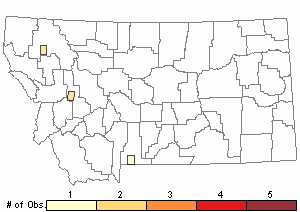
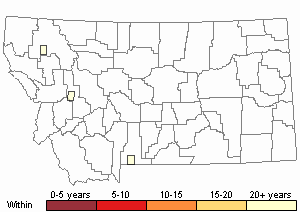
Observations in Montana Natural Heritage Program Database
Number of Observations: 5
(Click on the following maps and charts to see full sized version)
Relative Density
Recency
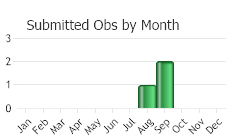
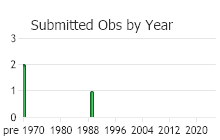
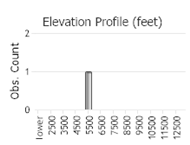 (Observations spanning multiple months or years are excluded from time charts)
Habitat
In Montana, Sonchus arvensis subsp. arvensis occurs in the same ecological settings as subsp. uliginosus, which includes wet meadows, marshes, ditch- and stream-banks, and irrigated fields in the plains and valleys zones of Montana (Lesica et al. 2022). Across its range, subsp. arvensis are especially found in urban areas where land is disturbed and wet (Hyatt in FNA 2006).
Ecology
POLLINATORS The following animal species have been reported as pollinators of this plant species or its genus where their geographic ranges overlap:
Bombus vagans,
Bombus bifarius,
Bombus fervidus, and
Bombus terricola (Thorp et al. 1983, Colla and Dumesh 2010).
Reproductive Characteristics
Sonchus arvensis subsp. arvensis reproduces by seeds and spreads by rhizomes.
GENETICS
Sonchus arvensis subsp. arvensis: 2n=54 (Hyatt in FNA 2006).
Management
Stewardship Responsibility
Threats or Limiting Factors
Sonchus arvensis subsp. arvensis can outcompete native plants through its prolific seed production and rhizomatous growth habit.
References
- Literature Cited AboveLegend:
 View Online Publication
 Colla, S.R. and S. Dumesh. 2010. The bumble bees of southern Ontario: notes on natural history and distribution. Journal of the Entomological Society of Ontario 141:39-68.
- Flora of North America Editorial Committee. 2006. Flora of North America North of Mexico. Vol. 20. Magnoliophyta: Asteridae, part 7: Asteraceae, part 2. Oxford Univ. Press, New York. xxii + 666 pp.
- Hitchcock, C.L. and A. Cronquist. 2018. Flora of the Pacific Northwest: An Illustrated Manual. Second Edition. Giblin, D.E., B.S. Legler, P.F. Zika, and R.G. Olmstead (eds). Seattle, WA: University of Washington Press in Association with Burke Museum of Natural History and Culture. 882 p.
- Lesica, P., M.T. Lavin, and P.F. Stickney. 2022. Manual of Montana Vascular Plants, Second Edition. Fort Worth, TX: BRIT Press. viii + 779 p.
- Thorp, R.W., D.S. Horning, and L.L. Dunning. 1983. Bumble bees and cuckoo bumble bees of California (Hymenoptera: Apidae). Bulletin of the California Insect Survey 23:1-79.
- Additional ReferencesLegend: View Online Publication
Do you know of a citation we're missing?- Lesica, P., M.T. Lavin, and P.F. Stickney. 2012. Manual of Montana Vascular Plants. Fort Worth, TX: BRIT Press. viii + 771 p.
- Web Search Engines for Articles on "Field Sowthistle"