View in other NatureServe Network Field Guides
NatureServe
Montana
Utah
Wyoming
Idaho
Wisconsin
British Columbia
South Carolina
Yukon
California
New York
Field Sowthistle - Sonchus arvensis
Other Names:
Perennial Sow-thistle, Perennial Sowthistle, Corn Sow Thistle, Gutweed, Swine Thistle, Tree Sow Thistle
State Rank Reason (see State Rank above)
Sonchus arvensis is native to Europe and was introduced into North America (Lesica et al. 2022). Plants likely came over as a contaminant in seed (McWilliams 2004). Sonchus arvensis is an invasive weed, especially in riparian and wetland habitats, and can out-compete native plant species. A conservation status rank is not applicable (SNA) because the plant is exotic (non-native) to Montana and is not a suitable target for conservation activities.
General Description
PLANTS: A rhizomatous perennial forb with erect, branched stems, 30-140 cm tall. Stem bases can be hard, almost woody. Stems have milky sap. Sources: Hyatt
in Flora of North America (FNA) 2006; Giblin et al. [eds.] 2018; Lesica et al. 2022
LEAVES: Arranged as a basal rosette and alternately on the stem (cauline). Blades are simple, linear-oblanceolate, in shape, with pinnately lobed margins, 4-30 cm long. Terminal lobes usually larger than lateral lobes. Leaf stems (petioles) are winged below, and upwards lacking (sessile) and clasping (auriculate) the stem. Sources: Hyatt
in FNA 2006; Giblin et al. [eds.] 2018; Lesica et al. 2022
INFLORESCENCE: Flowers arranged in yellow heads within a branched raceme (panicle). Flower heads composed of ligulate (strap-shaped petals) ray florets with stamens and pistil (perfect), usually 3-5 cm wide in full flower. Ray ligules, yellow, 7-13 mm long. Involucral bracts linear-lanceolate, unequal, and imbricate in 3 to 5 rows (series), 1-2 cm high – with or without glandular hairs. Fruit: Achene, brown, 2-4 mm long, minutely bumpy. Sources: Hyatt
in FNA 2006; Giblin et al. [eds.] 2018; Lesica et al. 2022
Montana has two subspecies,
uliginosus and
arvensis.
Phenology
Field Sowthistle flowers from July through September (Hyatt in FNA 2006).
Diagnostic Characteristics
In Montana there are three
Sonchus species – all yellow flowered and similar in form until you look closely.
Field Sowthistle –
Sonchus arvensis, non-native, undesirable
* Plants: Perennial. Long-taproot with spreading rhizomes.
* Flower Heads: Usually 3-5 cm wide (full flower). Yellow ligules 7-13 mm long, more or less equal to the length of the tube portion of the floret. Involucre 10-20 mm tall.
* Achene: Bumpy on and between the 5 or more ribs.
* Leaves: Toothed. Leaf base auricles often rounded, straight or curved.
* In Montana, two weakly defined subspecies are present,
uliginosus and
arvensis.
Common Sowthistle –
Sonchus oleraceus, non-native, undesirable
* Plants: Annual (maybe biennial). Short taproot. Lacking rhizomes.
* Flower Heads: Usually less than 2.5 cm wide (full flower). Yellow ligules 3-6 mm long, shorter or longer than the tube portion of ray floret. Involucre 8-15 mm tall.
* Achene: Weakly compressed. Bumpy between the 2-4 ribs on each side. Also bumpy on the ribs.
* Leaves: Leaf base auricles with acute lobes and
not coiled around stem.
Spiny-leaf Sowthistle –
Sonchus asper, non-native, undesirable
* Plants: Annual (maybe biennial). Short taproot. Lacking rhizomes
* Flower Heads: Usually less than 2.5 cm wide (full flower). Yellow ligules 3-6 mm long, shorter than the tube portion of the ray floret. Involucre 8-15 mm tall.
* Achene: Strongly compressed and somewhat winged. Smooth between the 3 ribs on each side.
* Leaves: spiny- to prickly-toothed margins. Leaf base auricles often rounded and coiled against the stem.
Nomenclature and Taxonomy
The genus Sonchos is Greek, and is an ancient name for a type of thistle (Hyatt in FNA 2006).
Species Range
Montana Range
Range Descriptions
 Non-native
Range Comments
Field Sowthistle is native to Europe and was introduced into North America (Lesica et al. 2022). It is believed that plants came over as a seed contaminant (McWilliams 2004). Sonchus arvensis subspecies arvensis was reported as early as 1814 in Pennsylvania (McWilliams 2004). Plants are found in all temperate regions of the continents (Hyatt in FNA 2006).
Herbarium plant specimens document its presence in Montana as early as 1904 in Gallatin County (CPNWH 2026). Since then the species has steadily expanded its distribution and have been documented in nearly all counties of Montana (Lesica et al. 2022; CPNWH 2026).
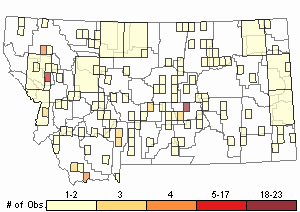
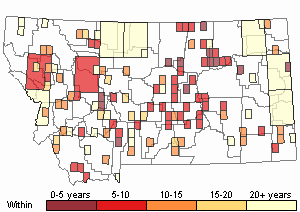
Observations in Montana Natural Heritage Program Database
Number of Observations: 237
(Click on the following maps and charts to see full sized version)
Relative Density
Recency
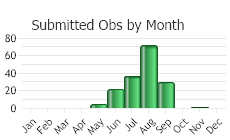
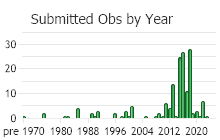
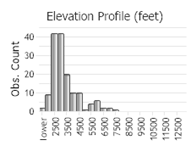 (Observations spanning multiple months or years are excluded from time charts)
Habitat
Field Sowthistle grows in wet meadows, marshes, ditch banks, and irrigated fields in the plains and valleys zones of Montana (Lesica et al. 2022). Plants grow better in relatively cooler, moisture climates and are more abundant in the northern portions of North America (Hyatt in FNA 2006).
Ecology
PLANT SUCCESSIONField Sowthistle is an early-successional plant (McWilliams 2004). It colonizes during the herbaceous stage of succession. It grows best or is more competitive where precipitation is abundant and climates are moderate.
SEED VIABILITY, GERMINATION, & GROWTH [Adapted from McWilliams 2004]
Field Sowthistle seeds have been documented in the diet of some North American birds. Ingested seeds that are excreted have been shown to germinate.
A study conducted in Manitoba, Canada collected soil samples from a marsh to test germination responses of Field Sowthistle seeds under different hydrological conditions. Soil samples kept moist, but exposed to 'drawdown' conditions germinated. Whereas seeds did not germinate from samples continuously flooded to a depth of two to three cm. Another study in Alberta, Canada found that seeds stored in fresh water were completely decomposed after three months.
Field Sowthistle seeds are generally less viable in cultivated soils. A few studies in the 1930s and 1940s found that some dormant seeds will remain viable in cultivated fields, for up to 3 years, and especially in clay soils.
Field Sowthistle seedlings grow and survive better in places with vegetative cover. Moist soils where there is plant cover or litter will facilitate the growth and survivorship of seedings. Seedlings are typically found along ponds and ditches, at the margin fields, and in lawns and meadows. In crop settings, plants have poor survivorship.
POLLINATORSHoneybees and other bees along with hover flies, and blister beetles are known to pollinate Field Sowthistle (McWilliams 2004). The following bee species have been reported as pollinators where the geographic ranges overlap with Field Sowthistle:
Bombus vagans,
Bombus bifarius,
Bombus fervidus, and
Bombus terricola (Thorp et al. 1983, Colla and Dumesh 2010).
CULTURAL USESField Sowthistle roots that are roasted have been used as a coffee substitute (McWilliams 2004). Young leaves that are tender can be eaten raw in salads or cooked (McWilliams 2004).
Useful Links:
Herbal RealityHenriette's Herbal Homepage
Reproductive Characteristics
Plants reproduce by seeds and spread vegetatively by rhizomes.
FLOWER HEADS
Receptacle flat to convex, without hairs or bracts. Ligulate with at least 80 florets per head, perfect. Pappus: 10 to 80, white, capillary, smooth or barbed bristles, 8-14 mm tall.
LIFE CYCLE [Adapted from McWilliams 2004]
In the spring, growth resumes when soil temperatures warm. After growth resumes, small leaves appear from shallow roots in about one week's time and adventitious roots develops in three to four week's time. When plants have five to seven leaves, the new roots thicken. In about three months after growth is resumed, new roots begin spreading. Thickening of new roots stops by mid-summer. Roots that are 2-3 mm in diameter will produce new shoots until late summer. Vegetative growth occurs at buds found on horizontal and vertical roots and the basal portions of aerial stems located just under the soil surface. New plants can grow from fragmented rhizomes (horizontal roots). Stems that grow from a bud on the rhizome or root emerge quickly and are strong. Stems that regenerate from a non-bud place on the rhizome or root, grow slowly and are weaker.
Seedlings typically do not flower in their first year of growth. Flower stems develop when plants have produced 12 to 15 leaves. Plants that grow from fragmented roots, can flower within one year. Flowering occurs in summer and is often completed by late summer but will continue until frost kills the plants. Seeds are formed through cross-pollination aided by insects. Seeds that form through self-pollination are usually smaller and not viable. Although a flower head may contain more than 80 florets, the number of fruits (one-seeded achenes) produced is highly variable among heads. Various studies in the US and Canada have reported 20 to 80 achenes produced per head. It takes about 10 days for flowers (florets) to produce mature fruits.
Seeds are primarily dispersed by wind and less frequently by bird. The pappus attached to the achene carries the seed easily with wind. Distances of 11 to 110 yards (10 to 100 meters) have been reported. The pappus has hooked hairs which allows them to attach to animals and clothing.
Field Sowthistle can develop a seedbank. It is unknown how long seeds remain viable under natural conditions. Soil samples taken from the field into the laboratory have shown that seeds can remain viable for at least 3 years, especially in clay soils.
Seeds germinate in response to increasing soil temperature and time since flowering. Optional temperatures for germination range from 77 to 86 degrees Fahrenheit (F). Less than five percent of seeds at temperatures below 68 and above 95 degrees F germinated. Laboratory studies indicate that the rate of germination is influenced by light. Seeds on the surface germinate at greater rates than when buried. Seeds with the radicle pointed horizontally germinated at higher percentages than when placed upwards or downwards.
Management
COUNTY & STATE DESIGNATIONSAs of 2024, Field Sowthistle is listed as
County Noxious in 6 counties, Montana: Broadwater, Deer Lodge, Liberty, Meagher, Pondera, and Toole.
INTEGRATED VEGETATION MANAGEMENTSuccessful management of non-native thistles requires that land-use objectives and a desired plant community be identified (Shelly et al. in Sheley and Petroff 1999). Once identified, an
integrated weed management strategy that promotes a weed-resistant plant community and serves other land-use objectives, such as for livestock forage, wildlife habitat, or recreation, can be developed. Often a combination of compatible control efforts will better achieve the desired objectives.
PREVENTION [Adapted from McWilliams 2004]
Because Field Sowthistle disperses with the wind, the most critical management tactic is to prevent its establishment, using several practices:
* Learn how to differentiate all Sowthistle species from native or desirable plants.
* Frequently monitor for new plants, and when found implement effective control methods (Early-Detection and Rapid-Response).
* Prevent vehicles from driving through, and animals from grazing within, infested areas.
* Thoroughly wash the undercarriage of vehicles and wheels in a designated area before moving to an un-infested area.
* Maintain proper grazing management that creates resilience to noxious and non-native weed invasion.
PHYSICAL and CULTURAL CONTROLS [Adapted from Zouhar 2002]
Physical and mechanical methods that sever the roots below ground will kill Bull Thistle plants. However, the site must be re-vegetated with the desirable plant community to prevent Bull Thistle seeds from germinating.
Tilling can reduce Field Sowthistle, but its effectiveness depends upon the maturity of the plants. Rhizomes that are cut and left in the soil can regenerate new plants.
Hand-pulling can effectively control Field Sowthistle if done initially and with frequent, persistent effort.
Mowing alone has mixed impacts (McWilliam 2004). Mowing reduces foliage, but does not kill the plants. Resprouts would need continuous mowing over several growing season.
GRAZING CONTROLS [Adapted from McWilliam 2004]
Field Sowthistle is considered "good" as a livestock feed and excellent for rabbit food. New growth, and even roots, are sometimes eaten by sheep and cattle. In comparison to alfalfa (
Medicago sativa), plants are less nutritional for cattle and lambs. Plants have lower neutral detergent fiber, but equal or higher levels of in vitro digestible dry matter, micro-, and macro-mineral content and crude protein. Dry Field Sowthistle has about 10% protein by weight. Palatability is lower as well; therefore, plants may decrease the overall forage potential of a pasture.
Field Sowthistle increases under conditions of excessive grazing where more palatable plants are eaten by livestock. Where sheep and cattle graze on new growth, plants may become overall weaker.
In central Montana, pronghorn have been observed grazing Field Sowthistle.
FIRE [Adapted from McWilliams 2004]
Field Sowthistle plants can colonize or re-establish on burned (and unburned) sites. Fire is not a necessary condition though. The growth of plants and establishment of populations depends upon soil moisture, season, precipitation, fire severity, and other factors. Seeds germinate and seedlings can establish on burned areas. Where a seedbank has developed, information suggests that seeds are not necessarily killed and can germinate. Depending upon the severity, fire can top-kill plants. Established plants respond regenerating buds that are near the soil surface and on underground rhizomes. Thus, populations can persist after a fire. Fire can stimulate flowering or plant growth. However, there is no clear trend in how a given population will respond – in terms of establishment, growth, or flower – after a site has burned.
CHEMICAL CONTROLS Herbicides are effective in gaining initial control of new invasions or very large infestations but
are a temporary control tactic because the chemicals don't change the environmental conditions. Chemicals are most effective when carefully planned, timed, and incorporated with long-term control tactics that include replacing weeds with desirable plant species, modifying land use management, and preventing new infestations.
The herbicide type and concentration, application time and method, environmental constraints, land use practices, local regulations, and other factors will determine its effectiveness and impact to non-target species. Strict adherence to application requirements defined on the herbicide label will reduce risks to human and environmental health. Consult your County Extension Agent and/or Weed District for information on herbicidal control. Chemical information is also available at
Greenbook.
Many broadleaf herbicides, such as 2,4-D, 2,4-DB, and MCPA, when used in the seedling stage can be effective on Field Sowthistle (McWilliams 2004). Some chemical resistance might develop with prolonged or frequent use. Herbicides often work better in combination with other cultural controls that work to reduce Field Sowthistle competition, prevent seed production, and reduce the reproductive capacity of the roots (McWilliams 2004).
BIOLOGICAL CONTROL [Adapted from McWilliams 2004]
In Canada, a tephritid fly and another fly (
Cystiphora sonchi were released and a mixture of impacts has been reported (McWilliams 2004). In Canada, a third fly,
Liriomyza sonchi was authorized for release in 1988. Information on these insects requires further literature searching.
Useful Links:Central and Eastern Montana Invasive Species TeamMontana Invasive Species websiteMontana Biological Weed Control Coordination ProjectMontana Department of Agriculture - Noxious WeedsMontana Weed Control AssociationMontana Weed Control Association Contacts WebpageMontana Fish, Wildlife, and Parks - Noxious WeedsMontana State University Integrated Pest Management ExtensionWeed Publications at Montana State University Extension - MontGuides
Stewardship Responsibility
Threats or Limiting Factors
Field Sowthistle is an aggressive non-native that can outcompete native plants, especially where soils are wet to moist. Plants are prolific seed produces and spread quickly by rhizomes. Plants can be an indicator of drying soils conditions, especially in wetlands. As wetlands dry, Field Sowthistle can colonize and establish quickly (McWilliams 2004).
References
- Literature Cited AboveLegend:
 View Online Publication
 Colla, S.R. and S. Dumesh. 2010. The bumble bees of southern Ontario: notes on natural history and distribution. Journal of the Entomological Society of Ontario 141:39-68.
- Flora of North America Editorial Committee. 2006. Flora of North America North of Mexico. Vol. 20. Magnoliophyta: Asteridae, part 7: Asteraceae, part 2. Oxford Univ. Press, New York. xxii + 666 pp.
- Hitchcock, C.L. and A. Cronquist. 2018. Flora of the Pacific Northwest: An Illustrated Manual. Second Edition. Giblin, D.E., B.S. Legler, P.F. Zika, and R.G. Olmstead (eds). Seattle, WA: University of Washington Press in Association with Burke Museum of Natural History and Culture. 882 p.
- Lesica, P., M.T. Lavin, and P.F. Stickney. 2022. Manual of Montana Vascular Plants, Second Edition. Fort Worth, TX: BRIT Press. viii + 779 p.
- McWilliams, J. 2004. Sonchus arvensis. In: Fire Effects Information System. USDA Forest Service, Rocky Mountain Research Station, Fire Sciences Laboratory.
- Thorp, R.W., D.S. Horning, and L.L. Dunning. 1983. Bumble bees and cuckoo bumble bees of California (Hymenoptera: Apidae). Bulletin of the California Insect Survey 23:1-79.
- Additional ReferencesLegend: View Online Publication
Do you know of a citation we're missing?- Lesica, P., M.T. Lavin, and P.F. Stickney. 2012. Manual of Montana Vascular Plants. Fort Worth, TX: BRIT Press. viii + 771 p.
- Simanonok, M. 2018. Plant-pollinator network assembly after wildfire. Ph.D. Dissertation. Bozeman, MT: Montana State University. 123 p.
- Simanonok, M.P. and L.A. Burkle. 2019. Nesting success of wood-cavity-nesting bees declines with increasing time since wildfire. Ecology and Evolution 9:12436-12445.
- Web Search Engines for Articles on "Field Sowthistle"