View in other NatureServe Network Field Guides
NatureServe
Montana
Utah
Wyoming
Idaho
Wisconsin
British Columbia
South Carolina
Yukon
California
New York
Geyer's Milkvetch - Astragalus geyeri
State Rank Reason (see State Rank above)
Astragalus geyeri is rare in Montana, where it occurs at the northern extent of the species' range. Plants have been documented from at least 10 occurrences across several counties in the state. As an annual plant, population levels can fluctuate widely from year to year. Population counts are imprecise but appear to be in the range of at 3,000 plants. Population trend data is not available. Populations are presumed to be relatively stable or to have not declined significantly because the habitat is largely intact. Significant, widespread threats are not known though a few sites could be negatively impacted by their proximity to roads, from ORV use, and from invasive plant species. Climate change may pose a potential risk to the state's populations.
Revisits to known occurrences, at specified intervals, to collect data on population parameters, habitat conditions, and potential threats are necessary to maintain an accurate and timely state conservation status rank. Monitoring at a subset of occurrences is necessary to track population trends. Surveys into areas with suitable habitat are also needed.
General Description
Geyer's Milkvetch is a small annual herb with simple or branched stems arising 5-20 cm high from a slender taproot. The pinnately compound leaves are 2-10 cm long with 5-13 linear to narrowly elliptic leaflets. Foliage is sparsely hairy. Ascending flower stalks arise from the leaf axils and are 6-25 mm long with 2-8 flowers. Each nodding pea-like flower is 3-15 mm long with a somewhat recurved upper petal that is 5-8 mm long, and a calyx that is 2-4 mm long and sparsely covered with light-colored hairs. Greenish, bladdery, pendant fruits are 15-24 mm long and shaped like a half moon.
Phenology
Plants bloom in late May and June, then become dry and many break off by the middle of the growing season (Heidel 1994).
Diagnostic Characteristics
Geyer's milkvetch is unusual among our Astragalus species, being a taprooted annual lacking multiple stems. The only species similar in this regard is A. lotiflorus, which has hairy pods that are flattened top to bottom. Astragalus agrestis and A. leptaleus also have unbranched stems but they arise from a rhizome rather than a taproot and are usually found in moist habitats. Only var. geyeri occurs in Montana.
Species Range
Montana Range
Range Descriptions
 Native
Range Comments
Southeast OR to CA and NV, and eastward through the Snake River drainage of southern ID to MT, WY, and UT.
Observations in Montana Natural Heritage Program Database
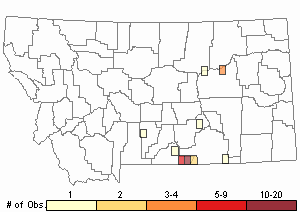
Number of Observations: 43
(Click on the following maps and charts to see full sized version)
Relative Density
Recency
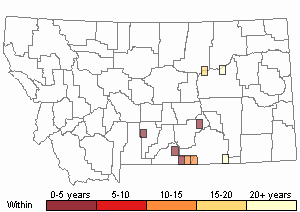
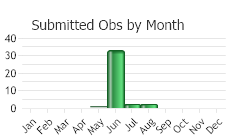
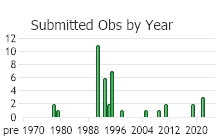
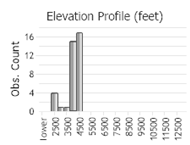 (Observations spanning multiple months or years are excluded from time charts)
Habitat
This milkvetch occupies loose, sandy soils with little or no organic matter and soil development; most Montana records are from sandy alluvial plains and terraces. In the Pryor Mountains, Geyer's milkvetch is restricted to sandy alluvial plains and terraces. Associates there include Artemisia tridentata, Stipa comata and Bouteloua gracilis. In the Hell Creek Recreation Area (Garfield County), it grows in very early, unstable successional habitat dominated by Calamovilfa longifolia and Oryzopsis hymenoides, near but not intermingled with Psoralea lanceolata, Astragalus kentrophyta and Lupinus pusillus.
In the CM Russell National Wildlife Refuge of Garfield County, Geyer's milkvetch grows on outcrops of Fox Hill sandstone along the shore of Fort Peck Reservoir. Sandstone outcrops are widespread in the Fort Union Formation along the Mussellshell valley and above the Fox Hill sandstone, but they are not as easily eroded as Fox Hill sandstone, and numerous searches there have failed to locate this species.
National Vegetation Classification System Groups Associated with this Species
Grassland
Lowland - Prairie Grassland
Sparse and Barren
Sparse and Barren
Ecology
Geyer's milkvetch is an annual, and is adapted to Great Basin desert conditions characterized by rainfall early in the growing season, followed by moisture stress. The droughty nature of the soils is exacerbated by the hot and dry microclimate of its habitat (Heidel 1994). Some populations have numbered over 1000 plants, however since this species is an annual, population sizes may be expected to fluctuate widely (Lesica and Achuff 1992). Occupied habitat in Montana has been estimated at less than 20 acres due to the highly localized nature of its habitat (Heidel 1994). The rounded, inflated seed pods can disperse by rolling downhill on slopes (Heidel 1994).
POLLINATORS The following animal species have been reported as pollinators of this plant species or its genus where their geographic ranges overlap:
Bombus vagans,
Bombus appositus,
Bombus auricomus,
Bombus bifarius,
Bombus borealis,
Bombus centralis,
Bombus fervidus,
Bombus flavifrons,
Bombus huntii,
Bombus mixtus,
Bombus nevadensis,
Bombus rufocinctus,
Bombus ternarius,
Bombus terricola,
Bombus occidentalis,
Bombus pensylvanicus,
Bombus griseocollis, and
Bombus insularis (Macior 1974, Thorp et al. 1983, Mayer et al. 2000, Colla and Dumesh 2010, Wilson et al. 2010, Koch et al. 2012, Miller-Struttmann and Galen 2014, Williams et al. 2014).
Management
Geyer's milkvetch occurs in sparsely vegetated habitats, so it can probably tolerate and may even require moderate levels of disturbance. However, over the long-term it may be affected by the encroachment of exotic annuals such as Halogeton glomeratus, Salsola kali and Melilotus officinalis.
Stewardship Responsibility
Threats or Limiting Factors
Reported threats to Montana's populations of Geyer's Milkvetch include invasive plant species, proximity to road corridors, and ORV use which may negatively impact a few occurrences. Climate change poses a potential risk to the state's populations. The MTNHP conducted a species-level assessment using the Climate Change Vulnerability Index (CCVI) in 2021, which resulted in a Highly Vulnerable rating to climate change. Climate change, including increased ambient temperatures, decreased snowpacks, and increased frequencies and severities of drought could have negative impacts on this species; however, field-based data on the timing and magnitude are not available.
References
- Literature Cited AboveLegend:
 View Online Publication
 Colla, S.R. and S. Dumesh. 2010. The bumble bees of southern Ontario: notes on natural history and distribution. Journal of the Entomological Society of Ontario 141:39-68.
- Koch, J., J. Strange, and P. Williams. 2012. Bumble bees of the western United States. Washington, DC: USDA Forest Service, Pollinator Partnership. 143 p.
- Lesica, P., M.T. Lavin, and P.F. Stickney. 2012. Manual of Montana Vascular Plants. Fort Worth, TX: BRIT Press. viii + 771 p.
- Macior, L.M. 1974. Pollination ecology of the Front Range of the Colorado Rocky Mountains. Melanderia 15: 1-59.
- Mayer, D.F., E.R. Miliczky, B.F. Finnigan, and C.A. Johnson. 2000. The bee fauna (Hymenoptera: Apoidea) of southeastern Washington. Journal of the Entomological Society of British Columbia 97: 25-31.
- Miller-Struttmann, N.E. and C. Galen. 2014. High-altitude multi-taskers: bumble bee food plant use broadens along an altitudinal productivity gradient. Oecologia 176:1033-1045.
- MTNHP Threat Assessment. 2021. State Threat Score Assignment and Assessment of Reported Threats from 2006 to 2021 for State-listed Vascular Plants. Botany Program, Montana Natural Heritage Program, Helena, Montana.
- Thorp, R.W., D.S. Horning, and L.L. Dunning. 1983. Bumble bees and cuckoo bumble bees of California (Hymenoptera: Apidae). Bulletin of the California Insect Survey 23:1-79.
- Williams, P., R. Thorp, L. Richardson, and S. Colla. 2014. Bumble Bees of North America. Princeton, NJ: Princeton University Press. 208 p.
- Wilson, J.S., L.E. Wilson, L.D. Loftis, and T. Griswold. 2010. The montane bee fauna of north central Washington, USA, with floral associations. Western North American Naturalist 70(2): 198-207.
- Additional ReferencesLegend: View Online Publication
Do you know of a citation we're missing?- Barneby, R.C., A. Cronquist, A.H. Holmgren, N.H. Holmgren, J.L. Reveal, P.K. Holmgren. 1989. Fabales. Intermountain Flora: Vascular Plants of the Intermountain West, U.S.A. Volume 3, Part B. Bronx, NY: New York Botanical Garden. 279 pp.
- Heidel, B.L. 1994. Sensitive plant species survey in Garfield and McCone Counties, Montana. Unpublished report to the Bureau of Land Management. Montana Natural Heritage Program, Helena, Montana. 58 pp. plus appendices.
- Lesica, P. and P.L. Achuff. 1992. Distribution of vascular plant species of special concern and limited distribution in the Pryor Mountain desert, Carbon County, Montana. Unpublished report to the Bureau of Land Management. Montana Natural Heritage Program, Helena, MT. 105 pp.
- Lesica, P., M.T. Lavin, and P.F. Stickney. 2022. Manual of Montana Vascular Plants, Second Edition. Fort Worth, TX: BRIT Press. viii + 779 p.
- Quire, R.L. 2013. The sagebrush steppe of Montana and southeastern Idaho shows evidence of high native plant diversity, stability, and resistance to the detrimental effects of nonnative plant species. M.Sc. Thesis. Bozeman, MT: Montana State University. 124 p.
- Seipel, T.F. 2006. Plant species diversity in the sagebrush steppe of Montana. M.Sc. Thesis. Bozeman, MT: Montana State University. 87 p.
- Web Search Engines for Articles on "Geyer's Milkvetch"