View in other NatureServe Network Field Guides
NatureServe
Montana
Utah
Wyoming
Idaho
Wisconsin
British Columbia
South Carolina
Yukon
California
New York
Prairie Goldenrod - Solidago ptarmicoides
Other Names:
Sneezeweed Aster,
Oligoneuron album, Aster ptarmicoides
State Rank Reason (see State Rank above)
Solidago ptarmicoides occurs in eastern Montana on the western edge of its North American range. Since 2015, survey efforts have led to finding more locations in Richland and Carter counties, where populations may be small to locally abundant. Population trends remain unknown, though it is presumed that populations are relatively stable or have experienced only minor declines as its habitat has remained largely intact and in good condition. Surveys have not identified potential threats to the species. Thus, the state conservation status for Solidago ptarmicoides appears to be more stable than previously thought, resulting in a State Rank change from S2S3 to S3.
Monitoring that assesses population trends is needed in Montana. Surveys that continue to document population size, viability, and extent, habitat conditions, and potential threats at intervals of at least every 10 years are needed. Surveys on lands modelled as predicted suitable habitat are also needed to bring forth information on the state's distribution.
General Description
Prairie Aster has stems that are 1-7 dm high and clustered on a woody-thickened, branched rootcrown. The narrowly lance-shaped leaves near the base of the plant have entire margins and are petiolate and up to 20 cm long, while those on the upper stem are shorter, strap-shaped, and lacking petioles. Foliage is glabrous to slightly roughened. The 3-60 flower heads are borne in an open, flat-topped inflorescence. The glabrous, overlapping involucral bracts of each head are 5-7 mm long, each with a greenish apex and a prominent, thickened midrib. The 10-25 rayflowers are white and 5-9 mm long, and the numerous disk flowers are white. The achene is glabrous and has a pappus of bristles that are thickened toward the top.
Phenology
Flowering August-September.
Diagnostic Characteristics
This species differs from other Solidago in having white flowers, resembling species formerly placed in Aster (in its broader taxonomic sense). It can be distinguished from the latter by its flat-topped inflorescence, its thickened, involucral bracts that are often blunt at the tips, and the thickened pappus bristles.
Species Range
Montana Range
Range Descriptions
 Native
Range Comments
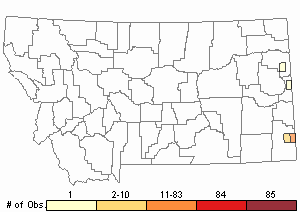
SK to QC south to OK, OH and SC. Known from Richland and Wibaux counties (Lesica et al. 2012. Manual of Montana Vascular Plants. BRIT Press. Fort Worth, TX).
Observations in Montana Natural Heritage Program Database
Number of Observations: 105
(Click on the following maps and charts to see full sized version)
Relative Density
Recency
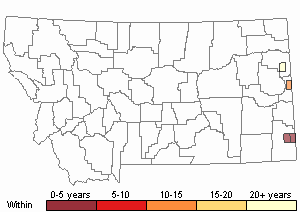
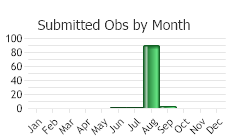
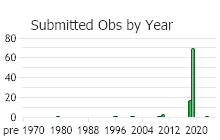
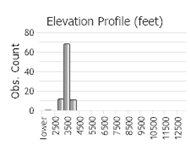 (Observations spanning multiple months or years are excluded from time charts)
Habitat
Open, dry grasslands, often on sandy soil or limestone on the plains.
National Vegetation Classification System Groups Associated with this Species
Forest and Woodland
Low Elevation - Xeric Forest and Woodland
Grassland
Lowland - Prairie Grassland
Ecology
POLLINATORS The following animal species have been reported as pollinators of this plant species or its genus where their geographic ranges overlap:
Bombus vagans,
Bombus appositus,
Bombus bifarius,
Bombus borealis,
Bombus fervidus,
Bombus flavifrons,
Bombus huntii,
Bombus melanopygus,
Bombus mixtus,
Bombus nevadensis,
Bombus rufocinctus,
Bombus ternarius,
Bombus terricola,
Bombus sitkensis,
Bombus occidentalis,
Bombus pensylvanicus,
Bombus bimaculatus,
Bombus griseocollis,
Bombus impatiens,
Bombus insularis,
Bombus suckleyi,
Bombus bohemicus,
Bombus flavidus, and
Bombus kirbiellus (Plath 1934, Heinrich 1976, Thorp et al. 1983, Johnson 1986, Shaw and Taylor 1986, Mayer et al. 2000, Colla and Dumesh 2010, Colla et al. 2011, Koch et al. 2012, Williams et al. 2014, Tripoldi and Szalanski 2015).
Stewardship Responsibility
Threats or Limiting Factors
Threats to Prairie Goldenrod have not been reported though climate change poses a potential risk to the state's populations. The MTNHP conducted a species-level assessment using the Climate Change Vulnerability Index (CCVI) in 2021, which resulted in a Moderately Vulnerable rating to climate change. Climate change including increased ambient temperatures, decreased snowpacks, and increased frequencies and severities of drought could have negative impacts on this species; however, field-based data on the timing and magnitude from climate change is not available.
References
- Literature Cited AboveLegend:
 View Online Publication
 Colla, S., L. Richardson, and P. Williams. 2011. Bumble bees of the eastern United States. Washington, DC: USDA Forest Service, Pollinator Partnership. 103 p.
- Colla, S.R. and S. Dumesh. 2010. The bumble bees of southern Ontario: notes on natural history and distribution. Journal of the Entomological Society of Ontario 141:39-68.
- Johnson, R.A. 1986. Intraspecific resource partitioning in the bumble bees Bombus ternarius and B. pennsylvanicus. Ecology 67:133-138.
- Koch, J., J. Strange, and P. Williams. 2012. Bumble bees of the western United States. Washington, DC: USDA Forest Service, Pollinator Partnership. 143 p.
- Lesica, P., M.T. Lavin, and P.F. Stickney. 2012. Manual of Montana Vascular Plants. Fort Worth, TX: BRIT Press. viii + 771 p.
- Mayer, D.F., E.R. Miliczky, B.F. Finnigan, and C.A. Johnson. 2000. The bee fauna (Hymenoptera: Apoidea) of southeastern Washington. Journal of the Entomological Society of British Columbia 97: 25-31.
- MTNHP Threat Assessment. 2021. State Threat Score Assignment and Assessment of Reported Threats from 2006 to 2021 for State-listed Vascular Plants. Botany Program, Montana Natural Heritage Program, Helena, Montana.
- Plath, O.E. 1934. Bumblebees and their ways. New York, NY: Macmillan Company. 201 p.
- Shaw, D.C. and R.J. Taylor.1986. Pollination ecology of an alpine fell-field community in the North Cascades. Northwest Science 60:21-31.
- Thorp, R.W., D.S. Horning, and L.L. Dunning. 1983. Bumble bees and cuckoo bumble bees of California (Hymenoptera: Apidae). Bulletin of the California Insect Survey 23:1-79.
- Tripoldi, A.D. and A.L. Szalanski. 2015. The bumble bees (Hymenoptera: Apidae: Bombus) of Arkansas, fifty years later. Journal of Melittology 50: doi: http://dx.doi.org/10.17161/jom.v0i50.4834
- Williams, P., R. Thorp, L. Richardson, and S. Colla. 2014. Bumble Bees of North America. Princeton, NJ: Princeton University Press. 208 p.
- Additional ReferencesLegend: View Online Publication
Do you know of a citation we're missing?- Lesica, P., M.T. Lavin, and P.F. Stickney. 2022. Manual of Montana Vascular Plants, Second Edition. Fort Worth, TX: BRIT Press. viii + 779 p.
- Vanderhorst, J.P., S.V. Cooper, and B.L. Heidel. 1998. Botanical and vegetation survey of Carter County, Montana. Unpublished report prepared for the Bureau of Land Management. Montana Natural Heritage Program, Helena. 116 pp. + app.
- Web Search Engines for Articles on "Prairie Goldenrod"