Search Field Guide
Advanced Search
MT Gov Logo
Montana Field Guide

Montana Field Guides

Vagrant Shrew - Sorex vagrans

Native Species

Global Rank: G5
State Rank: S5
(see State Rank Reason below)


Agency Status
USFWS:
USFS:
BLM:


External Links


State Rank Reason (see State Rank above)
Species is relatively common within suitable habitat and widely distributed across portions of the state
Vagrant Shrew (Sorex vagrans) Conservation Status Summary
State Rank: S5
Review Date = 09/12/2024
See the complete Conservation Status Rank Report
How we calculate Conservation Status Ranks
 
General Description
Pacific coast: tine present on anteriomedial edge of I1; tail distinctly bicolored in young, indistinctly bicolored in adults; never more than 4 pairs of friction pads on the second to fourth digits of hind feet; level of pigmentation at or below level of median tine on I1; body size small to medium; U5 triangular, body of U1s not touching, P4 overlapping U5; zygomatic process of maxillary pointed (Carraway 1990).

Diagnostic Characteristics
See Carraway (1995) for a key to western North American soricids based primarily on dentaries.

Species Range
Montana Range Range Descriptions
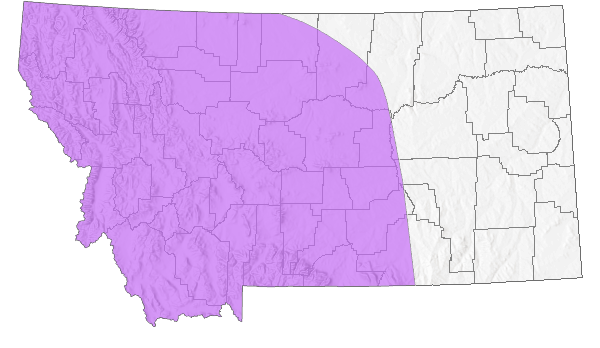
Native

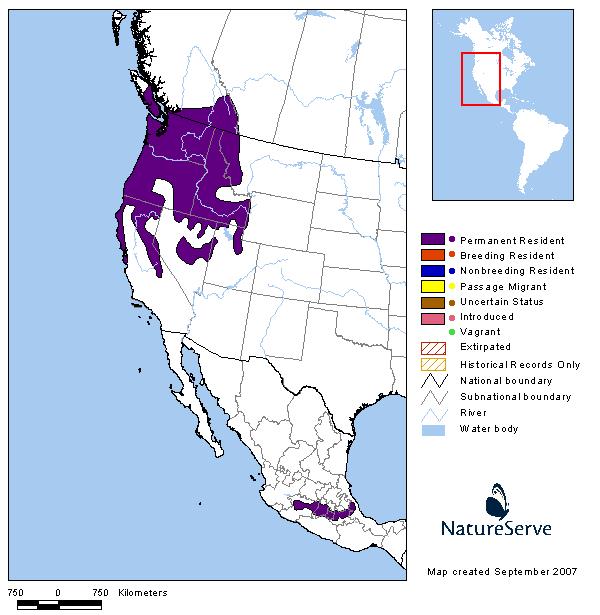
Western Hemisphere Range


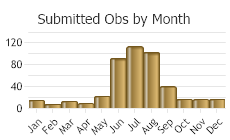
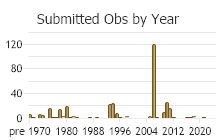
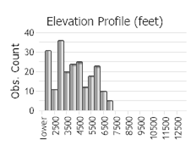
Observations in Montana Natural Heritage Program Database
Number of Observations: 507

(Click on the following maps and charts to see full sized version) Map Help and Descriptions
Relative Density
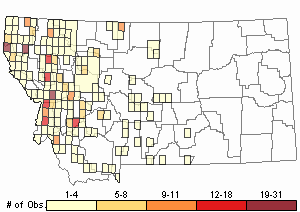
Recency
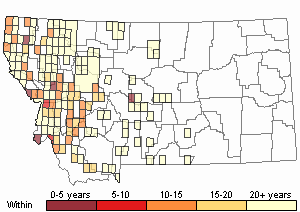
 

(Observations spanning multiple months or years are excluded from time charts)


Migration
Non-migratory.

Habitat
At elevations below 5000 ft, usually Douglas-fir, lodgepole pine, western larch, grand fir, western red cedar forests (Hennings and Hoffmann 1977). Often found in moist sites (Hoffmann and Pattie 1968).

National Vegetation Classification System Groups Associated with this Species
Alpine
Alpine - Vegetated
Forest and Woodland
Deciduous Forest and Woodland
Low Elevation - Xeric Forest and Woodland
Montane - Subalpine Forest and Woodland
Shrubland
Foothills - Montane Shrubland
Sagebrush Shrubland
Grassland
Lowland - Prairie Grassland
Montane - Subalpine Grassland
Wetland and Riparian
Alpine Riparian and Wetland
Peatland
Riparian and Wetland Forest
Riparian Shrubland
Wet Meadow and Marsh
Recently Disturbed or Modified
Harvested Forest
Insect-Killed Forest
Introduced Vegetation
Recently Burned
Human Land Use
Agriculture
Developed

Food Habits
Insects, annelida, shrews, vegetable matter, insect larvae. Apparently will also use plant seeds, carrion, and some mushrooms (van Zyll de Jong 1983).

Ecology
Uses echolocation to orient in darkness (Buchanan 1972). May live in geographic sympatry with Sorex monticolus, S. cinereus, S. palustris, and S. hoyi (Hennings and Hoffmann 1977).

Reproductive Characteristics
Pregnant from April to July. Average 6.6 young/litter. Females usually don't conceive first year. No first year males showed signs of sexual development. Males begin producing spermatoza early March. Short lifespan, high annual turnover (van Zyll de Jong 1983).


References
  • Literature Cited AboveLegend:   View Online Publication
    • Carraway, L.N. 1990. A morphologic and morphometric analysis of the 'Sorex vagrans species complex' in the Pacific coast region. Texas Tech Univ. Mus. Spec. Publ. (32): 1-76.
    • Carraway, L.N. 1995. A key to recent Soricidae of the western United States and Canada based primarily on dentaries. Occasional Papers of the Natural History Museum, University of Kansas (175):1-49.
    • Hennings, D. and R.S. Hoffmann. 1977. A review of the taxonomy of the Sorex vagrans species complex from western North America. Occasional Papers of the Museum of Natural History, the University of Kansas. 68: 1-35.
    • Hoffmann, R.S. and D.L. Pattie. 1968. A guide to Montana mammals: identification, habitat, distribution, and abundance. Missoula, MT: University of Montana. 133 p.
    • Van Zyll de Jong, C.G. 1983. Handbook of Canadian mammals. 1. Marsupials and insectivores. National Museum of Natural Sciences, National Museums of Canada, Ottawa, Canada. 210 pp.
  • Additional ReferencesLegend:   View Online Publication
    Do you know of a citation we're missing?
    • [WWPC] Washington Water Power Company. 1995. 1994 wildlife report Noxon Rapids and Cabinet Gorge Reservoirs. Washington Water Power Company. Spokane, WA.
    • Mezhzherin, V. A., and William O. Pruitt. 1964. Dehnel's phenomenon and its possible explanation. [Place of publication not identified]: [publisher not identified].

    • Adelman, E.B. 1979. A survey of the nongame mammals in the Upper Rattlesnake Creek drainage of western Montana. M.S. thesis. University of Montana, Missoula. 129 pp.
    • Anaconda Minerals Company, and Camp, Dresser & McKee. 1981. Anaconda Stillwater Project 6-month environmental baseline report. CDM Project No. 3139. Vol. I Appendix. Jan. 15, 1981.
    • Buchler, E.R. 1972. The use of echolocation by the wandering shrew, Sorex vagrans Baird. Ph.D dissertation. University of Montana, Missoula. 96 pp.
    • Burnett, G.W. 1981. Movements and habitat use of American Marten in Glacier National Park, Montana. M.S. Thesis. University of Montana. Missoula. 130 pp.
    • Carlsen, T. 1980. Small mammal trapping in the Elkhorns. [Unpublished report]. 7 pp.
    • Carlsen, T. and R. Northrup. 1992. Canyon Ferry Wildlife Management Area Final Draft Management Plan. March 1992.
    • Clark, T. W. 1973. Distribution and reproduction of shrews in Grand Teton National Park, Wyoming. Northwest Sci. 47(2): 128-131.
    • Clothier, R.R. 1955. Contribution to the life history of Sorex vagrans in Montana. Journal Mammal. 36(2): 214-220.
    • Conrey, Reesa Yale, 2002, Do highways influence population connectivity in small mammals? M.S. Thesis. University of Montana. Missoula, MT.
    • Feigley, H.P. 1981. Studies on native small mammals as intermediate hosts of Echinococcus multilocularis. M.Sc. Thesis. Bozeman, Montana: Montana State University. 50 p.
    • Foresman, K.R. 2001. The wild mammals of Montana. American Society of Mammalogists, Special Publication Number 12. Lawrence, KS. 278 pp.
    • Foresman, K.R. 2012. Mammals of Montana. Second edition. Mountain Press Publishing, Missoula, Montana. 429 pp.
    • Gillihan, S. W. and K. R. Foresman. 2004. Sorex vagrans. American Society of Mammalogists, Lawrence, KS. Mammalian Species No. 744:1-5.
    • Gillihan, Scott W. 1992. Morphological plasticity and continuous homeothermy of overwintering Sorex vagrans. M.S. Thesis. University of Montana. Missoula, MT.
    • Hanauska-Brown, L., B.A. Maxell, A. Petersen, and S. Story. 2014. Diversity Monitoring in Montana 2008-2010 Final Report. Montana Fish, Wildlife & Parks. Helena, MT. 78 pp.
    • Hayward, G. D. and P. H. Hayward. 1995. Relative abundance and habitat associations of small mammals in the Chamberlain Basin, central Idaho. Northwest Sci. 69(2): 114-125.
    • Heath, M.L. 1973. Small mammal populations in clearcuts of various ages in south central Montana. M.Sc. Thesis. Bozeman, Montana: Montana State University. 33 p.
    • Hoffmann, R. S. and R. D. Taber. 1960. Notes on Sorex in the northern Rocky Mountain alpine zone. Journal of Mammalogy 41(2): 230-234.
    • Ingles, L. G. 1961. Home range and habitats of the wandering shrew. J. Mammal. 42(4): 455-462.
    • Johnson, L.J. 1960. Mammal studies on the Lubrecht Forest, Montana: a preliminary report. Proc. Mont. Acad. Sci. 20: 40-47.
    • Joslin, Gayle, and Heidi B. Youmans. 1999. Effects of recreation on Rocky Mountain wildlife: a review for Montana. [Montana]: Montana Chapter of the Wildlife Society.
    • Joslin, Gayle. 1980. Wildlife inventory and hard rock mining impact analysis of the West Cabinet Mountains and Lake Creek Valley, Lincoln County, Montana. MTFWP 91 pgs + 47 pgs app.
    • Key, C.H. 1979. Mammalian utilization of floodplain habitats along the North Fork of the Flathead River in Glacier National Park, Montana. M.S. thesis. University of Montana, Missoula.
    • Koplin, J.R. 1962. Competition and niche segregation in the genus Microtus. M.S. thesis. Montana State University. 66 pp.
    • Lazaro, J., D.K. Dechmann, S. LaPoint, M. Wikelski, and M. Hertel. 2017. Profound reversible seasonal changes of individual skull size in a mammal. Current Biology. 27(20).
    • McCracken, K. E. 1990. Microhabitat and dietary partitioning in three species of shrews at Yellow Bay, Montana. M.A. thesis. University of Montana, Missoula. 38 pp.
    • Medin, D. E. and W. P. Clary. 1991. Small mammals of a beaver pond ecosystem and adjacent riparian habitat in Idaho. USDA, Forest Service, Res. Paper INT-445.
    • Northrop, Devine & Tarbell, Inc. 1994. Cabinet Gorge and Noxon Rapids hydroelectric developments: 1993 wildlife study. Unpublished report to the Washington Water Power Company, Spokane. Vancouver, Washington and Portland, Maine. 144 pp. plus appendices.
    • Oechsli, L.M. 2000. Ex-urban development in the Rocky Mountain West: consequences for native vegetation, wildlife diversity, and land-use planning in Big Sky, Montana. M.Sc. Thesis. Montana State University, Bozeman. 73 p.
    • Pattie, D.L. and N.A. M. Verbeek. 1967. Alpine mammals of the Beartooth Plateau. Northwest Science 41(3): 110-117.
    • Plopper, C.E. 1968. Insular and mainland populations of Peromyscus maniculatus at Flathead Lake, Montana. M.S. thesis. University of Montana, Missoula. 91 pp.
    • Ports, M. A. and S. B. George. 1990. Sorex preblei in the northern Great Basin. Great Basin Naturalist 50: 93-95.
    • Ramirez, Pedro, Jr. 1977. Small Populations in Different-Aged Clearcuts and Uncut Forests in Northwestern Montana. M. S. thesis. 72 pp.
    • Reichel, J.D. 1996. Northern bog lemming survey: 1995: Garnet Resource Area. Montana Natural Heritage Program. Helena, MT. 35 pp.
    • Reichel, J.D. and S.G. Beckstrom. 1994. Northern bog lemming survey: 1993. Unpublished report. Montana Natural Heritage Program. Helena, MT. 87 pp.
    • Reid, F. 2006. Peterson Field Guide to Mammals of North America, 4th Edition. Houghton Mifflin Company: Boston and New York, 608 pp.
    • Rust, H. J. 1946. Mammals of northern Idaho. J. Mammal. 27(4): 308-327.
    • Shepherd, Jay F. 1994. Initial response of small mammals to new forestry and overstory removal timber harvests. M.S. Thesis. University of Montana. Missoula, MT.
    • Smith H.C. 1988. The wandering shrew, Sorex vagrans, in Alberta. Canadian Field-Naturalist. 102:254-156.
    • Spencer, A. W. and D. Pettus. 1966. Habitat preferences of five sympatric species of long-tailed shrews. Ecology 47: 677-683.
    • Stearns-Roger Inc., 1975, Environmental baseline information of the Mount Vernon Region, Montana. January 31, 1975.
    • Thompson, Richard W., Western Resource Dev. Corp., Boulder, CO., 1996, Wildlife baseline report for the Montana [Montanore] Project, Lincoln and Sanders counties, Montana. In Application for a Hard Rock Operating Permit and Proposed Plan of Operation, Montanore Project, Lincoln and Sanders Counties, Montana. Vol. 5. Stroiazzo, John. Noranda Minerals Corp., Libby, MT. Revised September 1996.
    • Von Gunten. 1978. Pronghorn fawn mortality on the National Bison Range. M.S. thesis. University of Montana, Missoula. 82 pp.
    • Weckwerth, R.P. 1957. The relationship between the marten population and the abundance of small mammals in Glacier National Park. M.S. thesis. University of Montana, Missoula. 76 pp.
    • Woodman, N. 2018. American recent Eulipotyphla Nesophontids, Solenodons, Moles, and Shrews in the New World. Smithsonian Contributions to Zoology 650. 108 p.
    • Zackheim, K. 1973. Exhibit H: Wildlife Study. In Ash Grove Cement Co. files.
  • Web Search Engines for Articles on "Vagrant Shrew"
  • Additional Sources of Information Related to "Mammals"

Login Logout
Citation for data on this website:
Vagrant Shrew — Sorex vagrans.  Montana Field Guide.  .  Retrieved on , from