View in other NatureServe Network Field Guides
NatureServe
Montana
Utah
Wyoming
Idaho
Wisconsin
British Columbia
South Carolina
Yukon
California
New York
Hot Spring Phacelia - Phacelia thermalis
State Rank Reason (see State Rank above)
DRAFT: Requesting feedback on the 2026 revised rank, factors, and State Rank Reason outlined below and in the Conservation Status Rank Report.
Phacelia thermalis is rare in Montana, being known from a very small number of sites in the northeastern portion of the state, where it is disjunct from its primary range in northern California to southwestern Idaho. Population sizes and extents are poorly known, and most observations of the species are from 1978-1998. Therefore, its current status and trends are largely unknown. Three more recent observations may exist, but these are unverified. Threats are undocumented though invasive species, particularly sweet clover, can be problematic in these habitats.
Surveys are greatly needed to document the current status of the species and each occurrence. Information on population sizes and extent, habitat quality and potential threats are needed for all occurrences. Surveys of other areas of potentially suitable habitat within the range of the species may locate additional populations.
General Description
Hot Spring Phacelia is an annual that is branched from the base. It has prostrate or ascending stems. The alternate leaves have broadly lance-shaped blades that are 1-9 cm long with toothed and deeply lobed margins and well-developed petioles. Foliage is glandular-hairy. The short-stalked flowers are borne in crowded, narrow, 1-sided, curved spikes that are up to 10 cm long. The spikes unwind as they mature and originate in the leaf axils. The lavender to whitish flowers each have a 5-lobed tubular corolla that is 3-4 mm long and 5 narrowly lance-shaped, hairy sepals that are as long as the corolla in flower but twice as long in fruit. The stamens are included in the corolla tube. The fruit is a capsule with 2-4 seeds.
Phenology
In Montana, collection dates range from June 12 to July 9, the latter presumed to be in fruit.
Diagnostic Characteristics
The similar P. ivesiana has linear calyx lobes, transversely corrugated seeds and is known only from Carbon County. P. scopulina has leaves that are lobed less than halfway to the midrib, and is known only from southern Silver Bow County. In central and eastern Montana, the only other annual Phacelia with pinnately lobed or divided leaves is Phacelia linearis, which is single-stemmed with linear leaves and showy petals that exceed the calyx. Hot spring phacelia also bears superficial resemblance to annual species in other genera of the Waterleaf Family, but has a multi-flowered inflorescence as opposed to solitary flowers.
Species Range
Montana Range
Range Descriptions
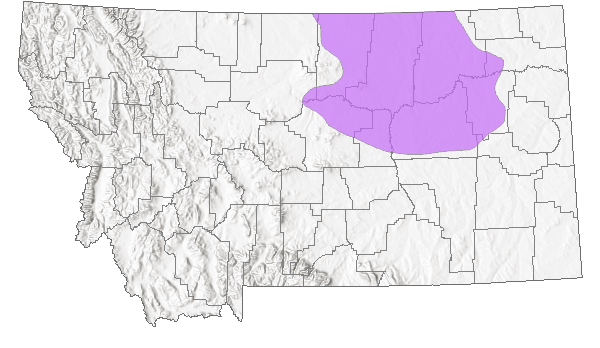
 Native
Range Comments
This species is native from northern California to southeastern Oregon and east to southwestern Idaho and Montana (Hickman 1993). It has been reported introduced in Saskatchewan (Scoggan 1978).
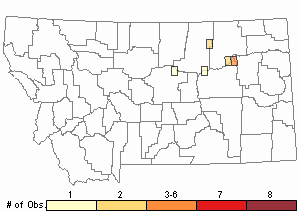
Observations in Montana Natural Heritage Program Database
Number of Observations: 13
(Click on the following maps and charts to see full sized version)
Map Help and Descriptions
Relative Density
Recency
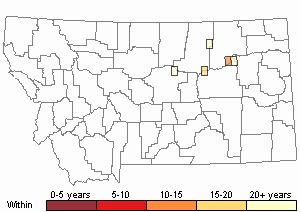
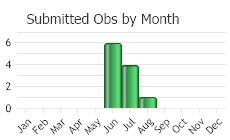
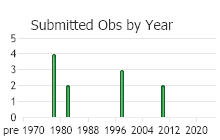
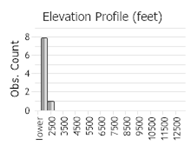 (Observations spanning multiple months or years are excluded from time charts)
Habitat
Habitat information for the very few Montana records of this plant varies widely. In Fergus County it was collected on level ground immediately above a steep-sloped coulee. The Garfield County collection came from a steep slope immediately above the beach of York Island (Heidel 1994). It occupies open to partially wooded settings; the only associated species mentioned in collection records is Douglas-fir at the Fergus County site.
National Vegetation Classification System Groups Associated with this Species
Forest and Woodland
Deciduous Forest and Woodland
Montane - Subalpine Forest and Woodland
Ecology
Hot spring phacelia is an annual and population numbers may fluctuate significantly from year to year. It occurs in disturbed habitats, and Scoggan (1979) reports it as introduced in Saskatchewan.
POLLINATORS The following animal species have been reported as pollinators of this plant species or its genus where their geographic ranges overlap:
Bombus appositus,
Bombus bifarius,
Bombus centralis,
Bombus fervidus,
Bombus flavifrons,
Bombus frigidus,
Bombus huntii,
Bombus melanopygus,
Bombus mixtus,
Bombus nevadensis,
Bombus rufocinctus,
Bombus sylvicola,
Bombus sitkensis,
Bombus occidentalis,
Bombus griseocollis,
Bombus insularis, and
Bombus kirbiellus (Macior 1974, Thorp et al. 1983, Shaw and Taylor 1986, Mayer et al. 2000, Wilson et al. 2010, Pyke et al. 2012, Koch et al. 2012, Williams et al. 2014).
Management
As an annual species near the northern limit of its range, this plant may be particularly vulnerable to competition from weeds. Its habitat in northeastern Montana has been extensively invaded by sweet clover (Melilotus spp.), which can invade arid microhabitats, shifting the course of succession and out-competing native plant species (Heidel 1994).
Stewardship Responsibility
Threats or Limiting Factors
STATE THREAT SCORE REASON
Threat impact not assigned because threats are not known (MTNHP Threat Assessment 2021).
References
- Literature Cited AboveLegend:
 View Online Publication
 Koch, J., J. Strange, and P. Williams. 2012. Bumble bees of the western United States. Washington, DC: USDA Forest Service, Pollinator Partnership. 143 p.
- Macior, L.M. 1974. Pollination ecology of the Front Range of the Colorado Rocky Mountains. Melanderia 15: 1-59.
- Mayer, D.F., E.R. Miliczky, B.F. Finnigan, and C.A. Johnson. 2000. The bee fauna (Hymenoptera: Apoidea) of southeastern Washington. Journal of the Entomological Society of British Columbia 97: 25-31.
- MTNHP Threat Assessment. 2021. State Threat Score Assignment and Assessment of Reported Threats from 2006 to 2021 for State-listed Vascular Plants. Botany Program, Montana Natural Heritage Program, Helena, Montana.
- Pyke, G.H., D.W. Inouye, and J.D. Thomson. 2012. Local geographic distributions of bumble bees near Crested Butte, Colorado: competition and community structure revisited. Environmental Entomology 41(6): 1332-1349.
- Shaw, D.C. and R.J. Taylor.1986. Pollination ecology of an alpine fell-field community in the North Cascades. Northwest Science 60:21-31.
- Thorp, R.W., D.S. Horning, and L.L. Dunning. 1983. Bumble bees and cuckoo bumble bees of California (Hymenoptera: Apidae). Bulletin of the California Insect Survey 23:1-79.
- Williams, P., R. Thorp, L. Richardson, and S. Colla. 2014. Bumble Bees of North America. Princeton, NJ: Princeton University Press. 208 p.
- Wilson, J.S., L.E. Wilson, L.D. Loftis, and T. Griswold. 2010. The montane bee fauna of north central Washington, USA, with floral associations. Western North American Naturalist 70(2): 198-207.
- Additional ReferencesLegend: View Online Publication
Do you know of a citation we're missing?- Heidel, B.L. 1994. Sensitive plant species survey in Garfield and McCone Counties, Montana. Unpublished report to the Bureau of Land Management. Montana Natural Heritage Program, Helena, Montana. 58 pp. plus appendices.
- Lesica, P., M.T. Lavin, and P.F. Stickney. 2012. Manual of Montana Vascular Plants. Fort Worth, TX: BRIT Press. viii + 771 p.
- Lesica, P., M.T. Lavin, and P.F. Stickney. 2022. Manual of Montana Vascular Plants, Second Edition. Fort Worth, TX: BRIT Press. viii + 779 p.
- Scoggan, H. J. 1979. The Flora of Canada. Part 4: Dicotyledoneae (Loasaceae to Compositae). National Museum of Natural Sciences Publications in Botany No. 7(4). Ottawa, Canada. 1711 pp.
- Seipel, T.F. 2006. Plant species diversity in the sagebrush steppe of Montana. M.Sc. Thesis. Bozeman, MT: Montana State University. 87 p.
- Web Search Engines for Articles on "Hot Spring Phacelia"