View in other NatureServe Network Field Guides
NatureServe
Montana
Utah
Wyoming
Idaho
Wisconsin
British Columbia
South Carolina
Yukon
California
New York
Smooth Fleabane - Erigeron leiomerus
State Rank Reason (see State Rank above)
Rare in Montana, where it is currently known from only a couple of alpine sites in the southwest portion of the state. Current population levels and trends are unknown. However, its high-elevation habitat is relatively inaccessible, and there are no obvious threats. Additional sites are likely to be documented if surveys were to be conducted.
General Description
Smooth Fleabane is an herbaceous perennial. Its unbranched, lax stems reach up to 15 cm high and arise from a branched rootcrown that surmounts a taproot. The basal leaves are up to 7 cm long and have a petiole and a narrowly elliptic to lance-shaped blade; those of the upper stem are smaller and narrower. Foliage is glabrous to sparsely hairy. A single flower head is borne at the top of each stem. Heads have a single series of narrowly lance-shaped, glandular involucral bracts that are 4-6 mm long. There are 15-60 white to blue rays, 6-11 mm long, and numerous yellow disk flowers, ca. 3-4 mm long. The achenes have 15-25 fine, long bristles and a few short ones, forming a pappus on top.
Phenology
Flowering in July.
Diagnostic Characteristics
There are many species of Erigeron in our area; a hand lens and technical manual are needed for positive identification.
Species Range
Montana Range
Range Descriptions
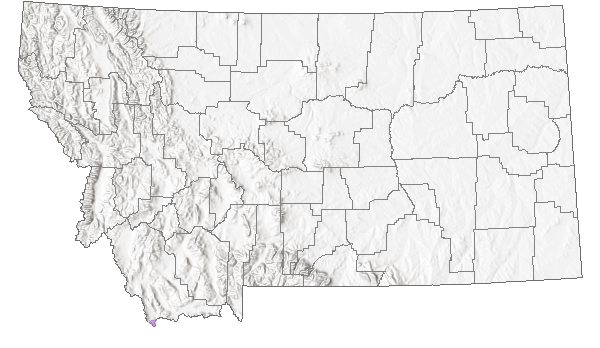
 Native
Range Comments
Central ID and adjacent MT, south to UT, CO, and NM. Peripheral.
Observations in Montana Natural Heritage Program Database
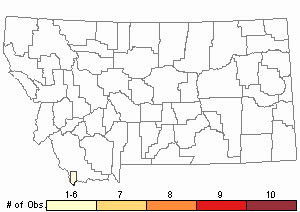
Number of Observations: 8
(Click on the following maps and charts to see full sized version)
Map Help and Descriptions
Relative Density
Recency
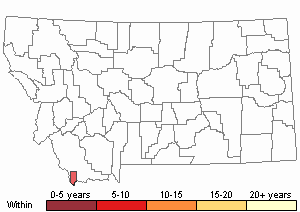
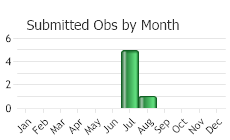
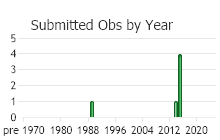
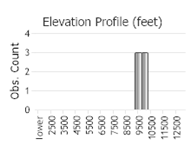 (Observations spanning multiple months or years are excluded from time charts)
Habitat
Rocky soil or talus in the alpine zone.
National Vegetation Classification System Groups Associated with this Species
Alpine
Alpine - Sparse and Barren
Alpine - Vegetated
Ecology
POLLINATORS The following animal species have been reported as pollinators of this plant species or its genus where their geographic ranges overlap:
Bombus bifarius,
Bombus centralis,
Bombus fervidus,
Bombus flavifrons,
Bombus huntii,
Bombus melanopygus,
Bombus mixtus,
Bombus rufocinctus,
Bombus occidentalis, and
Bombus insularis (Thorp et al. 1983, Wilson et al. 2010, Colla and Dumesh 2010, Koch et al. 2012).
Stewardship Responsibility
Threats or Limiting Factors
STATE THREAT SCORE REASON
Reported threats to Montana’s populations of Smooth Fleabane are due to motorcycle recreation occurring in the vicinity of most known populations. Smooth Fleabane populations are concentrated in an area that is designated for non-motorized travel. However, the remote area is infrequently visited by law enforcement and motorized use continues despite legal regulation (MTNHP Threat Assessment 2021). At least slight populations declines are expected if motorized activity remains unmitigated.
References
- Literature Cited AboveLegend:
 View Online Publication
 Colla, S.R. and S. Dumesh. 2010. The bumble bees of southern Ontario: notes on natural history and distribution. Journal of the Entomological Society of Ontario 141:39-68.
- Koch, J., J. Strange, and P. Williams. 2012. Bumble bees of the western United States. Washington, DC: USDA Forest Service, Pollinator Partnership. 143 p.
- MTNHP Threat Assessment. 2021. State Threat Score Assignment and Assessment of Reported Threats from 2006 to 2021 for State-listed Vascular Plants. Botany Program, Montana Natural Heritage Program, Helena, Montana.
- Thorp, R.W., D.S. Horning, and L.L. Dunning. 1983. Bumble bees and cuckoo bumble bees of California (Hymenoptera: Apidae). Bulletin of the California Insect Survey 23:1-79.
- Wilson, J.S., L.E. Wilson, L.D. Loftis, and T. Griswold. 2010. The montane bee fauna of north central Washington, USA, with floral associations. Western North American Naturalist 70(2): 198-207.
- Additional ReferencesLegend: View Online Publication
Do you know of a citation we're missing?- Lesica, P. 1991. Noteworthy Collections in Montana....
- Lesica, P., M.T. Lavin, and P.F. Stickney. 2012. Manual of Montana Vascular Plants. Fort Worth, TX: BRIT Press. viii + 771 p.
- Lesica, P., M.T. Lavin, and P.F. Stickney. 2022. Manual of Montana Vascular Plants, Second Edition. Fort Worth, TX: BRIT Press. viii + 779 p.
- Simanonok, M.P., and L.A. Burkle. 2014. Partitioning interaction turnover among alpine pollination networks: Spatial temporal, and environmental patterns. Ecosphere 5(11):149.
- Web Search Engines for Articles on "Smooth Fleabane"