View in other NatureServe Network Field Guides
NatureServe
Montana
Utah
Wyoming
Idaho
Wisconsin
British Columbia
South Carolina
Yukon
California
New York
Rock-jasmine Wild Buckwheat - Eriogonum androsaceum
State Rank Reason (see State Rank above)
DRAFT: Requesting feedback on the 2026 revised rank, factors, and State Rank Reason outlined below and in the Conservation Status Rank Report.
Eriogonum androsaceum is uncommon on subalpine and alpine rocky slopes, ridges and fellfields in northwest Montana. Most occurrences are in remote areas with many in designated wilderness areas or within Glacier National Park. The remote habitat limits the potential for negative impacts, and no significant and widespread threats to the species are known besides potential impacts associated with climate change. Population levels are poorly documented though appear to be relatively robust. Trends are unknown though populations have likely been relatively stable in the recent past or experienced only minor declines.
Climate change may negatively affect this species over the next several decades. However, the timing and magnitude of potential impacts are largely unknown. Although climate change is listed as a potential threat to the species, it does not affect the overall threat rank or scoring, or the final subnational rank.
Survey and monitoring data are needed to be able to determine population levels, assess condition and for assessing population trends. Surveys in potentially suitable habitat are likely to document additional occurrences.
General Description
Mat-forming perennial from a spreading, woody caudex. Flowering stems erect, 2–6 cm, old leaves at the base. Leaves basal, crowded; the blade narrowly oblong, 1–2 cm long, tomentose below, sparsely so above. Inflorescence a compact umbel; bracts linear; involucres tomentose, 3–5 mm long with 5 to 8 erect lobes. Flowers 3–6 mm long, light yellow, fading to orange with a tubular base ca. 1 mm long; tepals sparsely hairy, similar in shape; stamens exserted. Achene 4–6 mm long (
Lesica et al. 2012. Manual of Montana Vascular Plants. BRIT Press. Fort Worth, TX).
Diagnostic Characteristics
Similar to Eriogonum flavum, which is almost always much larger in all parts, but the very compact form named E. flavum var. polyphyllum can be equally small and mat-forming. The only diagnostic character may be the perianth base, which differs from E. flavum in having a broad base, not a stipe as thin as the pedicel.
Species Range
Montana Range
Range Descriptions
 Native
Range Comments
SW Alberta and southeast British Columbia, south through Idaho and Montana.
Observations in Montana Natural Heritage Program Database
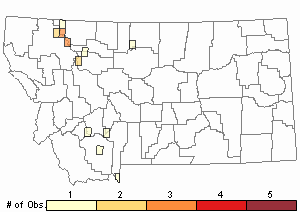
Number of Observations: 42
(Click on the following maps and charts to see full sized version)
Relative Density
Recency
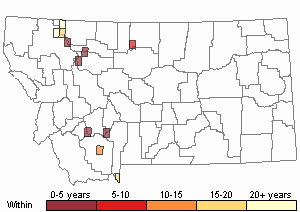
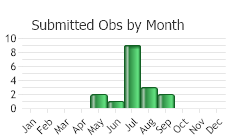
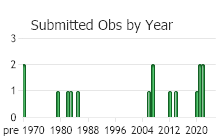
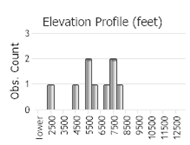 (Observations spanning multiple months or years are excluded from time charts)
Habitat
Stony, usually calcareous soil of exposed ridges, slopes; upper subalpine, alpine (
Lesica et al. 2012. Manual of Montana Vascular Plants. BRIT Press. Fort Worth, TX).
Ecology
POLLINATORS The following animal species have been reported as pollinators of this plant species or its genus where their geographic ranges overlap:
Bombus bifarius,
Bombus centralis,
Bombus flavifrons,
Bombus huntii,
Bombus melanopygus,
Bombus mixtus,
Bombus ternarius,
Bombus occidentalis,
Bombus insularis, and
Bombus flavidus (Thorp et al. 1983, Koch et al. 2012, Williams et al. 2014).
Stewardship Responsibility
References
- Literature Cited AboveLegend:
 View Online Publication
 Koch, J., J. Strange, and P. Williams. 2012. Bumble bees of the western United States. Washington, DC: USDA Forest Service, Pollinator Partnership. 143 p.
- Lesica, P., M.T. Lavin, and P.F. Stickney. 2012. Manual of Montana Vascular Plants. Fort Worth, TX: BRIT Press. viii + 771 p.
- Thorp, R.W., D.S. Horning, and L.L. Dunning. 1983. Bumble bees and cuckoo bumble bees of California (Hymenoptera: Apidae). Bulletin of the California Insect Survey 23:1-79.
- Williams, P., R. Thorp, L. Richardson, and S. Colla. 2014. Bumble Bees of North America. Princeton, NJ: Princeton University Press. 208 p.
- Additional ReferencesLegend: View Online Publication
Do you know of a citation we're missing?- Lesica, P., M.T. Lavin, and P.F. Stickney. 2022. Manual of Montana Vascular Plants, Second Edition. Fort Worth, TX: BRIT Press. viii + 779 p.
- Web Search Engines for Articles on "Rock-jasmine Wild Buckwheat"