View in other NatureServe Network Field Guides
NatureServe
Montana
Utah
Wyoming
Idaho
Wisconsin
British Columbia
South Carolina
Yukon
California
New York
Tall Baby's-breath - Gypsophila paniculata
Other Names:
Common Gypsophila, Panicled Baby's-breath
State Rank Reason (see State Rank above)
Gypsophila paniculata is native to Eurasia and was brought to North America for ornamental purposes (Hawbaker and Seipel 2024). Plants that escape cultivated settings can colonize grasslands, rangelands, and croplands where their dense populations can outcompete native and desirable vegetation and crops. A conservation status rank is not applicable (SNA) because the plant is exotic (non-native) to Montana and is not a suitable target for conservation activities.
General Description
PLANTS: Perennial forbs with stems that branch above – forming a cloud-like appearance - and grow from a stout taproot, 40-90 cm tall. Plants lack hairs (glabrous) and have a whitish bloom (glaucous). Sources: Pringle in Flora of North America (FNA) 2005; Lesica et al. 2022
LEAVES: Leaf nodes are swollen, and oppositely arranged on stem. Gray-green to blue-green leaves attach directly, without a leaf stem (sessile), to the plant stem and barely unite around it. Blades are simple, linear-lanceolate in shape, and have a single central vein, and 2-5 cm long. Leaves become shorter upwards. Sources: Pringle in FNA 2005; Lesica et al. 2022
INFLORESCENCE: A diffusely branched, terminal cyme of tiny white flowers. Inflorescence stalk lacks hairs (glabrous). Sepals: United at their bases (calyx) with round, thin-margined (membranous) lobes, 1-4 mm long, and is glabrous. Petals: 5, white to light purple, separate, oblanceolate in shape, and 2-3 mm long. Fruit: Capsule. Sources: Pringle in FNA 2005; Giblin et al. [eds.] 2018; Lesica et al. 2022
Phenology
Flowering occurs from summer to fall (Pringle in FNA 2005).
Diagnostic Characteristics
In the United States, there are 4 introduced
Gypsophila species, all referred to as baby's-breath (Pringle
in FNA 2005). Of these, two species have made their way to Montana.
Tall Baby's-breath -
Gypsophila paniculata, non-native, undesirable
* Peduncle: Stalk of the inflorescence lacks hairs (glabrous).
* Flowers: Sepals glabrous. Petals are shorter, less than 4 mm tall, and usually are not tinged with pink.
* Leaves: Do not clasp the stem.
Garden Baby's-breath -
Gypsophila scorzonerifolia, non-native, undesirable
* Peduncle: Stalk of the inflorescence is glandular and hairy.
* Flowers: Sepals are glandular and hairy. Petals are taller, 4-6 mm long, and often tinged with pink.
* Leaves: Clasp the stem.
Species Range
Montana Range
Range Descriptions
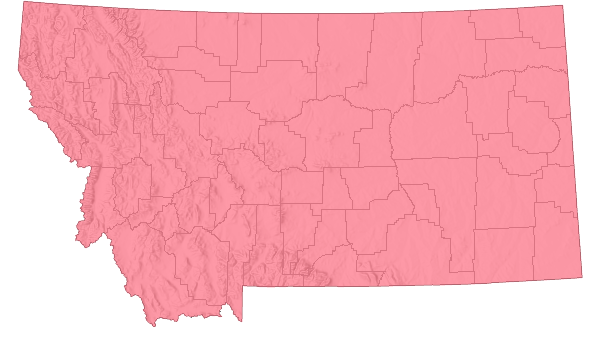
 Non-native
Range Comments
Tall Baby's-breath is native to Eurasia (Hawbaker and Seipel 2024). Plants are adapted to continental climate conditions.
Around 1887, Tall Baby's-breath was initially brought into North America for ornamental purposes (Hawbaker and Seipel 2024). In the Pacific Northwest it was first reported in 1931.
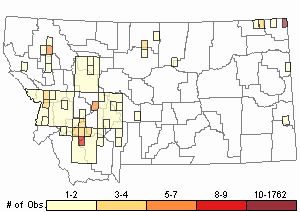
Observations in Montana Natural Heritage Program Database
Number of Observations: 1532
(Click on the following maps and charts to see full sized version)
Map Help and Descriptions
Relative Density
Recency
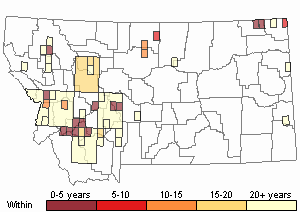

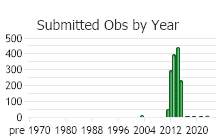
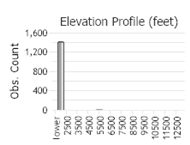 (Observations spanning multiple months or years are excluded from time charts)
Habitat
Tall Baby's-breath colonizes grasslands (especially west of the Continental Divide), fields and roadsides in the plains and valleys zones of Montana (Lesica et al. 2022). Plants grow best in coarse-textured soils and can tolerate variable conditions in moisture regimes and temperatures – hence they can germinate rapidly when conditions are good (Hawbaker and Seipel 2024). Plants are especially problematic in idle croplands, rangelands, and hayfields in northeastern Montana (Hawbaker and Seipel 2024).
Ecology
PLANT-SOIL INTERACTIONS
Tall Baby's-breath grows in all soil textures (Hawbaker and Seipel 2024). Plants growing in coarse textured soils exhibit more aggressive growth. Seedlings and mature plants exhibit rapid root growth, producing a thick taproot that can grow 13 feet deep!
Reproductive Characteristics
Tall Baby's-breath reproduces by seed.
FRUITS
Fruit is a capsule. Capsules are globose, opening by 4 slits, and producing up to four seeds. Capsules are shorter than the calyx (sepals).
LIFE CYCLE [Adapted from Hawbaker and Seipel 2024]
Tall Baby's-breath stems sprout in early May. As Tall Baby's-breath plants mature, the upper portion of the root forms a woody crown from which several stems or shoots emerge. The root crown has been found to be up to 10 inches in diameter in a mature plant. Plants become reproductive, producing flowers and setting seed, in their third year of life. As plant develop reproductively, foliage becomes more sparse. Seeds mature 4-5 weeks after the first flower buds open. Mature plants can produce around 13,000 seeds each year. Seeds primarily get distributed by seeds. In the late growing season, plants become dry and brittle, which allows strong winds to break their stems causing the plants to tumble across the landscape. Although most seeds drop near the parent plant, tumbling plants have the power to re-distribute seeds long distances. As a result, roadsides, ravines, and fence rows often have a pile up of tumbling Tall Baby's-breath plants. Once sown into the soil, it is believed that seeds stay viable for up to two years. Both seedlings and mature plants exhibit rapid root growth that produces very long taproots, up to 13 feet deep!
Economic Value
Tall Baby's-breath is grown extensively in the horticultural industry and primarily for the use in floristry. Tall Baby's-breath is very versatile and a common filler in flower arrangements. Whether fresh or dried, the plant is well-known for its ability to create a delicate, airy, and softening effect in bouquets, centerpieces, floral headpieces, wreaths, and in various types of craft. In the Pacific Northwest during the early 1900s, Tall Baby's-breath was often planted around homesteads and cemeteries. Plants are not grown in Montana, and do not contribute to the state's economy. Most of the cut baby's-breath used by florists come from wholesalers in Washington and California (Thomas, Montana Department of Agriculture, personal communication).
In Montana, Tall Baby's-breath has escaped cultivated settings and aggressively spread into grasslands, rangelands, pastures, and other natural areas. Tall Baby's-breath negatively impacts Montana's agricultural and rangeland economics. The plant's ability to form dense patches decreases forage and crop production. Farmers and ranchers must allocate more funding and time to reduce or eliminate perennial invasives.
Management
COUNTY & STATE DESIGNATIONSAs of 2024, Tall Baby's-breath is listed as
County Noxious in 14 counties: Blaine, Broadwater, Chouteau, Daniels, Deer Lodge, Flathead, Jefferson, Ravalli, Richland, Roosevelt, Sanders, Sheridan, Silver Bow, and Vallye.
INTEGRATED VEGETATION MANAGEMENTAn integrated vegetative management approach provides the best long-term control, and requires that land-use objectives and a desired plant community be identified (Shelly et al.
in Sheley and Petroff 1999). Once identified an integrated weed management strategy that promotes a weed-resistant plant community and serves other land-use objectives such as livestock forage, wildlife habitat, or recreation can be developed.
PREVENTIONFocus on preventing establishment, spread, and seed production, using a variety of practices (Hawbaker and Seipel 2024):
* Learn to identify Tall Baby's-breath at various stages of development.
* Avoid driving vehicles and other equipment through areas that have Tall Baby's-breath.
* Report new infestations to the landowner, land manager, or weed district.
GRAZING In general, grazing increases Tall-Baby's-breath (Hawbaker and Seipel 2024). In the early stages of growth, intensive livestock grazing can reduce Tall Baby's-breath vigor and seed production. The nutritional value and palatability of plants near or in the flowering stage is lower.
PHYSICAL and CULTURAL CONTROLS Hand-pulling can be effective for young plants, but becomes more difficult as plant's mature (Hawbaker and Seipel 2024).
Mowing that is done prior to flowering can constrain seed production (Hawbaker and Seipel 2024). Mowing after the bird-nesting season, does not decrease Tall Baby's-breath density or vigor.
Tilling that is shallow is tolerated by Tall Baby's-breath, indicating it is not an effective control method (Hawbaker and Seipel 2024). Deep tillage can prevent or reduce establishment and survival; however, plants must be severed below the crown to prevent regeneration. In CRP lands tillage is not an appropriate method because it changes soil health and erosional properties and alters habitat.
CHEMICAL Herbicides can be effective, especially when properly integrated with intensive pasture management. The herbicide type and concentration, application time and method, environmental constraints, land use practices, local regulations, and other factors will determine its effectiveness and impact to non-target species. Strict adherence to application requirements defined on the herbicide label will reduce risks to human and environmental health. Consult your County Extension Agent and/or Weed District for information on herbicidal control. Chemical information is also available at
Greenbook.
Metsulfuron-methyl is an active ingredient in certain herbicides that can reduce Tall Baby's-breath plants without harming perennial grasses (Hawbaker and Seipel 2024). Trademark brands include: Escort® XP and Omni® brand MSM 60DF. These herbicides should be applied after the plant emerges and in the bolt to pre-flowering stages. A study near Peerless, Montana found significant reductions in the density of Tall Baby's-breath after a 3-year studied.
BIOLOGICAL CONTROLBiological control agents have not been identified (Hawbaker and Seipel 2024).
Useful Links:Central and Eastern Montana Invasive Species TeamMontana Invasive Species websiteMontana Biological Weed Control Coordination ProjectMontana Department of Agriculture - Noxious WeedsMontana Weed Control AssociationMontana Weed Control Association Contacts WebpageMontana Fish, Wildlife, and Parks - Noxious WeedsMontana State University Integrated Pest Management ExtensionWeed Publications at Montana State University Extension - MontGuides
Stewardship Responsibility
Threats or Limiting Factors
Tall Baby's-breath can form very dense stands in grasslands and rangelands, declines in forest production, and is especially troublesome in lands that are part of Conservation Reserve Program (CRP) (Hawbaker and Seipel 2024). As plants grow nutritional value for livestock and wildlife species declines.
References
- Literature Cited AboveLegend:
 View Online Publication
- Flora of North America Editorial Committee. 2005. Flora of North America North of Mexico. Volume 5. Magnoliophyta: Caryophyllidae: Caryophyllales, Polygonales, and Plumbaginales. New York, NY: Oxford Univ. Press. vii + 656 pp.
- Hawbaker, Inga, and Tim Seipel. 2024. Baby's Breath (Gypsophila paniculata). Lives and Landscapes, Montana State University Extension, Montana State University, Bozeman, Montana.
 Hitchcock, C.L. and A. Cronquist. 2018. Flora of the Pacific Northwest: An Illustrated Manual. Second Edition. Giblin, D.E., B.S. Legler, P.F. Zika, and R.G. Olmstead (eds). Seattle, WA: University of Washington Press in Association with Burke Museum of Natural History and Culture. 882 p.
- Lesica, P., M.T. Lavin, and P.F. Stickney. 2022. Manual of Montana Vascular Plants, Second Edition. Fort Worth, TX: BRIT Press. viii + 779 p.
- Sheley, Roger, and Janet Petroff. 1999. Biology and Management of Noxious Rangeland Weeds. Oregon State University Press, Corvallis, Oregon.
- Additional ReferencesLegend: View Online Publication
Do you know of a citation we're missing?- Lesica, P., M.T. Lavin, and P.F. Stickney. 2012. Manual of Montana Vascular Plants. Fort Worth, TX: BRIT Press. viii + 771 p.
- Web Search Engines for Articles on "Tall Baby's-breath"