View in other NatureServe Network Field Guides
NatureServe
Montana
Utah
Wyoming
Idaho
Wisconsin
British Columbia
South Carolina
Yukon
California
New York
Belted Whiteface - Leucorrhinia proxima
General Description
We do not yet have descriptive information on this species. Please try the buttons above to search for information from other sources.
Species Range
Montana Range
Range Descriptions
 Native
Observations in Montana Natural Heritage Program Database
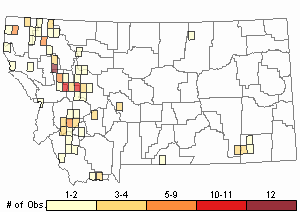
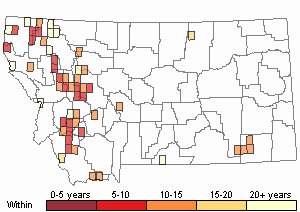
Number of Observations: 142
(Click on the following maps and charts to see full sized version)
Relative Density
Recency
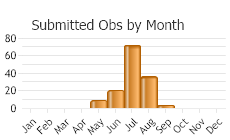
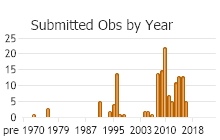
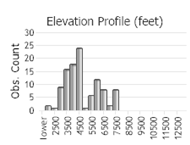 (Observations spanning multiple months or years are excluded from time charts)
Habitat
The Belted Whiteface prefers marshy or boggy ponds, fens and lakeshores with abundant vegetation as breeding habitat. This species also occurs away from breeding sites when they forage in small forest openings (Dunkle 2000, Paulson 2009).
Ecological Communities Associated with this Species
Wetland and Riparian
Alpine Riparian and Wetland
Peatland
Riparian and Wetland Forest
Riparian Shrubland
Wet Meadow and Marsh
Food Habits
Larvae feed on a wide variety of aquatic insects, such as mosquito larvae, other aquatic fly larvae, mayfly larvae, and freshwater shrimp. They will also eat very small fish and tadpoles.
Adult- The dragonfly will eat almost any soft-bodied flying insect including mosquitoes, flies, small moths, mayflies, and flying ants or termites.
Ecology
Several male-male-female "tandems" have been collected or seen (Miller and Gustafson 1996).
Reproductive Characteristics
Male Belted Whitefaces tend to perch on vegetation over open water or on the surface of lily pads defending small territories of only a couple of square yards in size. Although individuals pair up at breeding sites, copulation occurs in nearby shrublands or forest (Dunkle 2000, Paulson 2009).
Stewardship Responsibility
References
- Literature Cited AboveLegend:
 View Online Publication
- Dunkle, S.W. 2000. Dragonflies through binoculars: A field guide to dragonflies of North America. New York, NY. Oxford University Press. 266 pp.
 Miller, K.B. and D.L. Gustafson. 1996. Distribution records of the Odonata of Montana. Bulletin of American Odonatology 3(4):75-88.
- Paulson, D.R. 2009. Dragonflies and Damselflies of the West. Princeton University Press, Princeton. 535 pp.
- Additional ReferencesLegend: View Online Publication
Do you know of a citation we're missing?- Nelson, Howard E. 1953. The summer dragonflies of Flathead Valley, Montana. M.A. Thesis. University of Montana. Missoula, MT.
- Web Search Engines for Articles on "Belted Whiteface"
- Additional Sources of Information Related to "Insects"