View in other NatureServe Network Field Guides
NatureServe
Montana
Utah
Wyoming
Idaho
Wisconsin
British Columbia
South Carolina
Yukon
California
New York
Field Crescent - Phyciodes pulchella
General Description
[From Ferris and Brown 1981; Scott 1986; Glassberg 2001, Guppy and Shepard 2001; Pyle 2002] Forewing 1.6-2.1 cm. Antennae knobs dark brown or black. Upperside orange and black, appearing primarily black above, hindwing postmedian orange band enclosing black dots; underside of forewing yellow-brown with a yellow discal bar and smaller black patches on the inner margin, underside of hindwing yellow-brown with rusty markings and more heavily patterned.
Shropshire and Tallamy (2025) provide a list, with synonymies, of 13,055 described native, exotic, and occasional straying Lepidoptera species of North America, north of Mexico; known but undescribed taxa, taxa with unresolved taxonomy, and excluded species are also included. The
main manuscript includes links to supplementary materials, including a reference list for Lepidoptera of North America north of Mexico, and a filterable spreadsheet with information on taxonomy, synonymy, size ranges of species, distribution by state, province, and country with references, and host-plant Family and Genus associations with references.
Phenology
Three or four flights: one flight from late June to early August in the mountains and far north, three to four flights in May to September on the Colorado plains, April-October in lowland California (Scott 1986). One flight early May to late September in the Pacific Northwest (Pyle 2002; James and Nunallee 2011), one flight late May to early August in British Columbia (Guppy and Shepard 2001).
Diagnostic Characteristics
Best told by the upper surface being relatively black in the basal and median regions of the wings, the underside of forewing with a yellow bar at the outer end of the discal cell running perpendicular to leading edge of wing, antennal knobs largely dark brown or black.
Species Range
Montana Range
Range Descriptions
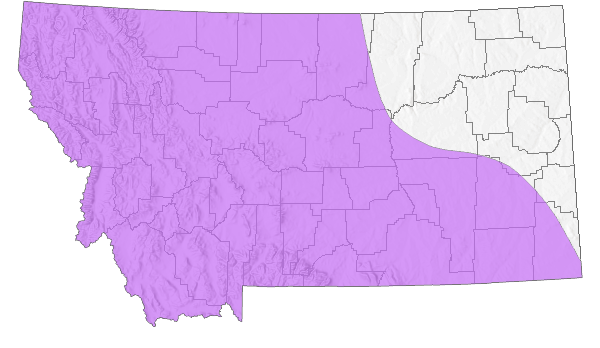
 Native
Range Comments
From central Alaska and northern Yukon Territory south to southern California, southern Arizona, and southern New Mexico, east to the western edge of the Great Plains (Scott 1986; Glassberg 2001; Pyle 2002); to at least 3355 m elevation in Colorado (Brown 1957). In Montana, widespread in the western 2/3 of the state (Kohler 1980; Stanford and Opler 1993). Mostly common to abundant (Glassberg 2001).
Shropshire and Tallamy (2025) provide a link to a supplemental filterable spreadsheet with information on distribution by state, province, and country with references for all Lepidoptera species of North America, north of Mexico.
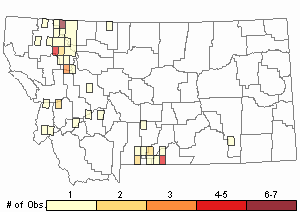
Observations in Montana Natural Heritage Program Database
Number of Observations: 73
(Click on the following maps and charts to see full sized version)
Map Help and Descriptions
Relative Density
Recency
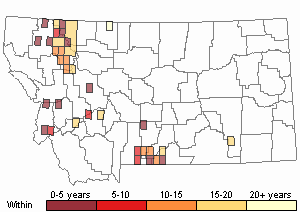
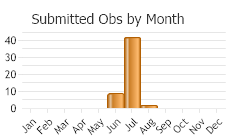
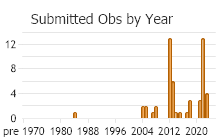
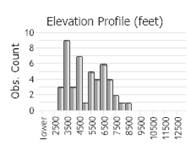 (Observations spanning multiple months or years are excluded from time charts)
Migration
Non-migratory.
Habitat
Prairie, forested foothills, moist montane meadows, taiga, above treeline in alpine tundra (Scott 1986; Pyle 2002; James and Nunnallee 2011). In Glacier National Park, Montana reported in mesic montane meadows and above treeline in alpine tundra (Debinski 1993).
Shropshire and Tallamy (2025) provide a link to a supplemental filterable spreadsheet with information on host-plant Family and Genus associations with references for all Lepidoptera species of North America, north of Mexico.
National Vegetation Classification System Groups Associated with this Species
Forest and Woodland
Deciduous Forest and Woodland
Low Elevation - Xeric Forest and Woodland
Montane - Subalpine Forest and Woodland
Grassland
Montane - Subalpine Grassland
Wetland and Riparian
Alpine Riparian and Wetland
Peatland
Riparian and Wetland Forest
Riparian Shrubland
Wet Meadow and Marsh
Food Habits
Larval food plants include many species of aster (Aster, Eucephalius, Eurybia, Machaeranthera)(Scott 1986, 1992; Guppy and Shepard 2001; Pyle 2002), but also on Taraxacum in captivity (James and Nunnallee 2011). Adults feed on flower nectar (including Achillea, Allium, Antennaria, Apocynum, Arnica, Aster, Astragalus, Bidens, Ceanothus, Centaurea, Cerastium, Chrysothamnus, Cirsium, Cryptantha, Erigeron, Erioganum, Erysimum, Galium, Grindelia, Helianthus, Lesquerella, Machaeranthera, Potentilla, Prunus, Ranunculus, Rudbeckia, Sedum, Senecio, Solidago, Taraxacum, and Trifolium) as well as dung and mud (Scott 1992; Pyle 2002, James and Nunnallee 2011).
Reproductive Characteristics
Females lay eggs in clusters (to 235 eggs per cluster but usually 30-40 eggs) on the undersides of host plant leaves, sometimes very close to the ground. Eggs hatch in 6-9 days. Larvae gather into groups and cover themselves in communal silk nests. Feeding occurs both diurnally and nocturnally. Larvae reach L3 instars by about 36-40 days post egg hatch, at which stage they diapause. Development to L4 instar began about 26 days after overwintwering completed, L5 in another 11 days, and pupation in 20 days after molting to L5; adults emerge from pupae (eclose) in abut 33-40 days, depending on temperature (Scott 1992; James and Nunnallee 2011). Males patrol for females low to the ground throughout the day in grassy swales, meadows, valley bottoms (Scott 1975b, 1986).
Stewardship Responsibility
References
- Literature Cited AboveLegend:
 View Online Publication
 Brown, F.M. 1957. Colorado Butterflies. Proceedings; Numbers Three through Seven. Denver Museum of Natural History, Denver, Co.
- Debinski, D. 1993. Butterflies of Glacier National Park, Montana. Occasional Papers of the Museum of Natural History, the University of Kansas, Lawrence, Kansas. No. 159: 1-13.
- Ferris, C.D. and F.M. Brown (eds). 1981. Butterflies of the Rocky Mountains. Univ. of Oklahoma Press. Norman. 442 pp.
- Glassberg, J. 2001. Butterflies through Binoculars: A Field Guide to the Butterflies of Western North America. Oxford University Press.
- Guppy, C.S. and J.H. Shepard. 2001. Butterflies of British Columbia: including western Alberta, southern Yukon, the Alaska Panhandle, Washington, northern Oregon, northern Idaho, northwestern Montana. UBC Press (Vancouver, BC) and Royal British Columbia Museum (Victoria, BC). 414 pp.
- James, D.G. and D. Nunnallee. 2011. Life histories of Cascadia butterflies. Corvallis, OR: Oregon State University Press. 447 p.
- Kohler, S. 1980. Checklist of Montana Butterflies (Rhopalocera). Journal of the Lepidopterists' Society 34(1): 1-19.
- Pyle, R.M. 2002. The butterflies of Cascadia: a field guide to all the species of Washington, Oregon, and surrounding territories. Seattle Audubon Society, Seattle, Washington. 420 pp.
- Scott, J.A. 1975b. Mate-locating behavior of western North American butterflies. Journal of Research on the Lepidoptera 14:1-40.
- Scott, J.A. 1986. The butterflies of North America: a natural history and field guide. Stanford University Press, Stanford, California.
- Scott, J.A. 1992. Hostplant records for butterflies and skippers (mostly from Colorado) 1959-1992, with new life histories and notes on oviposition, immatures, and ecology. Papilio new series #6. 185 p.
- Stanford, R.E. and P.A. Opler. 1993. Atlas of western USA butterflies: including adjacent parts of Canada and Mexico. Unpubl. Report. Denver and Fort Collins, Colorado 275 pp.
- Additional ReferencesLegend: View Online Publication
Do you know of a citation we're missing?- Allen, T.J., J.P. Brock, and J. Glassberg. 2005. Caterpillars in the field and garden: a field guide to the butterfly caterpillars of North America. Oxford University Press.
- Brock, J.P. and K. Kaufman. 2003. Kaufman Field Guide to Butterflies of North America. Houghton Mifflin Company, New York, NY 284 pp.
- Caruthers, J.C., and D. Debinski. 2006. Montane meadow butterfly species distributions in the Greater Yellowstone Ecosystem. University of Wyoming National Park Service Research Center Annual Report, 2006. Vol. 30, Art. 14. 85-96.
- Fultz, J.E. 2005. Effects of shelterwood management on flower-visiting insects and their floral resources. M.Sc. Thesis. Bozeman, MT: Montana State University. 163 p.
- Layberry, R.A., P.W. Hall, and J.D. LaFontaine. 1998. The Butterflies of Canada. University of Toronto Press. 280 pp. + color plates.
- Maxell, B.A. 2016. Northern Goshawk surveys on the Beartooth, Ashland, and Sioux Districts of the Custer-Gallatin National Forest: 2012-2014. Montana Natural Heritage Program. Helena, MT. 114pp.
- Opler, P.A., K. Lotts, and T. Naberhaus, coordinators. 2010. Butterflies and moths of North America. Big Sky Institute, Bozeman, MT. Available at: www.butterfliesandmoths.org (Accessed 15 June 2015).
- Scott, J.A. 1994. Biology and Systematics of Phyciodes (Phyciodes) [Lepidoptera, Nymphalidae]. Papilio, New Series #7: 120.
- Scott, J.A. 2014. Lepidoptera of North America 13. Flower visitation by Colorado butterflies (40,615 records) with a review of the literature on pollination of Colorado plants and butterfly attraction (Lepidoptera: Hersperioidea and Papilionoidea). Contributions of the C.P. Gillette Museum of Arthopod Diversity. Fort Collins, CO: Colorado State University. 190 p.
- Shropshire, K.J. and D.W. Tallamy. 2025. Lepidoptera of North America, north of Mexico: an annotated list containing geographic ranges and host-plant records. Zookeys.1261:101-113.
- Wahlberg, N., R. Oliveira, and J.A. Scott. 2003. Phylogenetic relationships of Phyciodes butterfly species (Lepidoptera: Nymphalidae): complex mtDNA variation and species delimitations. Systematic Entomology. Vol 28. 257-273.
- Web Search Engines for Articles on "Field Crescent"
- Additional Sources of Information Related to "Insects"