View in other NatureServe Network Field Guides
NatureServe
Montana
Utah
Wyoming
Idaho
Wisconsin
British Columbia
South Carolina
Yukon
California
New York
Sagebrush Vole - Lemmiscus curtatus
Native Species
Global Rank:
G5
State Rank:
S4
(see State Rank Reason below)
Agency Status
USFWS:
USFS:
BLM:
FWP SWAP:
SGCN
State Rank Reason (see State Rank above)
Species is common across grasslands and shrublands in eastern and central Montana. Species is likely stable, but faces the threat of habitat loss due to conversion of native habitat to agriculture
General Description
A medium-sized vole under an ounce in weight, the Sagebrush Vole measures between 4 1/4 and 5 5/8 inches, including its furry, dusky- and white-colored tail. It has thick, pale gray fur, darker above, whitish, silvery, or buffy below. Some individuals may have touches of buff color on their ears or noses (Zeveloff and Collett 1988). The feet are white to light gray, thickly covered with fur, with the hind feet being equivalent in length to the short tail (Foresman 2012).
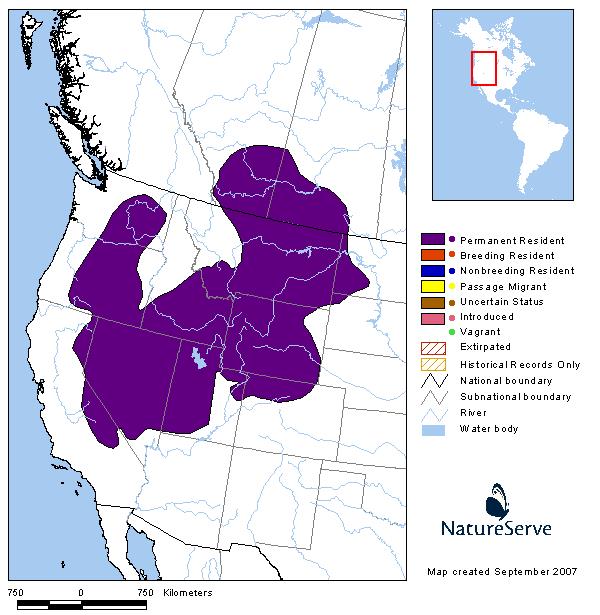
Species Range
Montana Range
Range Descriptions
 Native
Western Hemisphere Range
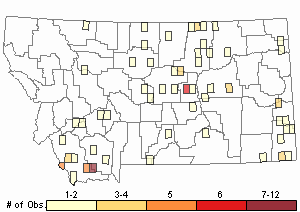
Observations in Montana Natural Heritage Program Database
Number of Observations: 112
(Click on the following maps and charts to see full sized version)
Relative Density
Recency
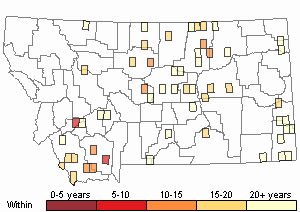
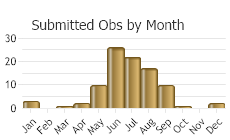
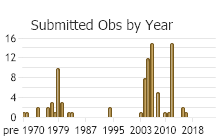
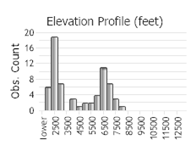 (Observations spanning multiple months or years are excluded from time charts)
Migration
Non-migratory.
Habitat
Sagebrush flats (Lampe et al. 1974). Associated with Artemisia spp., particularly Artemisia tridentata (Hoffmann and Pattie 1968). Also may be found in denser vegetation; constructs poorly defined runways. May use dry cattle chips for temporary shelter (Jones et al. 1983).
National Vegetation Classification System Groups Associated with this Species
Forest and Woodland
Low Elevation - Xeric Forest and Woodland
Montane - Subalpine Forest and Woodland
Shrubland
Arid - Saline Shrubland
Sagebrush Shrubland
Grassland
Lowland - Prairie Grassland
Wetland and Riparian
Alkaline - Saline Wetlands
Riparian and Wetland Forest
Riparian Shrubland
Recently Disturbed or Modified
Recently Burned
Human Land Use
Agriculture
Developed
Food Habits
Leaves, stems, flowers or immature fruits of grasses and forbs. Sagebrush and rabbit brush leaves, inner bark of shrubs in winter and even undigested plant residues in cattle chips when other foods are scarce (Jones et al. 1983).
Ecology
Mobile colonies - occupies deep snow cover areas in winter, south-facing slopes in spring, lower elevations in summer. Highly developed hearing. Not active in strong winds. Numerous predators (Jones et al. 1983).
Reproductive Characteristics
Females and males mature at 1 to 2 months age. Litter size may be correlated with precipitation and available vegetation. Young are altricial at birth; weaned at about 18 days of age.
Stewardship Responsibility
References
- Literature Cited AboveLegend:
 View Online Publication
 Foresman, K.R. 2012. Mammals of Montana. Second edition. Mountain Press Publishing, Missoula, Montana. 429 pp.
- Hoffmann, R.S. and D.L. Pattie. 1968. A guide to Montana mammals: identification, habitat, distribution, and abundance. Missoula, MT: University of Montana. 133 p.
- Jones, J.K., D.M. Armstrong, R.S. Hoffmann and C. Jones. 1983. Mammals of the northern Great Plains. University of Nebraska Press, Lincoln. 379 pp.
- Lampe, R.P., J.K. Jones Jr., R.S. Hoffmann, and E.C. Birney. 1974. The mammals of Carter County, southeastern Montana. Occa. Pap. Mus. Nat. Hist. Univ. Kan. 25:1-39.
- Zeveloff, S.I. and F.R. Collett. 1988. Mammals of the Intermountain west. University of Utah Press, Salt Lake City, Utah.
- Additional ReferencesLegend: View Online Publication
Do you know of a citation we're missing?- Allen, K.L., T. Weaver, and D. Flath. 1994. Small mammals in Northern Rocky Mountain ecosystems. Unpubl. report to Bureau of Land Management and United States Forest Service, August 31, 1994. Montana State Univ., Bozeman. 54 pp.
- Atkinson, E.C. 1992. Ferruginous hawk (Buteo regalis) inventories on the Dillon Resource Area of southwest Montana: 1992. Montana Natural Heritage Program for Bureau of Land Management, Dillon Resource Area. 34 pp.
- Bachen, D.A. 2014. Cheatgrass invasion of sagebrush steppe: Impacts of vegetation structure on small mammals. M.Sc. Thesis. Bozeman, Montana: Montana State University. 96 p.
- Butts, T.W., Western Technology and R.L. Eng. 1993. Continental Lime Indian Creek Mine, Townsend, MT. Life of Mine Wildlife Reconnaissance. In Life-of-Mine Amendment. Continental Lime, Inc., Indian Creek Mine & Plant. Vol. 2. October 13, 1992.
- Carlsen, T. 1980. Small mammal trapping in the Elkhorns. [Unpublished report]. 7 pp.
- Carroll, L. E. and H. H. Genoways. 1980. Lagurus curtatus. Mamm. Species 124:1-6.
- Fjell, Alan K., and Brian R. Mahan, compilers., 1984, Peabody Coal Company Big Sky Mine, Rosebud County, MT. Wildlife monitoring report: 1983 field season. February 1984.
- Foresman, K.R. 2001. The wild mammals of Montana. American Society of Mammalogists, Special Publication Number 12. Lawrence, KS. 278 pp.
- Hanauska-Brown, L., B.A. Maxell, A. Petersen, and S. Story. 2014. Diversity Monitoring in Montana 2008-2010 Final Report. Montana Fish, Wildlife & Parks. Helena, MT. 78 pp.
- Hoffmann, R.S., P.L. Wright, and F.E. Newby. 1969. The distribution of some mammals in Montana. I. Mammals other than bats. Journal of Mammalogy 50(3): 579-604.
- Joslin, Gayle, and Heidi B. Youmans. 1999. Effects of recreation on Rocky Mountain wildlife: a review for Montana. [Montana]: Montana Chapter of the Wildlife Society.
- Kritzman, E.B. 1977. Little mammals of the Pacific Northwest. Pacific Search Press, Seattle, WA.
- MacCracken, J.G., D.W. Uresk, and R.M. Hansen. 1985. Rodent-vegetation relationships in southeastern Montana. Northwest Science 59:272-278.
- Oechsli, L.M. 2000. Ex-urban development in the Rocky Mountain West: consequences for native vegetation, wildlife diversity, and land-use planning in Big Sky, Montana. M.Sc. Thesis. Montana State University, Bozeman. 73 p.
- Reid, F. 2006. Peterson Field Guide to Mammals of North America, 4th Edition. Houghton Mifflin Company: Boston and New York, 608 pp.
- Scow, K.L. 1981. Ecological distribution of small mammals at Sarpy Creek, Montana, with special consideration of the Deer Mouse, Peromyscus maniculatus. M.Sc. Thesis. Bozeman, Montana: Montana State University. 73 p.
- Sieg, C.H., D.W. Uresk, and R M. Hansen. 1986. The value of bentonite mine spoils in southeastern Montana as small mammal habitat. Northwest Science 60(4): 218-224.
- Trout, R.G. 1978. Small mammal abundance and distribution in the Missouri River Breaks, Montana. M.Sc. Thesis. Bozeman, Montana: Montana State University. 64 p.
- Tschache, O.P. 1970. Effects of ecological changes induced by various sagebrush control techniques on small mammal populations. M.Sc. Thesis. Bozeman, MT: Montana State University. 51 p.
- VTN Colorado, Inc. Decker Coal Company., 1975, Draft environmental impact assessment for the proposed North Extension of the West Decker Mine.
- Web Search Engines for Articles on "Sagebrush Vole"
- Additional Sources of Information Related to "Mammals"