View in other NatureServe Network Field Guides
NatureServe
Montana
Utah
Wyoming
Idaho
Wisconsin
British Columbia
South Carolina
Yukon
California
New York
Columbia Locoweed - Oxytropis campestris var. columbiana
Other Names:
Oxytropis columbiana
State Rank Reason (see State Rank above)
Originally known in Montana from six occurrences all around Flathead Lake. However, two of the occurrences are now extirpated. Private lands, which are subject to development in the area, play a vital role in maintaining viable populations of this plant in Montana.
- Details on Status Ranking and Review
Population Size
Score3 - Vey Small: Generally <2,000 individuals.
CommentApproximately 1,000 individuals documented. Current population data are needed for most populations.
Range Extent
Score3 - Local Endemic or Very Small Montana Range: Generally restricted to an area <10,000 sq. miles (equivalent to the combined area of Phillips and Valley Counties) or <6 Sub-basins (4th code watersheds) Range-wide OR limited to one Sub-basin in Montana
Area of Occupancy
Score3 - Very Low: Generally occurring in 3 or fewer Subwatersheds (6th Code HUC’s).
Environmental Specificity
Score2 - High: Species is restricted to a highly specialized and limited habitat and is typically dependent upon unaltered, high-quality habitat (C Values of 8-10).
Trends
Score1-3 - Declining: Species is likely declining though the magnitude of declines is uncertain. Declines may be based upon range extent and/or occupied area in the recent past (approximately 30 years).
CommentAvailable data appear to show that populations have declined in size and extent though additional monitoring data are needed to verify this potential trend.
Threats
Score2-3 - High to Very High.
CommentHydrologic alteration, shoreline development, recreation activities and invasive species pose threats to the populations.
Intrinsic Vulnerability
Score0-1 - Low to Moderate Vulnerability.
Raw Conservation Status Score
Score
14 to 18 total points scored out of a possible 19.
General Description
Columbia Crazyweed is a clump-forming perennial with leafless flower stalks that are 5-30 cm tall, and arising from a branched rootstock. The basal leaves are pinnately compound with mostly less than 17 leaflets, and have membranous stipules that are attached to the petiole for at least 1/2 their length. The greenish to grayish foliage is sparsely to densely covered by hairs. The flower stalks are slightly shorter to much longer than the leaves and bear 5-40 flowers in a spike-like inflorescence. The pea-like flowers are 10-20 mm long. The greenish tubular calyx is covered by grayish to blackish hairs and has five pointed teeth. The white corolla consists of an upper banner petal, two wing petals at the side, and a lower keel petal with purple spots. The pod is two-celled, several seeded, membranous, and 1-2.5 cm long
Phenology
Flowering in late May - early June; fruiting in late June - early July.
Diagnostic Characteristics
OXYTROPIS CAMPESTRIS is most similar to O. SERICEA in having whitish corollas, stipules attached to petioles for most their length, foliage not glandular, leaflets 2-ranked, and inflorescences with more than 4 flowers. OXYTROPIS SERICEA differs by having pods which become bony rather than membranous, and by somewhat larger flowers, averaging 15 mm long. Other subspecies of OXYTROPIS CAMPESTRIS differ by having cream colored flowers with lower petals that lack purple spots, and by leaves mostly with more than 17 leaflets.
Species Range
Montana Range
Range Descriptions
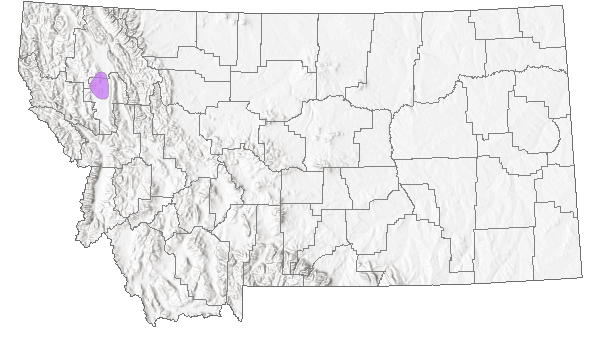
 Native
Range Comments
Regional endemic, northeastern Washington and northwestern Montana. Known in Washington from gravelly banks along the Columbia River from the confluence with the Spokane River north to near the Canadian border. Also known form similar habitat along the shores of Flthead Lake, Montana. It is believed that most populations in Washington were destroyed by construction of Grand Coulee Dam. However, populations along the Columbia River may still occur near the Canadian border. Until the mid 1980's only one or two populations were known from around Flathead Lake. Elisens identified Oxytropis populations along the North Folk of the Flathead River as O. columbiana (Peter Lesica's letter to D.R. Harm, 1992).
Observations in Montana Natural Heritage Program Database
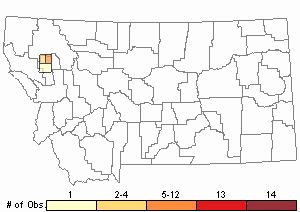
Number of Observations: 18
(Click on the following maps and charts to see full sized version)
Map Help and Descriptions
Relative Density
Recency
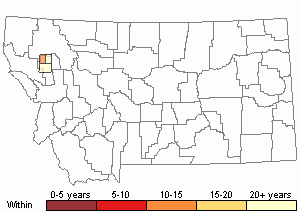
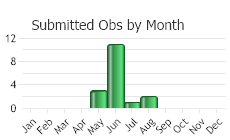
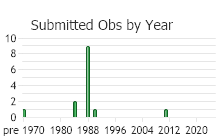
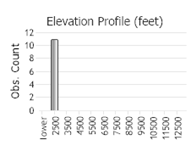 (Observations spanning multiple months or years are excluded from time charts)
Habitat
Gravelly shoreline along major lakes and rivers.
National Vegetation Classification System Groups Associated with this Species
Wetland and Riparian
Riparian and Wetland Forest
Ecology
POLLINATORS The following animal species have been reported as pollinators of this plant species or its genus where their geographic ranges overlap:
Bombus appositus,
Bombus bifarius,
Bombus centralis,
Bombus fervidus,
Bombus flavifrons,
Bombus melanopygus,
Bombus nevadensis,
Bombus rufocinctus,
Bombus sylvicola,
Bombus occidentalis,
Bombus insularis, and
Bombus kirbiellus (Macior 1974, Bauer 1983, Shaw and Taylor 1986, Williams et al. 2014, Miller-Struttmann and Galen 2014).
Stewardship Responsibility
Threats or Limiting Factors
STATE THREAT SCORE REASON
Reported threats to Montana's population of Columbia Locoweed are of concern because most of the state population is on privately-owned shoreline properties along Flathead Lake (MTNHP Threat Assessment 2021). About one-third of known populations have been destroyed following residential development. Lacking protective process required to develop public-owned properties, extant populations are exposed to ongoing development. The risk of direct displacement of populations and subsequent indirect threats of fragmentation and habitat degradation is likely to increase time.
References
- Literature Cited AboveLegend:
 View Online Publication
- Bauer, P.J. 1983. Bumblebee pollination relationships on the Beartooth Plateau tundra of Southern Montana. American Journal of Botany. 70(1): 134-144.
- Lesica, P., M.T. Lavin, and P.F. Stickney. 2012. Manual of Montana Vascular Plants. Fort Worth, TX: BRIT Press. viii + 771 p.
 Macior, L.M. 1974. Pollination ecology of the Front Range of the Colorado Rocky Mountains. Melanderia 15: 1-59.
- Miller-Struttmann, N.E. and C. Galen. 2014. High-altitude multi-taskers: bumble bee food plant use broadens along an altitudinal productivity gradient. Oecologia 176:1033-1045.
- MTNHP Threat Assessment. 2021. State Threat Score Assignment and Assessment of Reported Threats from 2006 to 2021 for State-listed Vascular Plants. Botany Program, Montana Natural Heritage Program, Helena, Montana.
- Shaw, D.C. and R.J. Taylor.1986. Pollination ecology of an alpine fell-field community in the North Cascades. Northwest Science 60:21-31.
- Williams, P., R. Thorp, L. Richardson, and S. Colla. 2014. Bumble Bees of North America. Princeton, NJ: Princeton University Press. 208 p.
- Additional ReferencesLegend: View Online Publication
Do you know of a citation we're missing?- Lesica, P. 1988. The occurrence and taxonomic status of Oxytropis campestris var. Columbiana in Montana. Unpublished report.
- Lesica, P., M.T. Lavin, and P.F. Stickney. 2022. Manual of Montana Vascular Plants, Second Edition. Fort Worth, TX: BRIT Press. viii + 779 p.
- Web Search Engines for Articles on "Columbia Locoweed"