View in other NatureServe Network Field Guides
NatureServe
Montana
Utah
Wyoming
Idaho
Wisconsin
British Columbia
South Carolina
Yukon
California
New York
Evermann Fleabane - Erigeron evermannii
State Rank Reason (see State Rank above)
DRAFT: Requesting feedback on the 2026 revised rank, factors, and State Rank Reason outlined below and in the Conservation Status Rank Report.
Erigeron evermannii is very rare in the state where it is known from only two populations in Ravalli County. The size and extent of the populations are undocumented and they have not been observed or surveyed since the 1960's and 1970's, as such trends are unknown. However, the species occurs in remote, alpine habitats that are largely intact and in good condition, as such, it seems likely that populations may be relatively stable or experiencing only minor declines. No significant threats to the existing populations are known besides potential impacts from climate change. The species appears to be at a potentially high risk of extirpation in the state due to its extreme rarity.
Due to the lack of data and that the existing data are out-of-date, surveys are greatly needed to establish baseline information on population sizes and extent, as well as information on habitat quality and potential threats. Additional surveys in potentially suitable habitat are also needed to look for other populations.
General Description
Evermann Fleabane is a dwarf perennial. Its stems reach up to 10 cm high and arise from a branched rootstock and from a long, deep-seated taproot. The glabrous basal leaves are up to 4 cm long, spoon-shaped, and rounded at the tips. The stem leaves are greatly reduced or lacking. The flowering heads are solitary at the ends of the stems. The rays that compose the petals of the flowering head are 6-10 mm long and white or occasionally light blue. The involucral bracts are 5-8 mm long, spreading hairy, and usually glandular. The achenes have 25-35 unequal-length bristles, forming a pappus, at the top.
Phenology
Flowering in July-August.
Diagnostic Characteristics
Erigeron is a large and difficult genus to distinguish. The tap-rooted habit, triple-nerved basal leaves, stem pubescence, almost complete absence of stem leaves, and the shifting talus habitat are good distinguishing characters for E. evermannii.
Species Range
Montana Range
Range Descriptions
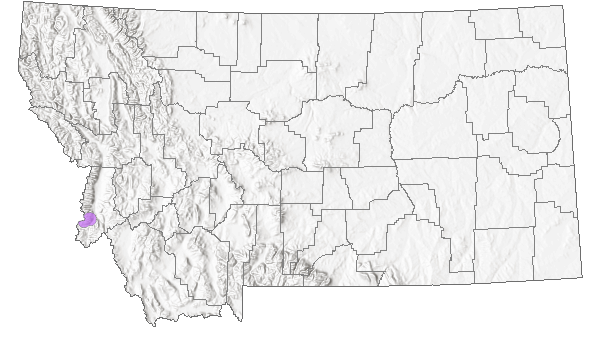
 Native
Range Comments
Central ID to southwest MT. Regional endemic.
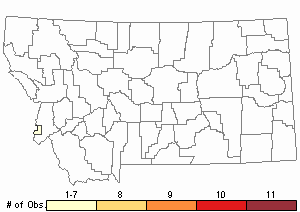
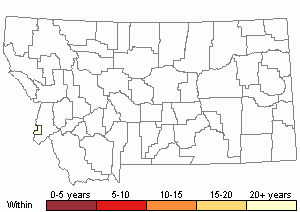
Observations in Montana Natural Heritage Program Database
Number of Observations: 8
(Click on the following maps and charts to see full sized version)
Map Help and Descriptions
Relative Density
Recency
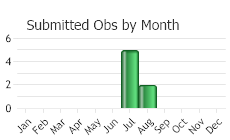
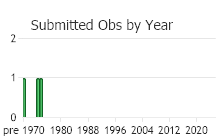
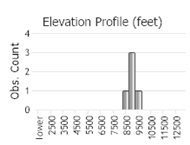 (Observations spanning multiple months or years are excluded from time charts)
Habitat
Shifting talus slopes and dry, rocky meadows near or above timberline.
National Vegetation Classification System Groups Associated with this Species
Alpine
Alpine - Sparse and Barren
Alpine - Vegetated
Ecology
POLLINATORS The following animal species have been reported as pollinators of this plant species or its genus where their geographic ranges overlap:
Bombus bifarius,
Bombus centralis,
Bombus fervidus,
Bombus flavifrons,
Bombus huntii,
Bombus melanopygus,
Bombus mixtus,
Bombus rufocinctus,
Bombus occidentalis, and
Bombus insularis (Thorp et al. 1983, Wilson et al. 2010, Colla and Dumesh 2010, Koch et al. 2012).
Stewardship Responsibility
Threats or Limiting Factors
STATE THREAT SCORE REASON
Threat impact not assigned because threats are not known (MTNHP Threat Assessment 2021).
References
- Literature Cited AboveLegend:
 View Online Publication
 Colla, S.R. and S. Dumesh. 2010. The bumble bees of southern Ontario: notes on natural history and distribution. Journal of the Entomological Society of Ontario 141:39-68.
- Koch, J., J. Strange, and P. Williams. 2012. Bumble bees of the western United States. Washington, DC: USDA Forest Service, Pollinator Partnership. 143 p.
- MTNHP Threat Assessment. 2021. State Threat Score Assignment and Assessment of Reported Threats from 2006 to 2021 for State-listed Vascular Plants. Botany Program, Montana Natural Heritage Program, Helena, Montana.
- Thorp, R.W., D.S. Horning, and L.L. Dunning. 1983. Bumble bees and cuckoo bumble bees of California (Hymenoptera: Apidae). Bulletin of the California Insect Survey 23:1-79.
- Wilson, J.S., L.E. Wilson, L.D. Loftis, and T. Griswold. 2010. The montane bee fauna of north central Washington, USA, with floral associations. Western North American Naturalist 70(2): 198-207.
- Additional ReferencesLegend: View Online Publication
Do you know of a citation we're missing?- Lesica, P., M.T. Lavin, and P.F. Stickney. 2012. Manual of Montana Vascular Plants. Fort Worth, TX: BRIT Press. viii + 771 p.
- Lesica, P., M.T. Lavin, and P.F. Stickney. 2022. Manual of Montana Vascular Plants, Second Edition. Fort Worth, TX: BRIT Press. viii + 779 p.
- Web Search Engines for Articles on "Evermann Fleabane"