View in other NatureServe Network Field Guides
NatureServe
Montana
Utah
Wyoming
Idaho
Wisconsin
British Columbia
South Carolina
Yukon
California
New York
Big Horn Fleabane - Erigeron allocotus
State Rank Reason (see State Rank above)
DRAFT: Requesting feedback on the 2026 revised rank, factors, and State Rank Reason outlined below and in the Conservation Status Rank Report.
Erigeron allocotus is a regional endemic with most of its range in Wyoming and extending into Montana in the Bighorn Basin-Pryor Mtn Desert region. Within portions of its range in Montana, it can be relatively common in localized area. The species' habitat is largely intact and in good condition. Trend data are lacking though populations have likely been relatively stable or experienced only minor declines. No significant threats have been identified for it. As a result of its relative abundance within portions of its range, low threat levels, extensive areas of good condition habitat, and trends that are suspected of being relatively stable, the species may be relatively secure within the state.
Continued surveys to monitor some populations will be beneficial to ensure that populations do not decline significantly in size and extent.
General Description
Taprooted perennial with a usually branched caudex. Stems ascending to erect, 5–10 cm. Herbage hirsute, minutely glandular. Leaves mainly basal; blades spatulate, 1–2 cm long, mostly 3-lobed at the tip. Heads 1 to 4, radiate. Involucres campanulate, 4–6 mm high; phyllaries in 2 to 3 series, glandular, sparsely hirsute. Rays white to pink, 20 to 40 ligules filiform, 3–6 mm long. Disk corollas ca. 3 mm long. Achenes ca. 2 mm long (
Lesica et al. 2012. Manual of Montana Vascular Plants. BRIT Press. Fort Worth, TX).
Phenology
Flowering in May to early July.
Diagnostic Characteristics
Erigeron compositus has leafless or almost leafless stems that are cleft into 5-10 narrow segments.
Species Range
Montana Range
Range Descriptions
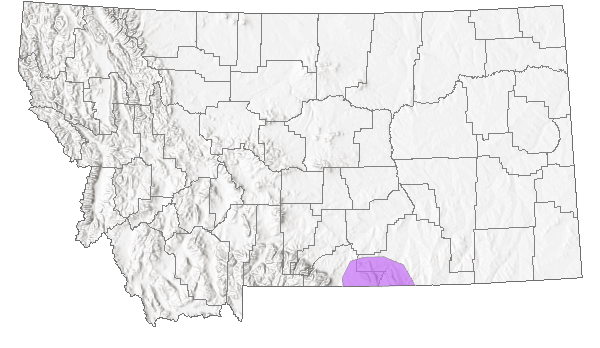
 Native
Range Comments
Regional endemic of the Bighorn and Pryor ranges and adjacent foothills in north-central Wyoming and south-central Montana.
Observations in Montana Natural Heritage Program Database
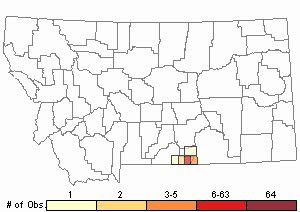
Number of Observations: 84
(Click on the following maps and charts to see full sized version)
Map Help and Descriptions
Relative Density
Recency
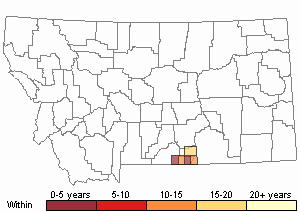
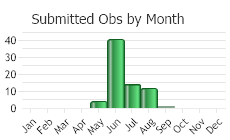
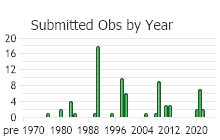
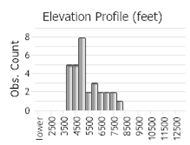 (Observations spanning multiple months or years are excluded from time charts)
Habitat
Stony, sparsely vegetated, limestone or calcareous sandstone-derived soil of exposed ridges and cliffs in the valleys and montane zone.
National Vegetation Classification System Groups Associated with this Species
Forest and Woodland
Low Elevation - Xeric Forest and Woodland
Montane - Subalpine Forest and Woodland
Shrubland
Arid - Saline Shrubland
Sagebrush Shrubland
Sparse and Barren
Sparse and Barren
Ecology
POLLINATORS The following animal species have been reported as pollinators of this plant species or its genus where their geographic ranges overlap:
Bombus bifarius,
Bombus centralis,
Bombus fervidus,
Bombus flavifrons,
Bombus huntii,
Bombus melanopygus,
Bombus mixtus,
Bombus rufocinctus,
Bombus occidentalis, and
Bombus insularis (Thorp et al. 1983, Wilson et al. 2010, Colla and Dumesh 2010, Koch et al. 2012).
Stewardship Responsibility
Threats or Limiting Factors
STATE THREAT SCORE REASON
Threat impact not assigned because threats are not known (MTNHP Threat Assessment 2021).
References
- Literature Cited AboveLegend:
 View Online Publication
 Colla, S.R. and S. Dumesh. 2010. The bumble bees of southern Ontario: notes on natural history and distribution. Journal of the Entomological Society of Ontario 141:39-68.
- Koch, J., J. Strange, and P. Williams. 2012. Bumble bees of the western United States. Washington, DC: USDA Forest Service, Pollinator Partnership. 143 p.
- Lesica, P., M.T. Lavin, and P.F. Stickney. 2012. Manual of Montana Vascular Plants. Fort Worth, TX: BRIT Press. viii + 771 p.
- MTNHP Threat Assessment. 2021. State Threat Score Assignment and Assessment of Reported Threats from 2006 to 2021 for State-listed Vascular Plants. Botany Program, Montana Natural Heritage Program, Helena, Montana.
- Thorp, R.W., D.S. Horning, and L.L. Dunning. 1983. Bumble bees and cuckoo bumble bees of California (Hymenoptera: Apidae). Bulletin of the California Insect Survey 23:1-79.
- Wilson, J.S., L.E. Wilson, L.D. Loftis, and T. Griswold. 2010. The montane bee fauna of north central Washington, USA, with floral associations. Western North American Naturalist 70(2): 198-207.
- Additional ReferencesLegend: View Online Publication
Do you know of a citation we're missing?- Heidel, B.L. and W. Fertig. 2000. Rare plants of Bighorn Canyon National Recreation Area. Report to the National Fish and Wildlife Foundation and Bighorn Canyon National Recreation Area, National Park Service. Montana Natural Heritage Program and Wyoming Natural Diversity Database. Helena and Laramie. 63 pp. plus appendices.
- Lesica, P. and P.L. Achuff. 1992. Distribution of vascular plant species of special concern and limited distribution in the Pryor Mountain desert, Carbon County, Montana. Unpublished report to the Bureau of Land Management. Montana Natural Heritage Program, Helena, MT. 105 pp.
- Lesica, P., M.T. Lavin, and P.F. Stickney. 2022. Manual of Montana Vascular Plants, Second Edition. Fort Worth, TX: BRIT Press. viii + 779 p.
- Web Search Engines for Articles on "Big Horn Fleabane"