View in other NatureServe Network Field Guides
NatureServe
Montana
Utah
Wyoming
Idaho
Wisconsin
British Columbia
South Carolina
Yukon
California
New York
White-footed Deermouse - Peromyscus leucopus
Native Species
Global Rank:
G5
State Rank:
S4
(see State Rank Reason below)
Agency Status
USFWS:
USFS:
BLM:
State Rank Reason (see State Rank above)
Species is restricted to riparian forests and shrublands along rivers and streams in eastern Montana. It has likely declined with the reduction of these habitats as the forests were cleared for agriculture and ongoing lack of recruitment of cottonwood trees due to the altered hydrology within some of these systems. It faces threats from additional habitat loss from these issues.
General Description
Adults are reddish brown (juveniles gray), with a white belly, white feet, membranous ears, and bicolored tail (usually not sharply bicolored); adult total length 145 to 205 mm, tail 62 to 97 mm (usually shorter than head and body), hind foot 18 to 24 mm, ear 13 to 19 mm; 16 to 29 g in the northeastern U.S.; 3 pairs of mammae (Paradiso 1960, Godin 1977, Hall 1981).
Diagnostic Characteristics
Often difficult to distinguish from P. maniculatus. In New England, differs from P. maniculatus by having coarser and redder pelage, a more well-defined mid-dorsal stripe, a tail that is less distinctly white on the ventral surface and that seldom is as long as the head and body, and a broader rostrum (Godin 1977). See Hoffmeister (1986) for differences from Peromyscus species in the southwestern U.S.
Species Range
Montana Range
Range Descriptions
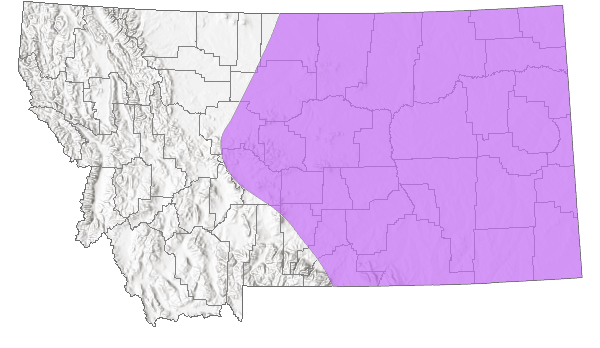
 Native
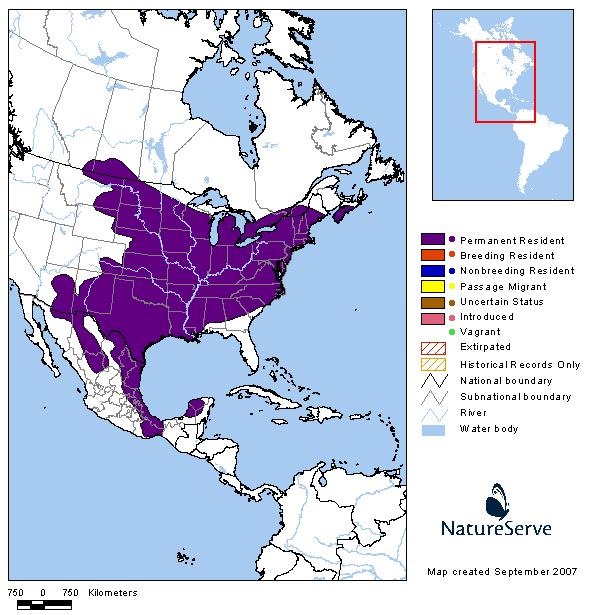
Western Hemisphere Range
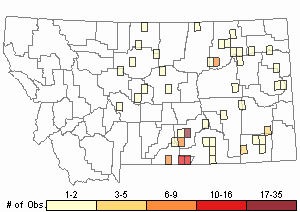
Observations in Montana Natural Heritage Program Database
Number of Observations: 136
(Click on the following maps and charts to see full sized version)
Map Help and Descriptions
Relative Density
Recency
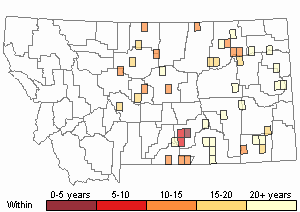
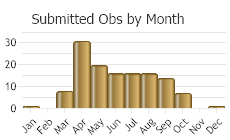
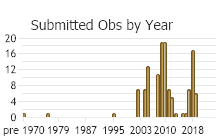
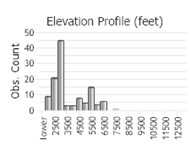 (Observations spanning multiple months or years are excluded from time charts)
Migration
Non-migratory.
Habitat
Riparian woodland, dendritic distribution, uses thickets, shrubs. Nest 7 inches in diameter of plant materials.
National Vegetation Classification System Groups Associated with this Species
Forest and Woodland
Deciduous Forest and Woodland
Low Elevation - Xeric Forest and Woodland
Montane - Subalpine Forest and Woodland
Shrubland
Arid - Saline Shrubland
Foothills - Montane Shrubland
Sagebrush Shrubland
Grassland
Lowland - Prairie Grassland
Wetland and Riparian
Alkaline - Saline Wetlands
Peatland
Riparian and Wetland Forest
Riparian Shrubland
Wet Meadow and Marsh
Recently Disturbed or Modified
Harvested Forest
Human Land Use
Agriculture
Developed
Food Habits
Somewhat omnivorous. Seeds, fruits and insects are dominant items, with order of importance varying between season and ranges.
Ecology
Semi-arboreal.
Reproductive Characteristics
Probably restricted to warmer months with peaks in March to April and September to October, in midsummer heat reporduction may slow down.
Stewardship Responsibility
References
- Literature Cited AboveLegend:
 View Online Publication
 Hall, E.R. 1981. The mammals of North America, volumes I and II. John Wiley & Sons, New York, NY. 1181 pp.
- Hoffmeister, D.F. 1986. Mammals of Arizona. Univ. Arizona Press and Arizona Game and Fish Dept. 602 pp.
- Paradiso, J.L. 1960. A new white-footed mouse (Peromyscus leucopus) from southeastern Virginia. Proceedings of the Biological Society of Washington 73:21-23.
- Additional ReferencesLegend: View Online Publication
Do you know of a citation we're missing?- Bendell, J.F. 1961. Some factors affecting the habitat selection of the white-footed mouse. Can. Field-Nat. 75(4):244-255.
- Blem, L.B., and C.R. Blem. 1975. The effect of flooding onlength of residency in the white-footed mouse, Peromyscus leucopus. Am. Midl. Nat. 94(1):232-236.
- Bramblett, R.G., and A.V. Zale. 2002. Montana Prairie Riparian Native Species Report. Montana Cooperative Fishery Research Unit, Montana State University - Bozeman.
- Cummings, J.R. and S.H. Vessey. 1994. Agricultural influences on movements of white-footed mice (Peromyscus leucopus). American Midland Naturalist 132:209-218.
- Foresman, K.R. 2001. The wild mammals of Montana. American Society of Mammalogists, Special Publication Number 12. Lawrence, KS. 278 pp.
- Foresman, K.R. 2012. Mammals of Montana. Second edition. Mountain Press Publishing, Missoula, Montana. 429 pp.
- Hanauska-Brown, L., B.A. Maxell, A. Petersen, and S. Story. 2014. Diversity Monitoring in Montana 2008-2010 Final Report. Montana Fish, Wildlife & Parks. Helena, MT. 78 pp.
- Hendricks, P., S. Lenard, D.M. Stagliano, and B.A. Maxell. 2013. Baseline nongame wildlife surveys on the Fort Peck Indian Reservation. Report to the Assiniboine and Sioux Tribes of the Fort Peck Indian Reservation. Montana Natural Heritage Program, Helena, MT. 83 p.
- Hoffmann, R.S. and D.L. Pattie. 1968. A guide to Montana mammals: identification, habitat, distribution, and abundance. Missoula, MT: University of Montana. 133 p.
- Joslin, Gayle, and Heidi B. Youmans. 1999. Effects of recreation on Rocky Mountain wildlife: a review for Montana. [Montana]: Montana Chapter of the Wildlife Society.
- Kaufman, D.W., M.E. Peak, G.A. Kaufman. 1985. Peromyscus leucopus in riparian woodlands: use of trees and shrubs. J. Mammal. 66(1)139-143.
- Kaufman, D.W., S.K. Peterson, R. Fristik and G.A. Kaufman. 1983. Effect of microhabitat features on habitat use by Peromyscus leucopus. Amer. Midl. Nat. 110(1): 177-185.
- Kaufman, G.A., D.W. Kaufman and E.J. Finck. 1988. Influence of fire and topography on habitat selection by Peromyscus maniculatus and Reithrodontomys megalotis in ungrazed tallgrass prairie. Journal of Mammalogy 69:342-352.
- Krohne, D.T. and R. Baccus. 1985. Genetic and ecological structure of a population of Peromyscus leucopus. Journal of Mammalogy. 66:529-537.
- Lackey, J.A., D.G. Huckaby, and B.G. Ormiston. 1985. Peromyscus leucopus. Mammalian Species 247:1-10.
- Matthews, W.L. 1981. Broadus-Pumpkin Creek baseline inventory - wildlife. Bureau of Land Management, Miles City, MT. 83 p.
- Montana Dept. of State Lands. U.S. Office of Surface Mining., 1985, Draft Environmental Impact Statement. Consolidation Coal Company. CX Ranch Mine, Big Horn County, Montana.
- Reichel, J.D. 1986. Habitat use by alpine mammals in the Pacific Northwest. Arctic and Alpine Research. 18(1): 111-119.
- Reid, F. 2006. Peterson Field Guide to Mammals of North America, 4th Edition. Houghton Mifflin Company: Boston and New York, 608 pp.
- Scow, K.L. 1981. Ecological distribution of small mammals at Sarpy Creek, Montana, with special consideration of the Deer Mouse, Peromyscus maniculatus. M.Sc. Thesis. Bozeman, Montana: Montana State University. 73 p.
- Sullivan, Daniel, 1982, Bait stations as a means of rodenticide presentation to control Columbian ground squirrrels. Technical Rep. 82-3. Sept. 1982.
- Williams, O. 1955. Distribution of mice and shrews in a Colorado montane forest. J. Mammal. 36(2): 221-231.
- Web Search Engines for Articles on "White-footed Deermouse"
- Additional Sources of Information Related to "Mammals"