Hayden's Shrew - Sorex haydeni
General Description
We do not yet have descriptive information on this species. Please try the buttons above to search for information from other sources.
Diagnostic Characteristics
See Carraway (1995) for a key to western North American soricids based primarily on dentaries.
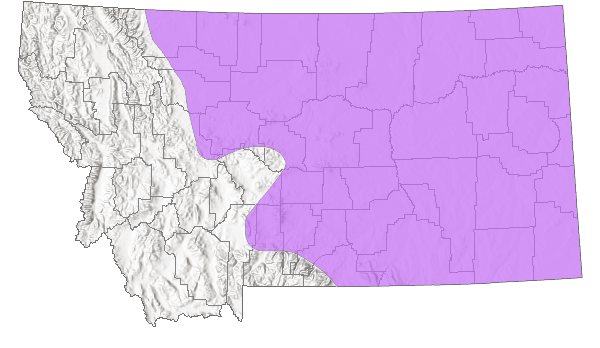
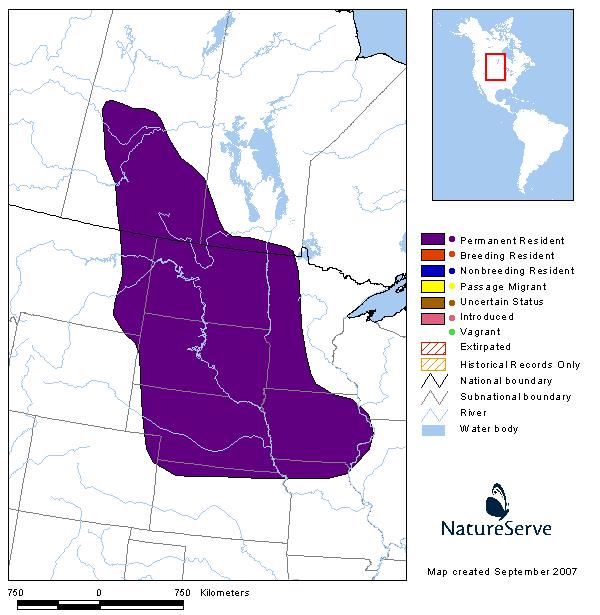
General Distribution
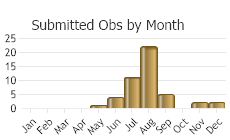
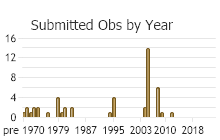
Summary of Observations Submitted for Montana
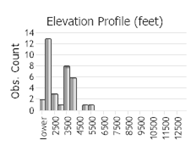
Number of Observations: 58
(Click on the following maps and charts to see full sized version)
Map Help and Descriptions
Relative Density
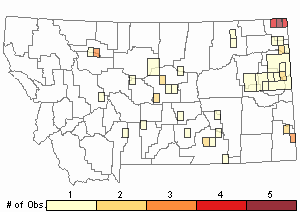
Recency
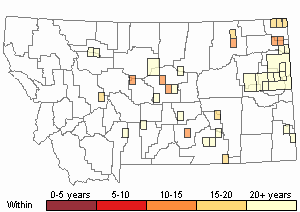
(Records associated with a range of dates are excluded from time charts)
Migration
Non-migratory.
Habitat
More partial to grassy habitats than is S. cinereus, which prefers forest and woodland. Partial to moist habitats. Young probably born in spherical nests 4 to 5 in. diameter, constructed of grass.
Ecological Systems Associated with this Species
- Details on Creation and Suggested Uses and Limitations
How Associations Were Made
We associated the use and habitat quality (high, medium, or low) of each of the 82 ecological systems mapped in Montana for
vertebrate animal species that regularly breed, overwinter, or migrate through the state by:
- Using personal observations and reviewing literature that summarize the breeding, overwintering, or migratory habitat requirements of each species (Dobkin 1992, Hart et al. 1998, Hutto and Young 1999, Maxell 2000, Foresman 2001, Adams 2003, and Werner et al. 2004);
- Evaluating structural characteristics and distribution of each ecological system relative to the species’ range and habitat requirements;
- Examining the observation records for each species in the state-wide point database associated with each ecological system;
- Calculating the percentage of observations associated with each ecological system relative to the percent of Montana covered by each ecological system to get a measure of “observations versus availability of habitat”.
Species that breed in Montana were only evaluated for breeding habitat use, species that only overwinter in Montana were only evaluated for overwintering habitat use, and species that only migrate through Montana were only evaluated for migratory habitat use.
In general, species were associated as using an ecological system if structural characteristics of used habitat documented in the literature were present in the ecological system or large numbers of point observations were associated with the ecological system.
However, species were not associated with an ecological system if there was no support in the literature for use of structural characteristics in an ecological system,
even if point observations were associated with that system.
High, medium, and low habitat quality was assigned based on the degree to which the structural characteristics of an ecological system matched the preferred structural habitat characteristics for each species in the literature.
The percentage of observations associated with each ecological system relative to the percent of Montana covered by each ecological system was also used to guide assignments of habitat quality.
If you have any questions or comments on species associations with ecological systems, please contact Bryce Maxell at
bmaxell@mt.gov or (406) 444-3655.
Suggested Uses and Limitations
Species associations with ecological systems should be used to generate potential lists of species that may occupy broader landscapes for the purposes of landscape-level planning.
These potential lists of species should not be used in place of documented occurrences of species (this information can be requested at:
http://mtnhp.org/requests/default.asp) or systematic surveys for species and evaluations of habitat at a local site level by trained biologists.
Users of this information should be aware that the land cover data used to generate species associations is based on imagery from the late 1990s and early 2000s and was only intended to be used at broader landscape scales.
Land cover mapping accuracy is particularly problematic when the systems occur as small patches or where the land cover types have been altered over the past decade.
Thus, particular caution should be used when using the associations in assessments of smaller areas (e.g., evaluations of public land survey sections).
Finally, although a species may be associated with a particular ecological system within its known geographic range, portions of that ecological system may occur outside of the species’ known geographic range.
Literature Cited
- Adams, R.A. 2003. Bats of the Rocky Mountain West; natural history, ecology, and conservation. Boulder, CO: University Press of Colorado. 289 p.
- Dobkin, D. S. 1992. Neotropical migrant land birds in the Northern Rockies and Great Plains. USDA Forest Service, Northern Region. Publication No. R1-93-34. Missoula, MT.
- Foresman, K.R. 2001. The wild mammals of Montana. Special Publication No. 12. Lawrence, KS: The American Society of Mammalogists. 278 p.
- Hart, M.M., W.A. Williams, P.C. Thornton, K.P. McLaughlin, C.M. Tobalske, B.A. Maxell, D.P. Hendricks, C.R. Peterson, and R.L. Redmond. 1998. Montana atlas of terrestrial vertebrates. Montana Cooperative Wildlife Research Unit, University of Montana, Missoula, MT. 1302 p.
- Hutto, R.L. and J.S. Young. 1999. Habitat relationships of landbirds in the Northern Region, USDA Forest Service, Rocky Mountain Research Station RMRS-GTR-32. 72 p.
- Maxell, B.A. 2000. Management of Montana’s amphibians: a review of factors that may present a risk to population viability and accounts on the identification, distribution, taxonomy, habitat use, natural history, and the status and conservation of individual species. Report to U.S. Forest Service Region 1. Missoula, MT: Wildlife Biology Program, University of Montana. 161 p.
- Werner, J.K., B.A. Maxell, P. Hendricks, and D. Flath. 2004. Amphibians and reptiles of Montana. Missoula, MT: Mountain Press Publishing Company. 262 p.
- Commonly Associated with these Ecological Systems
Forest and Woodland Systems
Grassland Systems
Open Water / Wetland and Riparian Systems
Shrubland, Steppe and Savanna Systems
Sparse and Barren Systems
Food Habits
Invertebrates and small vertebrates. Some vegetable matter. Seeds may form the bulk of the winter diet.
Ecology
May construct short tunnels and runways. Sight and smell apparently well developed but may also use ecolocation.
Reproductive Characteristics
Probably similar to S. cinereus. Individual shrews usually do not live beyond 14 months and usually produce 2, rarely 3 litters in a lifetime. Young weaned at about 20 days.
References
- Additional ReferencesLegend:
View WorldCat Record
View Online Publication
Do you know of a citation we're missing?
Foresman, K. R. 2001. The Wild Mammals of Montana. American Society of Mammologists, Special Publication No. 12: Lawrence, KS, 278 pp.
MacCracken, J. G., D. W. Uresk, and R. M. Hansen. 1985. Habitat used by shrews in southeastern Montana. Northwest Science 59(1):24-27.
Reid, F. 2006. Peterson Field Guide to Mammals of North America, 4th Edition. Houghton Mifflin Company: Boston and New York, 608 pp.
Western Technology and Engineering, Inc. (WESTECH)., 1994, Wildlife Monitoring Absaloka Mine Area Annual Report, 1994. Montana SMP 85005. OSMP Montana 0007D. Febr. 24, 1994.
- Web Search Engines for Articles on "Hayden's Shrew"
- Additional Sources of Information Related to "Mammals"