View in other NatureServe Network Field Guides
NatureServe
Montana
Utah
Wyoming
Idaho
Wisconsin
British Columbia
South Carolina
Yukon
California
New York
Western Tiger Salamander - Ambystoma mavortium
Other Names:
Tiger Salamander, Barred Tiger Salamander
Native Species
Global Rank:
G5
State Rank:
S5
(see State Rank Reason below)
Agency Status
USFWS:
USFS:
BLM:
State Rank Reason (see State Rank above)
Species is common, widely distributed, and stable.
General Description
EGGS
Laid singly or in small linear clusters of 5 to 120. Each ovum is black or brown above, light gray below, and surrounded by three jelly layers (Micken 1968). Ovum diameters are 2-3 mm (0.08-0.12 in), but total egg diameters, including the three jelly layers, are 7-9 mm (0.3-0.4 in) (Micken 1968, Tanner et al. 1971, Kaplan 1980).
LARVAE
Color is variable, but usually olive green or brown dorsally and silvery white ventrally. Three pairs of external feathery gills emanate from the sides of the head with 15-25 gill rakers on their anterior surface (Russell and Bauer 2000). They are relatively large and heavy-bodied, with a snout-vent length (SVL) of 5-98 mm (0.2-3.9 in) (Kaplan 1980, Hill 1995). Paedomorphs are pond-type larva (but lack balancers), with three large pairs of gills, vomerine teeth in U-shaped pattern, and dorsal fin extending to region of axilla; adults usually are about 15 to 22 cm (5.9-8.7 in) in total length (to about 34 cm or 3.4 in) (Stebbins 1954, 1985, Behler and King 1979, Conant and Collins 1998).
JUVENILES AND ADULTS
Color is variable, but background color is usually dark, with lighter mottling of yellow, tan, or green. Some may be uniformly dark in color (Koch and Peterson 1995). Venter is gray and 12-13 costal grooves are present. Adults are large and heavy-bodied with a SVL 70-90 mm (2.8-3.5 in), have a broad head, small eyes, and tubercles on the soles of the feet (Russell and Bauer 2000).
Diagnostic Characteristics
Long-toed Salamander (
A. macrodactylum) eggs have 2 jelly layers and have diameters greater than 10 mm (0.4 in), including the jelly layers. Larval Long-toed Salamanders have smaller heads and are translucent, light tan, or black dorsally and laterally with black and gold flecks. In addition, larval Long-toed Salamanders are white to pinkish ventrally and have 9-13 gill rakers on the anterior surface of their gills.
The Western Tiger Salamander differs from the Long-toed Salamander adults by lacking a distinct dorsal stripe or stripe like row of spots. Western Tiger Salamander differs from all other North American
Ambystoma in having tubercles on the soles of the feet. Coeur d'Alene Salamander (
Plethodon idahoensis) has a nasolabial groove whcih the Western Tiger Salamander lacks.
Species Range
Montana Range
Range Descriptions
 Native
Global Range

Estimated global breeding range area is: 3,349,328 km
2 (Approximately 9% in Montana)
See information about
 iNaturalist Geomodels
Range Comments
The systematics of the Western Tiger Salamander species complex are under debate, but most authorities recognize seven varieties which range from the Atlantic Ocean to the Great Basin and Columbia Plateau and from central Mexico to central Canada at elevations up to 3,350 (11,000 ft) (Gehlbach 1967a, Gehlbach 1967b, Shaffer and McKnight 1996, Irschick and Shaffer 1997, Petranka 1998). Although the edge of the range of the Gray Tiger Salamander, Ambystoma t. diaboli, approaches the northeastern corner of Montana, only a single subspecies, the Blotched Tiger Salamander, Ambystoma t. melanostictum, is currently known to occur in the state. In Montana they are known to range across the prairies and, in some places, into the mountains to the east of the Continental Divide. In addition, Western Tiger Salamander have recently been documented at a number of sites in the Tobacco Valley of northwestern Montana (Werner and Reichel 1996). It is not known whether this is a naturally occurring disjunct population, or whether their presence is the result of human introduction.
Maximum elevation: 2,769 m (9,085 ft), southern Gallatin County (Dave Deavours, MTNHP 2007).
Observations in Montana Natural Heritage Program Database
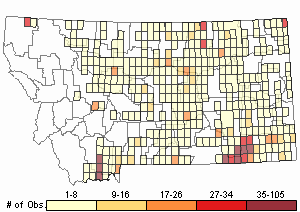
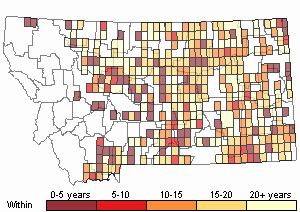
Number of Observations: 1961
(Click on the following maps and charts to see full sized version)
Relative Density
Recency

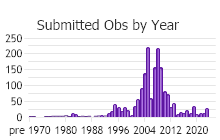
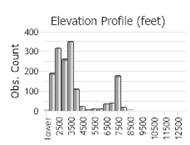 (Observations spanning multiple months or years are excluded from time charts)
Migration
Adults may migrate several hundred meters between terrestrial burrows and breeding habitats (Koch and Peterson 1995). Migrations usually occur nocturnally around the time of precipitation events when minimum daily temperatures are greater than 0 °C (32 °F) (Hill 1995).
Habitat
Adults are found in virtually any habitat, providing there is a terrestrial substrate suitable for burrowing and a body of water nearby suitable for breeding. Terrestrial adults usually remain underground, in self-made burrows or in those made by rodents or other animals (Koch and Peterson 1995, Madison and Farrand 1998). Western Tiger Salamanders in Montana are primarily associated with prairie or agricultural habitats. They breed in ponds, lakes, springs, intermittent streams, and stock ponds. Breeding sites almost always lack predatory fishes and can range from clear mountain ponds to temporary, manure-polluted pools in the lowlands (Micken 1971, USFWS 1964-1982, Baxter and Stone 1985, Hill 1995).
National Vegetation Classification System Groups Associated with this Species
Forest and Woodland
Deciduous Forest and Woodland
Low Elevation - Xeric Forest and Woodland
Montane - Subalpine Forest and Woodland
Shrubland
Arid - Saline Shrubland
Foothills - Montane Shrubland
Sagebrush Shrubland
Grassland
Lowland - Prairie Grassland
Montane - Subalpine Grassland
Sparse and Barren
Sparse and Barren
Wetland and Riparian
Alkaline - Saline Wetlands
Alpine Riparian and Wetland
Peatland
Riparian and Wetland Forest
Riparian Shrubland
Wet Meadow and Marsh
Recently Disturbed or Modified
Introduced Vegetation
Recently Burned
Human Land Use
Agriculture
Developed
Food Habits
In the water, larvae and adults feed on a variety of aquatic and terrestrial invertebrates. Some larvae and paedomorphic adults feed on other amphibian larvae including conspecifics (Dodson and Dodson 1971, Pfenning et al. 1991). In western Colorado, larvae feed on mostly arthropods. On land, adults may feed on a variety of invertebrates or even small mammals (Moore and Strickland 1955, Petranka 1998). In southern Manitoba, adult diets were found to be 87% Cammarus, 7% Coleoptera, and 8% Hirudinea.
Ecology
Late metamorphosis probably caused by temperature rather than food abundance. In some locations larval salamanders never transform, but rather become sexually mature and breed while retaining external gills (referred to as neoteny). These salamanders are often called "axolotls" or "water dogs." They are benthic in ponds but may enter upper water column at night. Paedomorphic populations tend to occur at higher elevations. They use behavioral thermoregulation where they tend to select warmest water in ponds (rarely above 25°C or 77 °F). These salamanders use the shallows during day and deep water at night (Heath 1975).
Reproductive Characteristics
Breeding takes place soon after snow melt. In Montana, breeding often occurs in May on the prairie and June to mid-August at 7780 ft (2371 m) in the southwest. Eggs are attached to submerged objects at shallower depths. Eggs hatch in approximately 15 days from June to August. Larvae may transform at the end of their first summer in August on the prairie but may remain larvae for a second or third summer at high elevations in cold waters (Micken 1968, Hill 1995). Metamorphosed adults may spend extensive periods of time feeding in ponds after breeding. Stays of up to 159 days have been documented in Montana (Hill 1995). In some instances, larvae may become sexually mature (paedogenesis) and reproduce without transforming (Micken 1968, Hill 1995).
Management
The following is taken from the Status and Conservation section for the Western Tiger Salamander account in
Maxell et al. 2009.
Western Tiger Salamanders are widely distributed and common on the prairies east of the main Rocky Mountain chain with larvae being found in most fishless ponds with adjacent soils that have not been plowed or otherwise heavily modified. However, their status in the mountains and mountain valleys east of the Continental Divide is largely uncertain. Risk factors relevant to the viability of populations of this species are likely to include grazing, non-indigenous species and their management, road and trail development and on- and off-road vehicle use, development of water impoundments, and habitat fragmentation, all as described above. Individual studies that specifically identify risk factors or other issues relevant to the conservation of Western Tiger Salamanders include the following. (1) Several studies in the western United States over the past five decades have documented the almost complete exclusion of Western Tiger Salamanders from waters were predatory fish have been introduced (Blair 1951, Carpenter 1953c, Levi and Levi 1955, USFWS 1964-1982, Collins et al. 1988, Geraghty 1992, Corn et al. 1997). Furthermore, at least two studies have documented multiple extinction and recolonization events by Western Tiger Salamanders as a result of the introduction, subsequent natural and human caused extinction, and subsequent reintroduction of trout in lakes in Yellowstone and Rocky Mountain National Parks (USFWS 1964-1982, Corn et al. 1997). Even larger larvae, or reproductively mature adults that fish are unable to prey on because of gape limitations are likely to be negatively impacted as a result of fish stocking because the diets of fish and salamanders largely overlap one another (Olenick and Gee 1981). (2) Hamilton (1941) reports that the piscicide rotenone has an LC50 value (i.e., causes 50% mortality) for metamorphosing Western Tiger Salamander larvae when 5% rotenone is applied at 0.1 mg/L for 24 hours. (3) The use of larval Western Tiger Salamanders as bait for sport fishing may have major impacts on Western Tiger Salamander populations and the entire aquatic community at both the site of collection and introduction because of their status as a top-level predator in many aquatic communities (Holomuzki and Collins 1987, Holomuzki et al. 1994). Furthermore, introduction can result in hybridization and genetic introgression with native populations, possibly leading to the elimination of distinct life histories and genetic makeups (Collins 1981, Collins et al. 1988). The bait industry’s use of salamander larvae may be quite extensive. For example, the average number and wholesale value of Western Tiger Salamander larvae in South Dakota wetlands was estimated at 35,625 and $1,614 per hectare, respectively, in 1989 (Carlson and Berry 1990) and Collins (1981) notes that in 1968 2.5 million salamander larvae were sold as bait on the lower Colorado River area alone. (4) Mass mortalities of Western Tiger Salamanders have been observed in agricultural landscapes in eastern Montana (Bryce Maxell, personal observation). Worthylake and Hovingh (1989) documented the recurring mass mortality of Western Tiger Salamanders in lakes contaminated with nitrogen from atmospheric pollution and the feces of sheep. The lakes were previously nitrogen limited and increased nitrogen levels allowed bacterial counts to increase in the summer leading to the mass mortality events. Pfenning et al. (1991) propose that contamination of waters through livestock defecation may alter life histories of Western Tiger Salamanders by limiting the number of cannibal morphs. Cannibal morphs may be more likely to spread pathogens as a result of eating infected conspecifics. Eutrophication of waters through fecal contamination may also cause planorbid snail numbers to rise, thereby increasing the number of nematode parasites and the rate of parasite infection that can subsequently lead to limb deformities (Bishop and Hamilton 1947). Finally, although they have not been linked to water quality, a number of recent mass mortality events have been caused by an iridovirus in the genus, Ranavirus (e.g., Bollinger et al. 1999). (5) Disturbance of terrestrial habitats by plowing and deep raking has been identified as a serious threat to a closely related species, the California Tiger Salamander (
Ambystoma californiense) which has recently been emergency listed as a federally endangered species (USDOI 2000). (6) Lefcort et al. (1997) found that waters contaminated with motor oil and silt resulted in decreased growth and survival rates of Western Tiger Salamander larvae as well as decreasing their ability to detect predators. (7) Kiesecker (1996) and Whiteman et al. (1995) documented reduced growth rates, survival rates, predatory success rates, in waters with lower pH (< pH 5.0). Harte and Hoffman (1989) hypothesized that acid precipitation, in the form of an acidic pulse during snow melt, had killed salamander embryos and caused a decline of a population of Western Tiger Salamanders in central Colorado from 1982 to 1987. However, this population has now apparently recovered (Wissinger and Whiteman 1992), and there is little evidence that either chronic or episodic acidification occurs in this area at levels sufficient to directly kill embryos (Corn and Vertucci 1992, Vertucci and Corn 1994, Vertucci and Corn 1996). However, lower pH levels resulting from acidification could act synergistically with pathogens or other contaminants to cause population declines as a result of reduced function of their immune systems (Carey et al. 1999).
Stewardship Responsibility
References
- Literature Cited AboveLegend:
 View Online Publication
 [USFWS] US Fish and Wildlife Service. 1964-1982. Fishery and aquatic management program in Yellowstone National Park annual project technical reports for calendar years 1964-1982. USDI Fish and Wildlife Service. Mammoth, WY.
- Baxter, G.T. and M.D. Stone. 1985. Amphibians and reptiles of Wyoming. Second edition. Wyoming Game and Fish Department. Cheyenne, WY. 137 p.
- Behler, J.L. and F.W. King. 1979. The Audubon Society field guide to North American reptiles and amphibians. Alfred E. Knpf, Inc., New York.
- Bishop, D.W. and R. Hamilton. 1947. Polydactyly and limb duplication occurring naturally in the tiger salamander (Ambystoma tigrinum). Science 106: 641-642.
- Blair, A.P. 1951. Note on the herpetology of the Elk Mountains, Colorado. Copeia 1951: 239-240.
- Bollinger, T.K., J. Mao, D. Schock, R.M. Brigham, and V.G. Chinchar. 1999. Pathology, isolation, and preliminary molecular characterization of a novel iridovirus from tiger salamanders in Saskatchewan. Journal of Wildlife Diseases 35(3): 413-429.
- Carey, C., N. Cohen, and L. Rollins-Smith. 1999a. Amphibian declines: an immunological perspective. Developmental and Comparative Immunology 23: 459-472.
- Carlson, B.N. and C.R. Berry, Jr. 1990. Population size and economic value of aquatic bait species in palustrine wetlands of eastern South Dakota (USA). Prairie Naturalist 22(2): 119-128.
- Carpenter, C.C. 1953c. An ecological survey of the herpetofauna of the Grand Teton-Jackson Hole area of Wyoming. Copeia 1953: 170-174.
- Collins, J.P. 1981. Distribution, habitats and life history variation in the tiger salamander (Ambystoma tigrinum) in east-central and southeast Arizona. Copeia 1981(3): 666-675.
- Collins, J.P., T.R. Jones, and H.J. Berna. 1988. Conserving genetically distinctive populations: the case of the Huachuca tiger salamander (Ambystoma tigrinum stebbinsi Lowe). In: Management of amphibians, reptiles, and small mammals in North America,
- Conant, R. and J.T. Collins 1998. A field guide to reptiles and amphibians of eastern and central North America. Third edition, expanded. Houghton Mifflin Company. Boston, MA. 616 p.
- Corn, P.S. and F.A. Vertucci. 1992. Descriptive risk assessment of the effects of acid deposition on Rocky Mountain Amphibians. Journal of Herpetology 26(4): 361-369.
- Corn, P.S., M.L. Jennings, and E. Muths. 1997. Survey and assessment of amphibian populations in Rocky Mountain National Park. Northwest. Nat. 78:34-55.
- Dodson, S.I. and V.E. Dodson. 1971. The diet of Ambystoma tigrinum larvae from western Colorado. Copeia 1971(4): 614-624.
- Gehlbach, F.R. 1967a. Ambystoma tigrinum. Catalogue of American Amphibians and Reptiles. 52.1-52.4.
- Gehlbach, F.R. 1967b. Evolution of tiger salamanders (Ambystoma tigrinum) on the Grand Canyon rims, Arizonia. Yearbook of the American Philosophy Society 266-269.
- Geraghty, C.B. 1992. Current habitat status and anthropogenic impacts on the tiger salamander. University of Illinois-Masters Thesis. 67pp.
- Hamilton, H.L. 1941. The biological action of rotenone on freshwater animals. Proceedings of the Iowa Academy of Science 48:467-479.
- Harte, J. and E. Hoffman. 1989. Possible effects of acidic deposition on a Rocky Mountain population of the tiger salamander (Ambystoma tigrinum). Conservation Biology 3(2): 149-158.
- Heath, A.G. 1975. Behavioral thermoregulation in high altitude tiger salamanders, Ambystoma tigrinum. Herpetologica 31(1): 84-93.
- Hill, S.R. 1995. Migratory chronology of adult tiger salamanders (Ambystoma tigrinum) and survey of larvae of the tiger salamander in the northern range of Yellowstone National Park. Masters thesis, Montana State University. Bozeman, MT. 72 pp.
- Holomuzki, J.R. and J.P. Collins. 1987. Trophic dynamics of a top predator, Ambystoma tigrinum nebulosum (Caudata: Ambystomatidae), in a lentic community. Copeia 1987(4): 949-957.
- Holomuzki, J.R., J.P. Collins and P.E. Brunkow. 1994. Trophic control of fishless ponds by tiger salamander larvae. Oikos 71(1): 55-64.
- Irschick, D.J. and H.B. Shaffer. 1997. The polytypic species revisited: morphological differentiation among tiger salamanders (Ambystoma tigrinum) (Amphibia: Caudata). Herpetologica 53(1): 30-49.
- Kaplan, R.H. 1980. The implications of ovum size variability for offspring fitness and clutch size within several populations of salamanders (Ambystoma). Evolution 34(1): 51-64.
- Kiesecker, J. 1996. pH mediated predator-prey interactions between Ambystoma tigrinum and Pseudacris triseriata. Ecological Applications 6(4): 1325-1331.
- Koch, E.D. and C.R. Peterson. 1995. Amphibians and reptiles of Yellowstone and Grand Teton national parks. University of Utah Press, Salt Lake City, UT. 188 p.
- Lefcort, H., K. Hancock, K. Maur, and D. Rostal. 1997. The effects of used motor oil and silt on the growth, survival, and the ability to detect predators by tiger salamanders, Ambystoma tigrinum. Archives of Environmental Contaminants and Toxicology 32: 383-388.
- Levi, H.W. and L.R. Levi. 1955. Neotenic salamanders, Ambystoma tigrinum, in the Elk Mountains of Colorado. Copeia 1955(4): 309.
- Madison, D.M., and L. Farrand, III. 1998. Habitat use during breeding and emigration in radio-implanted tiger salamanders (Ambystoma tigrinum). Copeia 1998: 402-410.
- Maxell, B.A., P. Hendricks, M.T. Gates, and S. Lenard. 2009. Montana amphibian and reptile status assessment, literature review, and conservation plan, June 2009. Montana Natural Heritage Program. Helena, MT. 643 p.
- Micken, L. 1968. Some summer observations on the tiger salamander (Ambystoma tigrinum) in Blue Lake, Madison County, Montana. Proceedings of the Montana Academy of Sciences, Billings, Montana volume 28: 77-80.
- Micken, L. 1971. Additional notes on neotenic Ambystoma tigrinum melanostictum in Blue Lake, Madison County, Montana. Proceedings of the Montana Academy of Sciences 31: 62-64.
- Moore, J.E. and E.H. Strickland. 1955. Further notes on the food of Alberta amphibians. American Midland Naturalist 52: 221-224.
- Olenick, R.J., J.H. Gee. 1981. Tiger Salamanders (Ambystoma tigrinum) and stocked rainbow trout (Salmo gairdneri): potential competitors for food in Manitoba prairie pothole lakes. Canadian Field Naturalist 95(2): 129-132.
- Petranka, J.W. 1998. Salamanders of the United States and Canada. Smithsonian Institution Press, Washington D.C. 587 pp.
- Pfenning, D.W., M.L.G. Loeb, and J.P. Collins. 1991. Pathogens as a factor limiting the spread of cannibalism in tiger salamanders. Oecologia 88: 161-166.
- Russell, A. P. and A. M. Bauer. 2000. The Amphibians and Reptiles of Alberta: A field guide and primer of boreal herpetology. University of Calgary Press, Toronto, Ontario. 279 p.
- Shaffer, H.B. and M.L. McKnight. 1996. The polytypic species revisited: genetic differentiation and molecular phylogenetics of the tiger salamander, Ambystoma tigrinum (Amphibia: Caudata) complex. Evolution 50(1): 417-433.
- Stebbins, R.C. 1954. Amphibians and reptiles of western North America. McGraw-Hill, New York. Xxii + 528 pp.
- Stebbins, R.C. 1985. A field guide to western reptiles and amphibians. Houghton Mifflin Company, Boston. 336 pp.
- Tanner, W.W., D.L. Fisher, and T.J. Willis. 1971. Notes on the life history of Ambystoma tigrinum nebulosum Hallowell in Utah. Great Basin Naturalist 31(4): 213-222.
- U.S. Department of the Interior [USDOI]. 2000. Legislation and Conservation: Ambystoma californiense. Herpetological Review 31(2): 68.
- Vertucci, F.A. and P.S. Corn. 1994. A reply to Harte and Hoffman, acidification and salamander recruitment. BioScience 44: 126.
- Vertucci, F.A. and P.S. Corn. 1996. Evaluation of episodic acidification and amphibian declines in the Rocky Mountains. Ecological Applications 6(2): 449-457.
- Werner, J.K. and J.D. Reichel. 1996. Amphibian and reptile monitoring/survey of the Kootenai National Forest: 1995. Montana Natural Heritage Program. Helena, MT. 115 pp.
- Whiteman, H.H., R.D. Howard, and K.A. Whitten. 1995. Effects of pH on embryo tolerance and adult behavior in the tiger salamander (Ambystoma tigrinum tigrinum). Canadian Journal of Zoology: 73: 1529-1537.
- Wissinger, S.A. and H.H. Whiteman. 1992. Fluctuation in a Rocky Mountain population of salamanders: anthropogenic acidification or natural variation? Journal of Herpetology 26(4):377-391
- Worthylake, K. M., and P. Hovingh. 1989. Mass mortality of salamanders (Ambystoma tigrinum) by bacteria (Acinetobacter) in an oligotrophic seepage mountain lake. Great Basin Naturalist 49(3): 364-372.
- Additional ReferencesLegend: View Online Publication
Do you know of a citation we're missing?- [DCC] Decker Coal Company. 1998. 1997 Consolidated annual progress report. Decker Coal Company West, North and East Pits. Decker, MT.
- [EI] Econ Incorporated. 1984. Terrestrial wildlife inventory for the Lame Jones and Ismay coal lease tracts. Econ Incorporated. Helena, MT.
- [OEA] Olson Elliot and Associates Research. 1985. 1983-1984 Wildlife monitoring report for the CX Ranch project. Olson Elliot and Associates Research. Helena, MT.
- [PRESI] Powder River Eagle Studies Incorporated. 1998a. Big Sky Mine 1997 wildlife monitoring studies. Powder River Eagle Studies Incorporated. Gillete, WY.
- [PRESI] Powder River Eagle Studies Incorporated. 1998b. Spring Creek Mine 1997 wildlife monitoring studies. Powder River Eagle Studies Incorporated. Gillete, WY.
- [VTNWI] VTN Wyoming Incorporated. No Date. Second year's analysis of terrestrial wildlife on proposed mine access and railroad routes in southern Montana and northern Wyoming, March 1979 - February 1980. VTN Wyoming Incorporated. Sheridan, WY. 62 p.
- [WESCO] Western Ecological Services Company. 1983a. Wildlife inventory of the Knowlton known recoverable coal resource area, Montana. Western Ecological Services Company, Novato, CA. 107 p.
- [WESCO] Western Ecological Services Company. 1983b. Wildlife inventory of the Southwest Circle known recoverable coal resource area, Montana. Western Ecological Services Company, Novato, CA. 131 p.
- [WESTECH] Western Technology and Engineering Incorporated. 1998. Wildlife Monitoring Absaloka Mine Area 1997. Western Technology and Engineering, Inc., Helena, Mt.
- Allison, L.J., P.E. Brunkow, and J.P. Collins. 1994. Opportunistic breeding after summer rains by Arizona tiger salamanders. Great Basin Naturalist 54(4): 376-379
- Anderson, F.B., D.D. Hassinger, and G.H. Dalrymple. 1971. Natural mortality of eggs and larvae of Ambystoma t. tigrinum. Ecology 52: 741-758.
- Anderson, J.D. 1968b. A comparison of the food habits of Ambystoma macrodactylum sigillatum, Ambystoma macrodactylum croceum and Ambystoma tigrinum californiense. Herpetologica 24(4): 273-284.
- Anderson, J.D. 1970. Description of the spermatophore of Ambystoma tigrinum. Herpetologica 26(3): 304-308.
- Anderson, J.D., D.D. Hassinger, and G.H. Dalrymple. 1971. Natural mortality of eggs and larvae of Ambystoma t. tigrinum. Ecology 52(6): 1107-1112.
- Annis, S.L., F.P. Dastoor, H. Ziel, P. Daszak, and J.E. Longcore. 2004. A DNA-based assay identifies Batrachochytrium dendrobatidis in amphibians. Journal of Wildlife Diseases 40(3):420-428.
- Arndt, R.G. 1989. Notes on the natural history and status of the tiger salamander (Ambystoma tigrinum) in Delaware. Bulletin of the Maryland Herpetological Society 25: 1-21.
- Arnold, S.J. 1976. Sexual behavior, sexual interference, and sexual defense in the salamanders Ambystoma maculatum, Ambystoma tigrinum, and Plethodon jordani. Zeitschrift fur Tierpsychologie 42:247-300.
- Artz, A.H., W.L. Silver, J.R. Mason and L. Clark. 1986. Olfactory responses of aquatic and terrestrial tiger salamanders (Ambystoma tigrinum) to airborne and waterborne stimuli. Journal of Comparative Physiology A Sensory Neural and Behavioral Physiolo
- Atkinson, E.C. and M.L. Atkinson. 2004. Amphibian and reptile survey of the Ashland and Sioux of the Custer National Forest with special emphasis on the Three-Mile Stewardship Area:2002. Marmot's Edge Conservation. 22 p.
- Baird S.F 1860. Siredon lichenoides? Baird. In: Cooper JG. Report upon the reptiles collected on the survey. Volume 12, Book 2, Part 3, No. 4. 36th Congress, 1st session, House Executive Document No. 56. Serial 1055. p 306.
- Ball, J.C. 2000. A winter/spring study of salamanders in a disturbed, fragmented habitat surrounded by farm land. Journal of the Iowa Academy of Science 107(3-4):175-181.
- Bauman, J.S. 1950. Migration of salamanders. Yellowstone Nature Notes 24(1): 4-5.
- Beal, M.D. 1951. The occurrence and seasonal activity of vertebrates in the Norris and Gibbon Geyser Basins of Yellowstone National Park. M.S. Thesis. Utah State Agricultural College. Logan, Utah. 61 pp.
- Benoy, G.A., T.D. Nudds, and E. Dunlop. 2002. Patterns of habitat and invertebrate diet overlap between tiger salamanders and ducks in prairie potholes. Hydrobiologia 481:47-59.
- Bergeron, D. 1978. Terrestrial Wildlife Survey Coal creek Mine Area, Montana. Unpublished report for Coal Creek Mining Co., Ashland, Montana.
- Berna, H.J. 1990. Ecology and life history of the tiger salamander (Ambystoma tigrinum nebulosum Hallowell) on the Kaibab Plateau. Unpublished MS thesis, Arizonia State University, Tempe, AZ, pp 1-121.
- Biedermann, B.P. 1988. Life history notes. Ambystoma tigrinum (tiger salamander). Migration. Herpetological Review 19(2): 33-34.
- Bishop, S.C. 1942. An older name for a recently described salamander. Copeia 1942(4): 256.
- Bizer, J.R. 1977. Life history phenomena of Ambystoma tigrinum in montane Colorado. Ph.D. dissertation, Washington University. 211 pp.
- Bizer, J.R. 1978. Growth rates and size at metamorphosis of high elevation populations of Ambystoma tigrinum. Oecologia 34: 175-184.
- Black, J.H., and A.N. Bragg. 1968. New additions to the herpetofauna of Montana. Herpetologica 24: 247.
- Bolek, M.G. 2000. Ambystoma tigrinum (Tiger Salamander) Coccidia. Herpetological Review 31(2): 97.
- Botts, D.A. 1978. Life history and movement of Ambystoma tigrinium and associated vertebrates around a semi-permanent pond. M.S. Thesis, Auburn University, Auburn, Alabama. 105pp,
- Bramblett, R.G., and A.V. Zale. 2002. Montana Prairie Riparian Native Species Report. Montana Cooperative Fishery Research Unit, Montana State University - Bozeman.
- Brandon, R.A., and D.J. Bremer. 1967. Overwintering of larval tiger salamanders in southern Illinois. Herpetologica 23: 67-68.
- Brodman, R. 2004. Intraguild predation on congeners affects size, aggression, and survival among Ambystoma salamander larvae. Journal of Herpetology 38(1):21-26.
- Brophy, T.E. 1980. Food habits of sympatric larval Ambystoma tigrinum and Notophthalmus viridescens. Journal of Herpetology 14: 1-6.
- Brukow, P.E. and J.P. Collins. 1996. Effects of individual variation in size on growth and development of larval salamanders. Ecology 77(5): 1483-1492.
- Brunson, R.B. 1955. Check list of the amphibians and reptiles of Montana. Proceedings of the Montana Academy of Sciences 15: 27-29.
- Buhlmann, K.A. and R.L. Hoffman. 1990. Ambystoma tigrinum tigrinum. Herpetological Review 21: 36.
- Bureau of Indian Affairs, Department of the Interior. 1981. Draft Environmental Impact Statement. Unpublished report for the Crow/Shell Coal Lease, Crow Indian Reservation, Montana.
- Burton, S.R., D.A. Patla, and C.R. Peterson. 2002. Amphibians of Red Rock Lakes National Wildlife Refuge: occurrence, distribution, relative abundance, and habitat associations. Herpetology Laboratory, Department of Biological Sciences, Idaho State University, Pocatello, ID. 66 p.
- Butts, T.W. 1997. Mountain Inc. wildlife monitoring Bull Mountains Mine No. 1, 1996. Western Technology and Engineering. Helena, MT.
- Calef, R.T. 1954. The salamander Ambystoma tigrinum nebulosum in southern Arizonia. Copeia. 1954: 223.
- Carpenter, C.C. 1955. Aposematic behavior in the salamander Ambystoma tigrinum melanostictum. Copeia 1955: 311.
- Church, S.A., J.M. Kraus, J.C. Mitchell, D.R. Church, and D.R. Taylor. 2003. Evidence for multiple Pleistocene refugia in the postglacial expansion of the eastern tiger salamander (Ambystoma tigrinum tigrinum). Evolution 57(2): 372-383.
- Clevenger, A.P., M. Mclvor, D. McIvor, B. Chruszcz, and K. Gunson. 2001. Tiger salamander, Ambystoma tigrinum, movements and mortality on the Trans-Canada Highway in southwestern Alberta. The Canadian Field-Naturalist 115: 199-204.
- Collins, J.P. 1988. Evolutionary relationships of Ambystoma tigrinum stebbinsi to other southwestern A. tigrinum based on mitochondrial DNA. Final Report, Nongame Branch, Arizona Game and Fish Department: 28p.
- Collins, J.P. and J.E. Cheek. 1983. Effect of food and density on development of typical and cannibalistic salamender larvae in Ambystoma tigrinum nebulosum. American Zoologist 23: 77-84
- Collins, J.P. and J.R. Holomuzki. 1984. Intraspecific variation in diet within and between trophic morphs in larval tiger salamanders (Ambystoma tigrinum nebulosum). Canadian Journal of Zoology 62: 168-174.
- Collins, J.P., J.B. Mitton, and B.A. Pierce. 1980. Ambystoma tigrinum: a multispecies conglomerate? Copeia 1980(4): 938-941
- Collins, J.P., K.E. Zerba, and M.J. Sredl. 1993. Shaping intraspecific variation: development, ecology and the evolution of morphology and life history variation in tiger salamanders. Genetica 89: 167-183.
- Conant, R. and J.T. Collins. 1991. A field guide to reptiles and amphibians of eastern and central North America. Third edition. Houghton Mifflin Company. Boston, MA. 450 pp.
- Cook, F.R. 1960. New localities for the plains spadefoot toad, tiger salamander, and the great plains toad in the Canadian prairies. Copeia 1960 (4): 363-364.
- Cooper, J.G. 1860. Report upon the reptiles collected on the survey. In: Reports of explorations and surveys to ascertain the most practicable and economical route for a railroad from the Mississippi River to the Pacific Ocean. Volume 12, Book 2, Part 3, Number 4. pp. 292-306, +14 pls. 36th Congress, 1st session, House Executive Document Number 56. Serial 1055.
- Cooper, S.V., C. Jean, and P. Hendricks. 2001. Biological survey of a prairie landscape in Montana's glaciated plains. Report to the Bureau of Land Management. Montana Natural Heritage Program, Helena, MT. 24 pp. plus appendices.
- Cope, E. D. 1879. A contribution to the zoology of Montana. American Naturalist 13(7): 432-441.
- Cope, E.D. 1867. A review of the species of the Amblystomidae. Proceedings of the Academy of Natural Sciences of Philadelphia 19: 166-211.
- Cope, E.D. 1875. Check-list of North American Batrachia and Reptilia; with a systematic list of the higher groups, and an essay on geographical distribution. Based on the specimens contained in the U.S. National Museum. U.S. Natioanl Museum Bulletin 1: 1-104.
- Corn, P.S., B.R. Hossack, E. Muths, D.A. Palta, C.R. Peterson, and A.L. Gallant. 2005. Status of amphibians on the Continental Divide: aurveys on a transect from Montana to Colorado, USA. Alytes 22(3-4):85-94.
- Coues, E. and H. Yarrow. 1878. Notes on the herpetology of Dakota and Montana. Bulletin of the U.S. Geological Geographic Survey of the Territories 4: 259-291.
- Craig, V. 1963. The axolotl "walking fish". Montana Wildlife 1963(Autumn): 3-4. Montana Fish and Game Department, Helena, MT.
- Craighead, A.C. 2000. Pellet and scat analysis as indicators of present and past habitats. M.Sc. Theses. Bozeman, MT: Montana State University. 219 p.
- Crother, B.I. (ed.) 2008. Scientific and standard English names of amphibians and reptiles of North America north of Mexico. SSAR Herpetological Circular No. 37:1-84.
- Dalrymple, G.H. 1970. Caddis fly larvae feeding upon eggs of Ambystoma t. tigrinum. Herpetologica 26: 128-129.
- Darda, D. 1982. Osteology and ontogeny of cannibalistic larvae in Ambystoma tigrinum. Abstract. 25th Annual ASIH Meeting. August 1-6. Raleigh, North Carolina. 117p.
- Davidson, E.W., M. Parris, J.P. Collins, J.E. Longcore, A.P. Pessier, and J. Brunner. 2003. Pathogenicity and transmission of chytridiomycosis in Tiger Salamanders (Ambystoma tigrinum). Copeia 3: 601-607.
- Day, D. 1989. Montco Terrestrial Wildlife Monitoring Report. Unpublished report for Montco, Billings, Montana.
- Day, D., P.J. Farmer, and C.E. Farmer. 1989. Montco terrestrial wildlife monitoring report December, 1987 - July, 1989. Montco, Billings, MT, and Western Technology and Engineering, Inc. Helena, MT.
- DeLacey, W.W. 1876. A trip up the South Snake River in 1863. Contributions to the Historical Society of Montana 1: 130-132.
- Deutschman, M.R. and J.J. Peterka. 1988. Secondary production of tiger salamanders (Ambystoma tigrinum) in three North Dakota (USA) prairie lakes. Canadian Journal of Fisheries and Aquatic Sciences 45(4): 691-697.
- Dineen, C.F. 1955. Food habits of the larval tiger salamander (Ambystoma tigrinum). Proceedings of the Indiana Acacdemy of Sciences 65: 231-233.
- Dood, A.R. 1980. Terry Badlands nongame survey and inventory final report. Montana Department of Fish, Wildlife, and Parks and Bureau of Land Management, Helena, MT. 70 pp.
- Duellman, W.E. 1954. Observations on autumn movements of the salamander Ambystoma tigrinum tigrinum in southeastern Michigan. Copeia 1954(2): 156-157.
- Dunn, E.R. 1940. The races of Ambystoma tigrinum. Copeia 1940(3): 154-162.
- Dupre, R.K. and S.C. Wood. 1988. Behavioral temperature regulation by aquatic ectotherms during hypoxia. Canadian Journal of Zoology 66(12): 2649-2652.
- Duvall, D. and D.O. Norris. 1978. Stimulation of land-drive behavior in adult salamanders (Ambystoma tigrinum) by thyroxine (T4). American Zoologist 18: 589.
- Duvall, D. and D.O. Norris. 1980. Stimulation of terrestrial-substrate preferences and locomotor activity in newly transformed tiger salamanders (Ambystoma tigrinum) by exogenous and endogenous thyroxine. Animal Behavior 28: 116-123.
- Econ, Inc. (Ecological Consulting Service), Helena, MT., 1977, 1977 wildlife and wildlife habitat monitoring study, Peabody Coal Company Big Sky Mine. Proj. 161-85-A. November 30, 1977.
- Econ, Inc. 1988. Wildlife monitoring report, 1987 field season, Big Sky Mine. March 1988. In Peabody Mining and Reclamation Plan Big Sky Mine Area B. Vol. 8, cont., Tab 10 - Wildlife Resources. Appendix 10-1, 1987 Annual Wildlife Report.
- Farmer, P. 1980. Terrestrial wildlife monitoring study, Pearl area, Montana June, 1978 - May, 1980. Western Technology and Engineering, Inc. Helena, MT.
- Farmer, P. J. 1980. Terrestrial Wildlife Monitoring Study, Pearl Area, Montana, June, 1978 - May, 1980. Tech. Rep. by WESTECH for Shell Oil Co.
- Feigley, H. P. 1997. Colonial nesting bird survey on the Bureau of Land Management Lewistown District: 1996. Unpublished report, U.S. Bureau of Land Management, Lewistown, Montana.
- Ferguson, D.E. 1961. The geographic variation of Ambystoma macrodactylum Baird, with the description of two new subspecies. American Midland Naturalist 65: 311-338.
- Fernandez, P.J., Jr., and J.P. Collins. 1988. Effect of environment and ontogeny on color pattern variation in Arizona tiger salamanders (Ambystoma tigrinum nebulosom Hallowell). Copeia 1988(4): 928-938.
- Fjell, Alan K., 1986, Peabody Coal Company Big Sky Mine, Rosebud County, MT. Wildlife monitoring report: 1985 field season. March 1986.
- Fjell, Alan K., and Brian R. Mahan., 1987, Big Sky Mine, Rosebud County, MT. Wildlife monitoring report: 1986 field season. April 1987.
- Fontenot, L.W., G.P. Noblet and S.G. Platt. 1994. Rotenone hazards to amphibians and reptiles. Herpetological Review 25(4):150-156.
- Garber, C.S. 1995a. A survey for U.S. Forest Service listed "Sensitive" amphibians including the spotted frog (Rana pretiosa), leopard frog (Rana pipiens), tiger salamander (Ambystoma tigrinum) and the boreal toad (Bufo boreas) on the north half of the
- Garber, C.S. 1995b. Addendum Number 1 to "A status survey for spotted frogs (Rana pretiosa) wood frogs (Rana sylvatica) and boreal toads (Bufo boreas) in the mountains of southern and eastern Wyoming. Unpublished report prepared by the Wyoming Natural
- Gates, M.T. 2005. Amphibian and reptile baseline survey: CX field study area Bighorn County, Montana. Report to Billings and Miles City Field Offices of Bureau of Land Management. Maxim Technologies, Billings, MT. 28pp + Appendices.
- Gehlbach, F.R. 1966. Types and type-localities of some taxa in the synonymy of Ambystoma tigrinum (Green). Copeia 1966(4): 881-882.
- Gehlbach, F.R. 1969. Determination of tiger salamander larval populations to different stages of pond succession at the Grand Canyon, Arizonia. Yearbook of the American Philosophy Society 1969: 299-302.
- Glass, B.P. 1951. Age at maturity of neotenic Ambystoma tigrinum mavortium Baird. American Midland Naturalist 46: 391-394.
- Gray, M.J. and L.M. Smith. 2005. Influence of land use on postmetamorphic body size of playa lake amphibians. Journal of Wildlife Management 69(2):515-524.
- Gruberg, E.R. and R.V. Stirling. 1972. Observations on the burrowing habits of the tiger salamander (Ambystoma tigrinum). Herpetological Review 4: 85-87.
- Hamilton, R. 1948. The egg-laying process in the tiger salamander. Copeia 1948(3): 212-213.
- Hamilton, W.J. Jr. 1946. Summer habitat of the yellow-barred tiger salamander. Copeia 1946: 51.
- Hammerson, G.A. 1999. Amphibians and reptiles in Colorado. University Press of Colorado & Colorado Division of Wildlife. Denver, CO. 484 p.
- Hamning, V.K., H.L. Yanites, and N.L. Peterson. 2000. Characterization of adhesive and neurotoxic components in skin granular gland secretions of Ambystoma tigrinum. Copeia 3:856-859.
- Hampton, P.M. 2006. Ambystoma t. tigrinum (eastern tiger salamander) paedomorphic population. Herptological Review 37(1):68-69.
- Hanauska-Brown, L., B.A. Maxell, A. Petersen, and S. Story. 2014. Diversity Monitoring in Montana 2008-2010 Final Report. Montana Fish, Wildlife & Parks. Helena, MT. 78 pp.
- Harte, J. and E. Hoffman. 1994. Acidification and salamander recruitment. BioScience 44(3): 125-126.
- Hassinger, D.D., J.D. Anderson, and G.H. Dalrymple. 1970. The early life history and ecology of Ambystoma tigrinum and Ambystoma opacum in New Jersey. American Midland Naturalist 84: 474-495.
- Heath, A.G. 1976. Respiratory responses to hypoxia by Ambystoma tigrinum larvae, paedomorphs, and metamorphosed adults. Comparative Biochemistry and Physiology 55: 45-49.
- Hendricks, P. 1999a. Amphibian and reptile survey of the Bureau of Land Management Miles City District, Montana. Montana Natural Heritage Program, Helena, MT. 80 p.
- Hendricks, P. and J.D. Reichel. 1996b. Preliminary amphibian and reptile survey of the Ashland District, Custer National Forest: 1995. Montana Natural Heritage Program, Helena, MT. 79 p.
- Hendricks, P. and J.D. Reichel. 1998. Amphibian and reptile survey on Montana refuges: 1996. Montana Natural Heritage Program, Helena, MT. 19 p.
- Hendricks, P. and M. Roedel. 2001. A faunal survey of the Centennial Valley Sandhills, Beaverhead County, Montana. Report to the U.S. Bureau of Land Management and U.S. Fish and Wildlife Service. Montana Natural Heritage Program, Helena, MT. 44 p.
- Hendricks, P., S. Lenard, D.M. Stagliano, and B.A. Maxell. 2013. Baseline nongame wildlife surveys on the Fort Peck Indian Reservation. Report to the Assiniboine and Sioux Tribes of the Fort Peck Indian Reservation. Montana Natural Heritage Program, Helena, MT. 83 p.
- Hensley, M. 1964. The tiger salamander in northern Michigan. Herpetologica 20: 203-204.
- Hill, S.R. and R.E. Moore. 1994. Herpetological survey in the northern range of Yellowstone National Park. Annual Report, Yellowstone National Park. February 1, 1994. 21 pp.
- Hill, S.R., Jr. and R.E. Moore. 1994a. Herpetological survey in the northern range of Yellowstone National Park. Investigator's Annual Reports Yellowstone National Park 1993. Yellowstone Center for Resources. pp. 96-97.
- Holomuzki, J.R. 1986a. Effect of microhabitat use on fitness components of larvae of tiger salamanders, Ambystoma tigrinum tigrinum. Oecologia 71: 142-148.
- Holomuzki, J.R. 1986b. Intraspecific predation and habitat use by tiger salamanders (Ambystoma tigrinum nebulosum). Journal of Herpetology 20(3): 439-441.
- Holomuzki, J.R. 1986c. Predator avoidance and diel patterns of microhabitat use by larval tiger salamanders. Ecology 67(3): 737-748.
- Holomuzki, J.R. 1989. Salamander predation and vertical distributions of zooplankton. Freshwater Biology 21(3) 461-472.
- Hossack, B. and P.S. Corn. 2001. Amphibian survey of Medicine Lake National Wildlife Refuge Complex: 2001. USGS Northern Rocky Mountain Science Center, Aldo Leopold Wilderness Research Institute, Missoula, MT. 13 p.
- Hossack,B.R., W.R. Gould, D.A. Patla, E. Muths, R. Daley, K. Legg, and P.S. Corn. 2015. Trends in Rocky Mountain amphibians and the role of beaver as a keystone species. Biological Conservation 187:260-269.
- Hovingh, P. 1986. Biogeographic aspects of leeches, mollusks, and amphibians in the intermountain region. Great Basin Naturalist 46: 736-744.
- Humphris, Michael., 1993, Wildlife Monitoring Report. Spring Creek Coal Company 1993 Mining Annual Report. Appendix I. April 11, 1993.
- Humphris, Michael., 1994, Wildlife Monitoring Report. Spring Creek Coal Company 1994 Mining Annual Report. Appendix I. April 1994.
- Jancovich, J.K., Davidson, E.W., Morado, J.F., Jacobs, B.L. and Collins, J.P. 1997. Isolation of a lethal virus from the endangered tiger salamander Ambystoma tigrinum stebbinsi. Diseases of Aquatic Organisms 31: 161-167.
- Jancovich, J.K., E.W. Davidson, A. Seiler, B.L. Jacobs, and J.P. Collins. Transmission of the Ambystoma tigrinum virus to alternative hosts. Diseases of Aquatic Organisms 46(3):159-163.
- Jancovich, J.K., J. Mao, V. G. Chinchar, C. Wyatt, S.T. Case, S. Kumar, G. Valente, S. Subramanian, E.W. Davidson, J.P. Collins, and B.L. Jacobs. 2003. Genomic sequence of a ranavirus (family Iridoviridae) associated with salamander mortalities in North America. Virology 316: 90-103.
- Jean, C., P. Hendricks, M. Jones, S. Cooper, and J. Carlson. 2002. Ecological communities on the Red Rock Lakes National Wildlife Refuge: inventory and review of aspen and wetland systems. Report to Red Rock Lakes National Wildlife Refuge.
- Jensen, J.B. 2003. Ambystoma tigrinum (Tiger Salamander). Predation. Herpetological Review 34(2):132-33.
- Johnson, E.B., P. Bierzychudek, H.H. Whiteman. 2003. Potential of prey size and type to affect foraging asymmetries in tiger salamander (Ambystoma tigrnum nebulosum) larvae. Canadian Journal of Zoology 81(10):1726-1735.
- Jones, Lawrence L. C., W. P. Leonard and D. H. Olson, eds. 2005. Amphibians of the Pacific Northwest. Seattle Audubon Society: Seattle, WA, 227 pp.
- Jones, T.R. 1988. Macrogeographic and microgeographic patterns of evolutionary differentiation in tiger salamanders (Ambystoma tigrinum) in the southwestern U.S.A., Ph.D. Dissertation, Arizonia State University, Tempe, AZ.
- Jones, T.R. and J.P. Collins. 1992. Analysis of a hybrid zone between subspecies of the tiger salamander (Ambystoma tigrinum) in central New Mexico, USA. Journal of Evolutionary Biology 5: 375-402.
- Jones, T.R., E.J. Routman, D.J. Begun, and J.P. Collins. 1995. Ancestry of an isolated subspecies of salamander, Ambystoma tigrinum stebbensi Lowe: The evolutionary significance of hybridization. Molecular Physiological Evolution 4: 194-202.
- Jones, T.R., J.P. Collins, T.D. Kocher, and J.B. Mitton. 1988. Systematic status and distribution of Ambystoma tigrinum stebbinsi Lowe (Amphibia: Caudata). Copeia 1988: 621-635.
- Joslin, Gayle, and Heidi B. Youmans. 1999. Effects of recreation on Rocky Mountain wildlife: a review for Montana. [Montana]: Montana Chapter of the Wildlife Society.
- Kapfer, J.M. and S.N. Jones. 2002. A method for rearing and keeping the eastern tiger salamander, Ambystoma tigrinum tigrinum. Bulletin of the Chicago Herpetological Society 37(2):25-28.
- Kenney, J.W., and F.L. Rose. 1974. Oxygen requirements and activity rhythms of the tiger salamander, Ambystoma tigrinum (Amphibia: Caudata). Herpetologica 30: 333-337.
- Knopf, G.N. 1962. Paedogenesis and metamorphic variation in Ambystoma tigrinum mavortium. Southwest Naturalist 7: 75.
- Knutson, M.G., W.B. Richarson, D.M. Reineke, B.R. Gray, J.R. Parmelee, and S.E. Weick. 2004. Agricultural ponds support amphibian populations. Ecological Applications 14(3):669-684.
- Koch, E.D. and C.R. Peterson. 1989. A preliminary survey of the distribution of amphibians and reptiles in Yellowstone National Park. pp. 47-49. In: Rare, sensitive and threatened species of the Greater Yellowstone Ecosystem, T.W. Clark, A.H. Harvey, R.D. Dorn, D.C. Genter, and C. Groves (eds.), Northern Rockies Conservation Cooperative , Montana Natural Heritage Program, The Nature Conservancy, and Mountain West Environmental Services. 153 p.
- Kocher, T.D. 1986. Genetic differentiation during speciation in the Rana pipiens and Ambystoma tigrinum species complexes. Ph.D. Dissertation, University of Colorado, Boulder, Colorado.
- Kolbe, J.J., B.E. Smith, and D.M. Browning. 2002. Burrow use by Tiger Salamanders (Ambystoma tigrinum) at a Black-tailed Prairie Dog (Cynomys ludovicianus) town in southwestern South Dakota. Herpetological Review 33(2):95-99.
- Kumpf, K.F. 1934. The courtship of Ambystoma tigrinium. Copeia 1934(1): 7-10.
- Lambing, J. H., D. A. Nimick, J. R. Knapton, and D. U. Palawski. 1994. Physical, chemical, and biological data for detailed study of the Sun River Irrigation Project, Freezout Lake Wildlife Management Area, and Benton Lake National Wildlife Refuge, west-central Montana, 1990-92, with selected data for 1987-89. Open-File Report 94-120, U.S. Geological Survey, Helena, Montana.
- Land & Water Consulting, Inc., Missoula, MT., 2002, Montana Dept. of Transportation Wetland Mitigation Monitoring Report, Year 2002: [Jack] Johnson - Valier, Montana. Proj. No. 130091.018. May 2003. In 2002 Wetland Mitigation Monitoring Reports, Vol. II.
- Lannoo, M.J. 1982. Food habits and feeding behavior of tiger salamander larvae (Ambystoma tigrinum) in northwestern Iowa. M.S. Thesis, Iowa State University, Ames, Iowa. 87p.
- Lannoo, M.J. and M.D. Bachmann. 1984a. Aspects of cannibalistic morphs in a population of Ambystoma tigrinum tigrinum larvae. American Midland Naturalist 112(1): 103-109.
- Lannoo, M.J. and M.D. Bachmann. 1984b. On flotation and air breathing in Ambystoma tigrinum larvae: stimuli for and the relationship between these behaviors. Canadian Journal of Zoology 62: 15-18.
- Lannoo, M.J., L. Lowcock, and J.P. Bogart. 1989. Sibling cannibalism in noncannibal morph Ambystoma tigrinum larvae and its correlation with high growth rates and early metamorphosis. Canadian Journal of Zoology 67(8) 1989: 1911-1914.
- Lannoo, M.J., M.P. Sweet, N.M. Ladehoff, E.S. Fangman, and W.B. Collins. 1990. Time to metamorphosis as a function of larval size in a population of Ambystoma tigrinum salamanders consisting of cannibal and typical morph phenotypes. Journal of the Iowa
- Larson, D.W. 1968. The occurenece of neotenic salamanders, Amystoma tigrinum diaboli Dunn in Devil's Lake, North Dakota. Copeia, 1968: 620-621.
- Leff, L.G. and M.D. Bachmann. 1986. Ontogenetic changes in predatory behavior of larval tiger salamanders (Ambystoma tigrinum). Canadian Journal of Zoology 64: 1337-1344.
- Leff, L.G. and M.D. Bachmann. 1988. Basis of selective predation by the aquatic larvae of the salamander, Ambystoma tigrinum. Freshwater Biology 19(1): 87-94.
- Leonard, W.P. and D.M. Darda. 1995. Ambystoma tigrinum (tiger salamander). Reproduction. Herptological Review 26(1): 29-30.
- Lindberg, A.J. 1995. Ambystoma tigrinum tigrinum. (Eastern tiger salamander). Reproduction and twinning. Herpetological Review 26(3): 142.
- Lindquist, S.B. and M.D. Bachmann. 1982. The role of visual and olfactory cues in the prey catching behavior of the tiger salamander, Ambystoma tigrinum. Copeia 1982(1): 81-90.
- Loeb, M.L.G., J.P. Collins and T.J. Maret. 1994. The role of prey in controlling expression of a trophic polymorphism in Ambystoma tigrinum nebulosum. Functional Ecology 8(2): 151-158.
- Lomolino, M.V. and G.A. Smith. 2004. Terrestrial vertebrate communities at black-tailed prairie dog (Cynomys ludovicianus) towns. Biological Conservation 115(1):89-100.
- Long, C.A. 1964. The badger as a natural enemy of Ambystoma tigrinum and Bufo boreas. Herpetologica 20(2): 144.
- Loredo, I., D.V. Vuren, and M.L. Morrison. 1996. Habitat use and migration behavior of the California tiger salamander. Journal of Herpetology 30: 282-285.
- Manville, R.H. 1957. Amphibians and reptiles of Glacier National Park, Montana. Copeia 1957: 308-309.
- Marnell, L. E. 1997. Herpetofauna of Glacier National Park. Northwestern Naturalist 78:17-33.
- Martin, P.R. 1980a. Terrestrial wildlife habitat inventory in southeastern Montana. Montana Department of Fish, Wildlife and Parks and Bureau of Land Management, Helena MT. 114 p.
- Matthews, W.L. 1979. Wibaux-Beach wildlife baseline study - nongame species. Bureau of Land Management, Miles City, MT. 93 p.
- Matthews, W.L. 1981. Broadus-Pumpkin Creek baseline inventory - wildlife. Bureau of Land Management, Miles City, MT. 83 p.
- Maxell, B. A. 2000. Management of Montana's amphibians: a review of factors that may present a risk to population viability and accounts on the identification, distribution, taxonomy, habitat use, natural history, and the status and conservation of individual species. Report to USFS Region 1, Order Number 43-0343-0-0224. University of Montana, Wildlife Biology Program. Missoula, MT. 161 p.
- Maxell, B.A., J.K. Werner, P. Hendricks, and D.L. Flath. 2003. Herpetology in Montana: a history, status summary, checklists, dichotomous keys, accounts for native, potentially native, and exotic species, and indexed bibliography. Society for Northwestern Vertebrate Biology, Northwest Fauna Number 5. Olympia, WA. 135 p.
- McEneaney, T. and J. Jensen. 1974. The reptiles and amphibians of the Charles M. Russell National Wildlife Range - 1974. Charles M. Russell National Wildlife Refuge. Lewistown, MT. 3 p.
- Miller, B.T. and J.H. Larson. 1986. Feeding habits of metamorphosed Ambtstoma tigrinum melanostictum in ponds of high pH (>9). Great Basin Naturalist 46(2): 299-301.
- Mundinger, J.G. 1975. The influence of rest-rotation grazing management on waterfowl production on stock-water reservoirs in Phillips County, Montana. M.Sc. Thesis. Bozeman, MT: Montana State University. 100 p.
- Muths, E., D.H. Campbell, and P.S. Corn. 2003. Hatching success in salamanders and chorus frogs at two sites in Colordao, USA: effects of acidic deposition and climate. Amphibia-Reptilia 24(1):27-36.
- Nicholas, J.S. 1922. The reactions of Amblystoma tigrnum to olfactory stimuli. Journal of Experimental Zoology 35: 257-281.
- Nicholas, J.S. 1925. A balancer in larvae of Ambystoma tigrinum. American Naturalist 59: 191-192.
- Nicholson, K.E. ed. 2025. Scientific and standard English names of amphibians and reptiles of North America north of Mexico, with comments regarding confidence in our understanding. Ninth Edition. Society for the Study of Amphibians and Reptiles. 87 p.
- Norris, D.O. 1973. Some aspects of reproduction in a population of neotenic tiger salamander, Ambystoma tigrinum. Journal of the Colorado-Wyoming Academy Science 7:39.
- Norris, D.O. 1989. Seasonal changes in diet of paedogenetic tiger salamanders (Ambystoma tigrinum mavortium). Journal of Herpetology 23: 87-89.
- Norris, D.O., R.E. Jones, and B.B. Criley. 1973. Pituitary prolactin levels in larval, neotenic and metamorphosed salamanders (Ambystoma tigrinum). General and Comparative Endocrinol., 20: 437-442.
- OEA Research. 1985. Wildlife Inventory:Monitoring Report for the CX Ranch Project. 1983-1984. Unpublished report for Consolidation Coal Company, Pittsburgh, Pennsylvania.
- Oechsli, L.M. 2000. Ex-urban development in the Rocky Mountain West: consequences for native vegetation, wildlife diversity, and land-use planning in Big Sky, Montana. M.Sc. Thesis. Montana State University, Bozeman. 73 p.
- Padgett-Flohr, G.E. and J.E. Longcore. 2005. Abystoma californiense (California Tiger Salamander). Fungal infection. Herpetological Review 36(1):50-51.
- Pague, C.A. and K.A. Buhlmann. 1991. Eastern tiger salamander. Pp. 431-433 In K. Terwilliger, coor. Virginia's endangered species. McDonald and Woodward, Blacksburg, VA.
- Parris, M.J., A. Storfer, J.P. Collins, and E.W. Davidson. 2005. Life-history responses to pathogens in tiger salamander (Ambystoma tigrinum) larvae. Journal of Herpetology 39(3):366-372.
- Patla, D.A. 1998a. Amphibians and reptiles in the Old Faithful sewage treatment area. Report to Yellowstone Center for Resources, Yellowstone National Park. 10 September, 1998. Greater Yellowstone Ecosystem Amphibian Survey and Monitoring Program, Herpetology Laboratory, Department of Biological Sciences, Idaho State University, Pocatello, ID. 7 p.
- Patla, D.A. 1998b. Potential effects of native fish restoration projects on amphibians in Yellowstone National Park Part I. Report to National Park Service, Yellowstone National Park. 20 November 1998. 26 pp.
- Patla, D.A. 1999a. Amphibians and reptiles along the grand loop road in Yellowstone National Park: Canyon Junction to Fishing Bridge Junction. December 11, 1999. Greater Yellowstone Ecosystem Amphibian Survey and Monitoring Program, Herpetology Laboratory, Department of Biological Sciences, Idaho State University, Pocatello, ID. 24 p.
- Patla, D.A. 1999b. Amphibians and reptiles of the Madison to Norris road improvement project area, Yellowstone National Park. 11 November, 1999. Greater Yellowstone Ecosystem Amphibian Survey and Monitoring Program, Herpetology Laboratory, Department of Biological Sciences, Idaho State University, Pocatello, ID. 17 p.
- Patla, D.A. 1999c. Amphibians and reptiles, Tower Junction to Canyon Village, Yellowstone National Park; addendum to previous report. 24 November, 1999. Greater Yellowstone Ecosystem Amphibian Survey and Monitoring Program, Herpetology Laboratory, Department of Biological Sciences, Idaho State University, Pocatello, ID. 10 p.
- Patla, D.A. 2000. Amphibians in potential native fish restoration areas, Yellowstone National Park Part II. 7 March, 2000. Greater Yellowstone Ecosystem Amphibian Survey and Monitoring Program, Herpetology Laboratory, Department of Biological Sciences, Idaho State University, Pocatello, ID. 22 p.
- Patla, D.A. and C.R. Peterson. 1996a. Amphibians and reptiles along the Grand Loop Highway in Yellowstone National Park: Tower Junction to Canyon Village. 24 February, 1996. Greater Yellowstone Ecosystem Amphibian Survey and Monitoring Program, Herpetology Laboratory, Department of Biological Sciences, Idaho State University, Pocatello, ID. 49 p.
- Patla, D.A. and C.R. Peterson. 1997. Amphibians and reptiles along the Grand Loop Highway in Yellowstone National Park: Mammoth Hot Springs to Norris Junction. 1 February, 1997. Greater Yellowstone Ecosystem Amphibian Survey and Monitoring Program, Herpetology Laboratory, Department of Biological Sciences, Idaho State University, Pocatello, ID. 60 p.
- Patla, D.A. and C.R. Peterson. 1998. Amphibians of the Greater Yellowstone Ecosystem. Natural Resource Conservation Cooperative News 11(Autumn 1998): 10-11.
- Patla, D.A. and C.R. Peterson. 1999. Are amphibians declining in Yellowstone National Park? Yellowstone Science 1999 (Winter):2-11.
- Patla, D.A. and C.R. Peterson. 2001. Status and trends of amphibian populations in the Greater Yellowstone Ecosystem, progress report, February 2001. Greater Yellowstone Ecosystem Amphibian Survey and Monitoring Program, Herpetology Laboratory, Department of Biological Sciences, Idaho State University, Pocatello, ID. 8 p.
- Pedersen, S.C. 1991. Dental morphology of the cannibal morph in the tiger salamander (Ambystoma tigrinum). Amphibia-Reptilia 12: 1-14.
- Pedersen, S.C. 1993. Skull growth in cannibalistic tiger salamanders, Ambystoma tigrinum. Southwestern Naturalist 38:316-324.
- Peterson, C.R. and J.P. Shive. 2002. Herpetological survey of southcentral Idaho. Idaho Bureau of Land Management Technical Bulletin 02-3:1-97.
- Peterson, C.R., C.J. Askey, and D.A. Patla. 1993. Amphibians and reptiles along the Grand Loop and Fountain Freight Roads between Madison Junction and Biscuit Basin in Yellowstone National Park. 26 July, 1993. Greater Yellowstone Ecosystem Amphibian Survey and Monitoring Program, Herpetology Laboratory, Department of Biological Sciences, Idaho State University, Pocatello, ID. 45 p.
- Peterson, C.R., D.A. Patla, and S.R. Sullivan. 1995. Amphibians and reptiles along the Grand Loop Highway in Yellowstone National Park: Madison Junction to Norris Campground. 7 July, 1995. Greater Yellowstone Ecosystem Amphibian Survey and Monitoring Program, Herpetology Laboratory, Department of Biological Sciences, Idaho State University, Pocatello, ID. 64 p.
- Peterson, C.R., E.D. Koch and P.S. Corn. 1992. Monitoring amphibian populations in Yellowstone and Grand Teton National Parks final report to University of Wyoming. National Park Service Research Center, Laramie, WY. 37 p.
- Petranka, J.W., A. Sih, L.B. Kats, and J.R. Holomuzki. 1987. Stream drift, size-specific predation, and the evolution of ovum size in an amphibian. Oecologia 71(4): 624-630.
- Pfenning, D.W. and J.P. Collins. 1993. Kinship affects morphogenesis in cannibalistic salamanders. Nature 362: 836-838.
- Pfenning, D.W., J.P. Collins, and R.E. Ziemba. 1999. A test of alternative hypotheses for kin recognition in canninbalistic tiger salamanders. Behavior Ecology 10: 436-443.
- Pfenning, D.W., P.W. Sherman and J.P. Collins. 1994. Kin recognition and cannibalism in polyphenic salamanders. Behavioral Ecology 5(2): 225-232.
- Pierce, B.A., J.B. Mitton, and F.L. Rose. 1981. Allozyme variation among large, small and cannibal morphs of the tiger salamander inhabiting the Llano Estacado of west Texas. Copeia 1981: 590-595.
- Pierce, B.A., J.B. Mitton, L. Jackson, and F.L. Rose. 1983. Head shape and size in cannibal and noncannibal larvae of the tiger salamander from west Texas. Copeia 1983: 1006-1012.
- Pierson, M.A. 1950. Mysterious Mr. Salamander. Yellowstone Nature Notes 24(2): 23-24.
- Powder River Eagle Studies, Inc., Gillette, WY., 2000, Spring Creek Mine 1999 Wildlife Monitoring. March 2000.
- Powder River Eagle Studies, Inc., Gillette, WY., 2002, Spring Creek Mine 2001 Wildlife Monitoring. March 2002
- Powers, J.H. 1903. The causes of acceleration and retardation in the metamorphis of Amblystoma tigrinium: a preliminary report. American Naturalist 34: 551-562.
- Powers, J.H. 1907. Morphological variation and is causes in Amblystoma tigrinum. Studies of Zoology Laboratory of University of Nebraska, 7: 197-273, pls. 1-9.
- Prosser, D.T. 1911. Habits of Amblystoma tigrinum at Tolland Colorado. University of Colorado Studies 8: 257-263.
- Rauscher, R.L. 2000. Tiger salamander axolotls in southwest Montana, final report. Bozeman, MT: Montana Department of Fish, Wildlife and Parks. 28p.
- Reese, R.W. 1969. The taxonomy and ecology of the tiger salamander (Ambystoma tigrinum) of Colorado. Ph.D. dissertation, University of Colorado, Boulder. 154 pp.
- Reichel, J. and D. Flath. 1995. Identification of Montana's amphibians and reptiles. Montana Outdoors 26(3):15-34.
- Reichel, J. D. In prep. Amphibian and reptile survey of USFWS lands in north-central Montana: 1996. Unpublished report.
- Reichel, J.D. 1995b. Preliminary amphibian and reptile survey of the Sioux District of the Custer National Forest: 1994. Montana Natural Heritage Program, Helena, MT. 75 p.
- Reichel, J.D. 1997. Amphibian and reptile survey in northcentral Montana on the Lewistown District, BLM. Unpublished report.
- Reichel, J.D. 1997a. Amphibian, reptile and northern bog lemming survey on the Rocky Mountain Front: 1996. Montana Natural Heritage Program, Helena, MT. 81 p.
- Reilly, S.M., G.V. Lauder, and J.P. Collins. 1992. Performance consequences of a trophic polymorphism: feeding behavior in typical and cannibal phenotypes of Ambystoma tigrinium. Copeia 1992: 672-679.
- Rodgers, L.T. and P.L. Risley. 1938. Sexual difference of urogenital ducts of Ambystoma tigrinum. Journal of Morphology 63: 119-141.
- Roedel, M.D. and P. Hendricks. 1998a. Amphibian and reptile survey on the Bureau of Land Management Lewistown District: 1995-1998. Montana Natural Heritage Program, Helena, MT. 53 p.
- Roedel, M.D. and P. Hendricks. 1998b. Amphibian and reptile inventory on the Headwaters and Dillon Resource Areas in conjunction with Red Rocks Lakes National Wildlife Refuge: 1996-1998. Montana Natural Heritage Program, Helena, MT. 46 p.
- Rogers, K.L. 1985. Facultative metamorphosis in a series of high altitude fossil populations of Ambystoma tigrinum (Irvington: Alamosa County, Colorado). Copeia 1985: 926-932.
- Rojas, S., K. Richards, J.K. Jancovich, and E.W. Davidson. 2005. Influence of temperature on Ranavirus infection in larval salamanders Ambystoma tigrinum. Diseases of Aquatic Organisms 63(2-3):95-100.
- Rose, F.L. 1976. Sex ratios of larval and transformed Ambystoma tigrinum Green inhabiting the Llano Estacado of west Texas. Copeia 1976: 455-461.
- Rose, F.L. and J.C. Harshbarger. 1977. Neoplastic and possibly related skin lesions in neotenic tiger salamanders from a sewage lagoon. Science 196: 315-317.
- Rose, F.L., and D. Armentrout. 1976. Adaptive strategies of Ambystoma tigrinum Green inhabiting the Llano Estacado of west Texas. Journal of Animal Ecology 45:713-729.
- Rossman, D.A. 1965. Rediscovery of the tiger salamander (Ambystoma tigrinium) in Louisana. Proceedings of Louisiana Academy of Science 27: 17-20.
- Routman, E. 1993. Population structure and genetic diversity of metamorphic and paedomorphic populations of the tiger salamander, Ambystoma tigrinum. Journal of Evolutionary Biology 6: 329-357.
- Routman, E.J. 1984. Paedomorphosis and population structure in the salamanders Cryptobranchus alleganiensis and Ambystoma tigrinum. Ph.D. Diss. Washington University. St. Louis, MO.
- Russell, A. P. and A. M. Bauer. 1993. The amphibians and reptiles of Alberta. University of Calgary Press. Calgary, Alberta. 264 p.
- Salthe, S.N. and J.S. Mecham. 1974. Reproductive and courtship patterns. Pp. 310-473 in B. Lafts, ed., Physiology of the Amphibia, vol.II. Academic Press, New York.
- Semlitsch, R.D. 1983b. Structure and dynamics of two breeding populations of the eastern tiger salamander (Ambystoma tigrinum). Copeia 1983(3): 608-616.
- Semlitsch, R.D. 1983c. Terrestrial movements of an eastern tiger salamander, Ambystoma tigrinum. Herpetological Review 14: 112-113.
- Semlitsch, R.D. 1987. Density dependant growth and fecundity in the paedomorphic salamander Ambystoma tigrinum. Ecology 68: 1003-1008.
- Sestrich, Clint. 2006. 2006 Hebgen Reservoir Amphibian Survey, USDA Forest Service Annual Progress Report to PPL Montana. Hebgen Lake Ranger District. Gallatin National Forest. West Yellowstone Montana.
- Sever, D.M. 1995. Spermathecae of Ambystoma tigrinum (Amphibia: Caudata): development and a role for the secretions. Journal of Herpetology 29(2): 243-255.
- Sever, D.M. and C.F. Dineen. 1978. Reproductive ecology of the tiger salamander (Ambystoma tigrinum) in northern Indiana. Proceedings of the Indiana Academy of Science 87:189-203.
- Sexton, O.J. and J.R. Bizer. 1978. Life history patterns of Ambystoma tigrinum in montane Colorado. American Midland Naturalist 99(1): 101-118.
- Sheen, J.P. and H.H. Whiteman. 1998. Head and body size relationships in polymorphic tiger salamander larvae from Colorado. Copeia 1998: 1089-1093.
- Shoop, R.C. 1974. Yearly variation in larval survival of Ambystoma tigrinum. Ecology 55: 440-444.
- Skinner, M.P. 1924. The Yellowstone Nature Book. A.C. McClurg Company, Chicago, IL. 221 p.
- Slater, J.R. 1934. Ambystoma tigrinium in the state of Washington. Copeia 1934: 189-190.
- Slater, J.R. 1937. Notes on the tiger salamander (Ambystoma tigrinum) in Washington and Idaho. Herpetologica 1: 81-83.
- Spear, S.F., C.R. Peterson, M.D. Matocq, and A. Storfer. 2005. Landscape genetics of tiger salamanders in Yellowstone Naitonal Park. Abstract. Northwestern Naturalist 86:116.
- Spring Creek Coal Company., 1992, Wildlife Monitoring Report. Spring Creek Coal Company 1992 Mining Annual Report. Appendix I.
- Sredl, M.J. and J.P. Collins. 1992. The interaction of predation, competition, and habitat complexity in structuring an amphibian community. Copeia 1992(3): 607-614.
- Stark, M.A. 1986b. Overwintering of an ambystomid salamander in a prairie rattlesnake hibernaculum. Herpetological Review 17(1): 7.
- Stebbins, R. C. 2003. A field guide to western reptiles and amphibians. 3rd Edition. Houghton Mifflin Company, Boston and New York. 533 p.
- Stine, C. Jr., J.A. Fowler, and R.S. Simmons. 1954. Occurrence of the eastern tiger salamander (Ambystoma tigrinium tigrinum) (Green) in Maryland, with notes on its life history. Ann. Carnegie Museum 33: 145-148 pls. 17-20.
- Stine, C.J. 1984. The life history and status of the eastern tigher salamander (Ambystoma tigrinum tigrinum Green) in Maryland. Bulletin of Maryland Herpetology Society 20: 65-108.
- Storfer, A. and C. White. 2004. Phenotypically plastic responses of larval Tiger Salamanders, Ambystoma tigrinum, to different predators. Journal of Herpetology 38(4):612-615.
- Sullivan, S.R. and C.R. Peterson. 1996. Amphibians and reptiles along the highway in Yellowstone National Park: Tower Junction to the Northeast Entrance. 25 February, 1996. Greater Yellowstone Ecosystem Amphibian Survey and Monitoring Program, Herpetology Laboratory, Department of Biological Sciences, Idaho State University, Pocatello, ID. 60 p.
- Taylor, D.H. 1972. Extra-optic photoreception and compass orientation in the larval and adult salamanders (Ambystoma tigrinum). Animal Behavior 20(2): 233-236.
- Taylor, D.H. and K. Adler. 1978. The pineal body: site of extraocular perception of celestial cues for orientation in the tiger salamander (Ambystoma tigrinum). Journal of Comparative Physiology 124: 357-361.
- Templeton, A.R., E. Routman, and C.A. Phillips. 1995. Separating population structure from history: a cladistic analysis of the geographical distribution of mitochondrial DNA haplotypes in the tiger salamander, Ambystoma tigrinum. Genetics 140: 767-782
- Test, F.C. 1893. Annotated list of reptiles and batrachians collected. In B.W. Evermann. A reconnaisance of the streams and lakes of western Montana and northwestern Wyoming. Bulletin of United States Fish Commission 11(1891): 57-59.
- Thompson, L.S. 1981. Circle West wildlife monitoring study: Third annual report. Technical report No. 8. Montana Department of Natural Resources and Conservation. Helena, Montana.
- Thompson, L.S. 1982. Circle West Wildlife Monitoring Study. Fourth annual report. Technical report 10. Montana Department of Natural Resources and Conservation, Helena, Montana.
- Tihen, J.A. 1969. Ambystoma. Catalogue of American Amphibians and Reptiles 75.1-75.4.
- Timken, R. No Date. Amphibians and reptiles of the Beaverhead National Forest. Western Montana College, Dillon, MT. 16 p.
- Trenham, P.C. 2001. Terrestrial habitat use by adult California tiger salamanders. Journal of Herpetology 35(2): 343-346.
- Trenham, P.C., H.B. Shaffer and M.R. Stromberg. 2000. Life History and Demographic Variation in the California Tiger Salamander (Ambystoma californiense). Copeia 2000: 365-377.
- Turner, F.B. 1951. A checklist of the reptiles and amphibians of Yellowstone National Park with incidental notes. Yellowstone Nature Notes 25(3): 25-29.
- Turner, F.B. 1952b. Duel in the sun. Yellowstone Nature Notes 26(5): 59-60.
- Turner, F.B. 1953a. New localities for the northwestern tiger salamander (Ambystoma tigrinum melanostictum) in Yellowstone Park. Yellowstone Nature Notes 27(5): 58-59.
- Turner, F.B. 1955. Reptiles and amphibians of Yellowstone National Park. Yellowstone Interpretive Series No. 5. Yellowstone Library and Museum Association. Yellowstone National Park, WY. 40 p.
- Turner, F.B. 1957. The ecology and morphology of Rana pretiosa pretiosa in Yellowstone Park, Wyoming. Ph.D. dissertation, University of California. Berkeley, CA. 252 pp.
- Twitty, V.C. 1941. Data on the life history of Ambystoma tigrinum californiense. Copeia 1941(1): 1-4.
- Van Kirk, R., L. Benjamin, and D. Patla. 2000. Riparian area assessment and amphibian status in the watersheds of the Greater Yellowstone Ecosystem. Greater Yellowstone Coalition, Bozeman, MT. 102 p.
- Vega, R., A. Ortega, A. Almanza, and E. Soto. 2006. Nitric oxide in the amphibian (Ambystoma tigrinum) lateral line. Neuroscience Letters 393;65-69.
- Vitt, L.J., J.P. Caldwell, and D.B. Shepard. 2005. Inventory of amphibians and reptiles in the Billings Field Office Region, Montana. Sam Noble Oklahoma Museum of Natural History and Department of Zoology, University of Oklahoma, Norman, OK. 33 pp.
- Waage, B.C. 1998. Western Energy Company Rosebud Mine 1997 annual wildlife monitoring report December 1, 1996 to November 30, 1997 survey period. Western Energy Company, Colstrip, MT.
- Waage, Bruce C., 1996, Western Energy Company Rosebud Mine, Colstrip, Montana: 1995 Annual Wildlife Monitoring Report; December 1, 1994 - November 30, 1995. February 28, 1996.
- Waage, Bruce C., 1998, Western Energy Company Rosebud Mine, Colstrip, Montana: 1997 Annual Wildlife Monitoring Report; December 1, 1996 - November 30, 1997 Survey Period. March 23, 1998.
- Waage, Bruce C., 1999, Western Energy Company Rosebud Mine, Colstrip, Montana: 1998 Annual Wildlife Monitoring Report; December 1, 1997 - November 30, 1998 Survey Period. February 24, 1999.
- Waage, Bruce C., 2000, Western Energy Company Rosebud Mine, Colstrip, Montana: 1999 Annual Wildlife Monitoring Report; December 1, 1998 - November 30, 1999. February 2000.
- Waage, Bruce C., 2001, Western Energy Company Rosebud Mine, Colstrip, Montana: 2000 Annual Wildlife Monitoring Report; December 1, 1999 - November 30, 2000. March 30, 2001.
- Walls, S.C. and A.R. Blaustein. 1994. Does kinship influence density dependence in a larval salamander? Oikos 71(3):459-468.
- Webb, R.G. 1969. Survival adaptations of tiger salamanders (Ambystoma tigrinum) in the Chihuahuan Desert. In: Physiological systems in semiard environments. C. Clayton Hoff and Marvin L. Riedull (eds.). University of New Mexico Pr., Albuquerque.
- Webb, R.G. and W.L. Roueche. 1971. Life history aspects of the tiger salamander (Ambystoma tigrinum mavortium) in the Chihuahuan desert. Great Basin Naturalist 31(4): 193-212.
- Werner, J.K., B.A. Maxell, P. Hendricks and D.L. Flath. 2004. Amphibians and Reptiles of Montana. Mountain Press Publishing Company: Missoula, MT. 262 pp.
- Werner, J.K., T. Plummer, and J. Weaslehead. 1998a. Amphibians and reptiles of the Flathead Indian Reservation. Intermountain Journal of Sciences 4(1-2): 33-49.
- Western Technology & Engineering, Inc. (WESTECH)., 1991, 1991 Bull Mountains Mine No. 1 Terrestrial Wildlife Monitoring Study. In Meridian Minerals Company Bull Mountains Mine No. 1 Permit Application, Musselshell County, Montana. Vol. 7 of 14: Section 26
- Western Technology and Engineering, Inc. (WESTECH). 1994. Wildlife Monitoring Absaloka Mine Area Annual Report, 1993. Montana SMP 85005. OSMP Montana 0007c. Mar. 12, 1994.
- Western Technology and Engineering, Inc. (WESTECH)., 1994, Wildlife Monitoring Absaloka Mine Area Annual Report, 1994. Montana SMP 85005. OSMP Montana 0007D. Febr. 24, 1994.
- Western Technology and Engineering, Inc. (WESTECH)., 1996, Wildlife Monitoring Absaloka Mine Area Annual Report, 1995. Montana SMP 85005. OSMP Montana 0007D. Febr. 23, 1996.
- Western Technology and Engineering, Inc. (WESTECH)., 1999, Wildlife Monitoring Absaloka Mine Area Annual Report, 1998. SMP 85005. OSMP Montana 0007E. April 1999.
- Western Technology and Engineering, Inc. (WESTECH)., 2000, Wildlife Monitoring Absaloka Mine Area Annual Report, 1999. Montana SMP 85005. OSMP Montana 0007E. February 2000.
- Western Technology and Engineering, Inc. (WESTECH)., 2001, Wildlife Monitoring Absaloka Mine Area Annual Report, 2000. Montana SMP 85005. OSMP Montana 0007E. February 2001.
- Wheeler, G.C. and J. Wheeler. 1966. The amphibians and reptiles of North Dakota. University of North Dakota, Grand Forks, ND. 104 pp.
- Whiteman, H.H. and S.A. Wissinger. 1990. Ecological correlates of paedomorphosis in high elevation populations of Ambystoma tigrinum nebulosum. American Zoologist 30: A86.
- Whiteman, H.H., J.P. Sheen, E.B. Johnson, A. VanDeusen, R. Cargille, and T.W. Sacco. 2003. Heterospecific prey and trophic polyphenism in larval tiger salamanders. Copeia. 2003(1):56-67.
- Whiteman, H.H., S.A. Wissinger and A.J. Bohonak. 1994. Seasonal movement patterns in a subalpine population of the tiger salamander, Ambystoma tigrinum nebulosum. Canadian Journal of Zoology 72(10): 1780-1787.
- Whiteman, H.H., S.A. Wissinger and W.S. Brown. 1996. Growth and foraging consequences of facultative paedomorphosis in the tiger salamander, Ambystoma tigrinum nebulosum. Evolutionary Ecology 10(4): 433-446.
- Whitford, W.G. and M. Massey. 1970. Responses of a population of Ambystoma tigrinum to thermal and oxygen greadients. Herpetologica 26: 372-376.
- Willey, R.L., B. Inouye, and S. Horn. 1989. Survey of reproducing populations containing neotenic morphs of the salamander Ambystoma tigrinum nebulosm, in the Gunnison Basin of Colorado. Colorado Division of Wildlife, Biological Report.
- Woodward, B. 1985. Ambystoma tigrinum (Ambystomidae) predation on Scaphiopus couchi (Pelobatidae) tadpoles of different sizes. Southwestern Naturalist 30(3): 460-461.
- Yarrow, H.C. 1882. Check list of North American reptilia and batrachia, with catalogue of specimens in the U.S. National Museum. United States National Museum Bulletin 24. 249 p.
- Zackheim, K. 1973. Exhibit H: Wildlife Study. In Ash Grove Cement Co. files.
- Zerba, K.E. 1989. Individual variation in diet of larval tiger salamanders (Ambystoma tigrinium nebulosum) in Arizona. Ph.D. Thesis, Arizonia State University.
- Zerba, K.E. and J.P. Collins. 1992. Spatial heterogeneity and individual variation in diet of an aquatic top predator. Ecology 73(1): 268-279.
- Web Search Engines for Articles on "Western Tiger Salamander"
- Additional Sources of Information Related to "Amphibians"