View in other NatureServe Network Field Guides
NatureServe
Montana
Utah
Wyoming
Idaho
Wisconsin
British Columbia
South Carolina
Yukon
California
New York
Pepperwort - Marsilea oligospora
State Rank Reason (see State Rank above)
Marsilea oligospora was re-segregated from Marsilea vestita (Johnson 1985; Johnson in Flora of North America 1993). Marsilea oligospora is known from a few collections in northwest Montana, where it can be abundant. Observation data is greatly needed to further assess its distribution and viability in Montana.
- Details on Status Ranking and Review
Range Extent
ScoreA - <100 sq km (< ~40 sq mi)
Area of Occupancy
ScoreD - 6-25 4-km2 grid cells
Number of Populations
ScoreB - 6 - 20
Number of Occurrences or Percent Area with Good Viability / Ecological Integrity
ScoreC - Few (4-12) occurrences with excellent or good viability or ecological integrity
Environmental Specificity
ScoreB - Narrow. Specialist or community with key requirements common
Threats
ScoreB - High
CommentThreat category includes: Noxious weeds (potential) and hydrologic alterations (potential).
General Description
PLANTS: Aquatic or amphibious perennials that grow in colonies from shallow, branched rhizomes. Sources: Johnson in Flora of North America (FNA) 1993; Lesica et al. 2022
LEAVES: Alternate and clover-like. Leaf petioles are longer than leaf blades, and are stiffly erect in water, or procumbent on land. Blades are palmately divided into 4-equal, broadly ovate, leaflets (pinnae), 6-15 mm long. Each pinnae has soft, shaggy hairs (pilose). Sources: Johnson in Flora of North America (FNA) 1993; Lesica et al. 2022
SPOROCARPS: Brown, often hairy, globose to ovate structures borne on short stalks at the base of a leaf petiole. They are 5-6 mm long, nut-like in character, and nod. The sporocarp has 1-2 teeth. The lower tooth is prominent, about 0.5 mm high. If present, the upper tooth is blunt and smaller, or absent. Sources: Johnson in FNA 1993; Lesica et al. 2022
The specific epithet oligospora is a combination of the Greek oligos, meaning “oligarchy” or “few”, and the Latin spora, meaning “spores,” “seeds,” or “to sow”. Marsilea is for Count Luigi Marsigli, an Italian naturalist and mycologist of the 18th century (Giblin et al. [eds.] 2018).
Phenology
Sporocarps are produced from June through October (Johnson in FNA 1993).
Diagnostic Characteristics
Montana has two native
Marsilea species. The plants resemble a clover because of their leaves - 4 broadly ovate, whorled leaflets (pinnae) - but they produce spores (not seeds) and are classified as fern-like. Yet, they are not ferns, in part, because their spore-producing structures (sporangium) are found inside a sporocarp and not on the underside of a leaf.
Pepperwort -
Marsilea oligospora, native, SOC
*Leaf petioles: 3-6 cm long
*Pinnae: 6-15 mm long and pilose.
*Sporocarps: 5-6 mm long and nod at maturity. Hairy (pubescent) but becoming glabrous with age.
*Sporocarp teeth: The lower tooth curves away from the sporocarp and is about 0.5 mm tall, ranging from 0.2-0.6 mm tall. The upper tooth is either absent or blunt and smaller.
Hairy Water Fern -
Marsilea vestita, native
*Leaf petioles: 3.1-5.7 long, but could be up to 20 cm long or up to 40 when floating.
*Pinnae: 3-19 mm long and sparsely pubescent to glabrous.
*Sporocarp: 3-6 mm long and slightly nod at maturity. Hairy (pubescent) but becoming glabrous with age.
*Sporocarp teeth: The lower tooth is usually about 0.5 mm long while the upper tooth is longer and acute.
Species Range
Montana Range
Range Descriptions
 Native
Range Comments
Pepperwort ranges from Washington south to California, and extends east to Montana and Utah (Lesica et al. 2022).
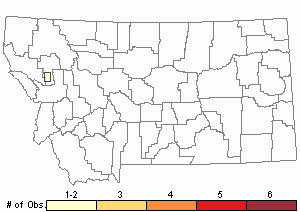
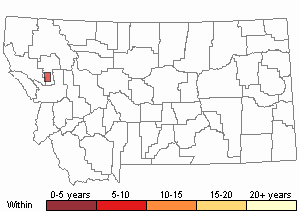
Observations in Montana Natural Heritage Program Database
Number of Observations: 5
(Click on the following maps and charts to see full sized version)
Relative Density
Recency
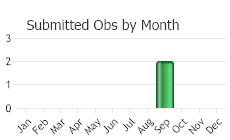
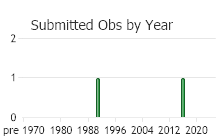
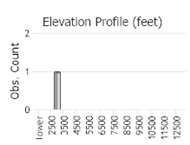 (Observations spanning multiple months or years are excluded from time charts)
Habitat
Pepperwort grows in shallow water in the valley zones of Montana (Lesica et al. 2022). Pepperwort requires habitats that have both wet and dry seasonal periods (Chau et al. 2014).
National Vegetation Classification System Groups Associated with this Species
Wetland and Riparian
Wet Meadow and Marsh
Open Water
Open Water
Ecology
INUNDATION
Many Marsilea species require habitats with specialized periods of both dry and inundated conditions in order to complete their life cycle (Chau and Reyes 2014). Consequently, they most often grow in habitats that are seasonally dry and only become wet during the rainy season or where water levels fluctuate from one season to the next (Pryer and Hearn 2009).
in a California-based study of vernal pools Pepperwort was found to be an indicator species for “long inundated communities” (Gosejohan et al. 2017). Pepperwort requires an extremely specialized inundation period of at least 212 days. This plant required both the longest period of inundation and the narrowest range of inundation period suitable for reproduction when compared against all other examined species.
NYCTINASTY
The leaf blades of Marsilea species move daily with the sun (nyctinasty). No other fern-like plant is known to exhibit nyctinasty (Petlewski et al. 2019). During the day, they assume a more or less horizontal position in order to maximize capture of sunlight and then change orientation by moving into a vertical position at night (Minorsky 2019). The mechanism by which this occurs is the pulvinus joint found at the swollen base of the leaf stalk which moves with water inflow or outflow to the pulvinus motor cells (Iwai et al. 2016). Nyctinastic movement in Marsilea species matches the rhythm of transpiration through opening and closing of stomata (Iwai et al. 2016).
PARASITISM
Parasitism by numerous insect species, including weevils from the genus Echinocnemus and several wasp species, has been observed on Marsilea mollis plants that are found in Arizona (Mauz et al. 2009). Endalus celatus, another weevil species, has been associated with M. mucronata (Mauz et al. 2009). In these cases, adults feed on the edges of the leaves and females deposit their eggs in the sporocarps (Board et al. 1971). After hatching, larvae feed on the spores inside the sporocarps and then pupate in the resulting empty cavity (Board et al. 1971). Similar weevil and wasp interactions may exist for other Marsilea species.
Reproductive Characteristics
Marsilea species are fern-like vascular plants that reproduce from spores; thus, the terminology below is often specific to ferns.
SPOROCARPS
Sporocarps are the fruit case which contain sporangia and the spores; they are unique to members of the Family Marsilieace. Visually, sporocarps are nut-like or bean-shaped structures that attach by a short stalk to the base of a leaf petiole (Nagalingum et al. 2006). When young, sporocarps are softer and may be green but become very hard and brown with age. Within the thick, hard wall of the mature sporocarp, are specialized reproductive structures that are enfolded and fused to contain two rows of sori (Pryer and Hearn 2009). The sori attach to a mucilaginous ring (Bilderback 1978). Because of these unique structures, leaves are not needed to house sporangium, as is the situation for true-ferns. The formation of sporocarps also allow the plants to become sexually mature earlier than other true-fern species (Pryer and Hearn 2009). This is especially advantageous for an organism that occupies habitats with uncertain conditions of moisture. Once the moisture is favorable for reproduction, then the sporocarp of an individual plant is ready to germinate (Pryer and Hearn 2009).
SORUS
The sorus is a cluster of sporangia, plural, with each sporangium, singular, containing the spores. Each sorus is surrounded by a thin shield (indusium) and contains two types of sporangium (bisporaginate): megasporangium produce haploid spores that develop into female gametophytes, and microsporangium produce haploid spores that develop into male gametophytes (Nagalingum et al. 2007). The indusia of adjacent sori are partially fused.
LIFE CYCLE
The life cycle of Marsilea is very unique in that they rely on the occurrence of both wet and dry periods to complete their reproductive life cycle (Chau and Reyes 2014). Germination occurs during the rainy season. Precipitation allows the sporocarp's contents (mature sori and mucilaginous ring) to become hydrated. The mucilaginous ring that surrounds the sori expands dramatically and ruptures the sporocarp, breaking it into valves, and carrying the sori to water (Johnson in FNA 1993; Nagalingum et al. 2007). From the sori, spores germinate (gametophyte growth) and fertilization occurs immediately (Johnson in FNA 1993). The gametophytic phase takes up to two days after which the sporophyte quickly develops rhizomes and leaves (Pryer and Hearn 2009). Development of new sporocarps follows the end of the growing season when the habitat dries completely (Pryer and Hearn 2009). In California, Marsilea oligospora reproduces while the vernal pond is inundated. Further, this species demonstrated an extreme specialization in being only found in vernal ponds that were inundated for a period of at least 212 days (Gosejohan et al. 2017). Sporocarps of Marsilea oligospora are remarkably tolerant of desiccation because successful germination was demonstrated even after 100 years (Chau 2013).
Management
Conservation measures to retain Marsilea oligospora populations require maintaining ephemeral habitats. Extensive observation data of Marsilea oligospora is needed to determine how management affects its status and biology in Montana.
Some insights for management may come from a closely related species that is endemic to Hawaii, Marsilea villosa (Wester et al. 2006). Marsilea villosa, has experienced a drastic decline in its range despite attempted conservation and management of populations (Wester et al. 2006). This is most likely due to its narrow habitat requirements combined with human alteration and aggressive invasive species. Off-road vehicles, trampling and grazing by cattle, and invasive grasses have been suggested as contributors to the plant's dwindling distribution. At many sites aggressive, invasive grass species have out-competed Marsilea villosa. Managers have found that Marsilea villosa plants responded positively to mowing because it reduced competition caused by the taller growth of grasses (Wester et al. 2006).
Stewardship Responsibility
Threats or Limiting Factors
STATE THREAT SCORE REASON
A threat impact score for M. oligospora is not assigned because threats are not known (MTNHP Threat Assessment 2021).
References
- Literature Cited AboveLegend:
 View Online Publication
- Bilderback, D.E. 1978. The DEcelopment of the Sporocarp of Marsilea vestita. American Journal of Botany, 65(6): 629-637.
 Chau, Marian M., and Whitney R. Reyes. 2014. Effects of Light, Flooding, and Weeding on Experimental Restoration of an Endangered Hawaiian Fern. January. Restoration Ecology. Volume 22, Number 1, pp. 107-116.
- Chau, Marian M., Whitney R. Reyes, and Tom A. Ranker. 2013. Ecological Factors Influencing Growth of the Endangered Hawaiian Fern Marsilea villosa (Marsileaceae) and Implications for Conservation Management. American Journal of Botany, 100(8), pp. 1532-1543.
- Flora of North America Editorial Committee. 1993. Flora of North America north of Mexico. Vol. 2. Pteridophytes and gymnosperms. Oxford Univ. Press, New York. xvi + 475 pp.
- Gosejohan, Meredith C., Peter J. Weisberg, and Kyle E. Merriam. 2016. Hydrologic Influences on Plant Community Structure in Vernal Pools of Northeastern California. Wetlands, Society of Wetland Scientists. DOI 10.1007/s13157-016-0863-3
- Lesica, P., M.T. Lavin, and P.F. Stickney. 2022. Manual of Montana Vascular Plants, Second Edition. Fort Worth, TX: BRIT Press. viii + 779 p.
- Mauz, Kathryn, and John Reeder. 2009. Marsilea Mollis (Marsileaceae) Sporocarps and Associated Insect Parasitism in Southern Arizona. September. Western North American Naturalist, Volume 69, Number 3, pp. 382-387.
- MTNHP Threat Assessment. 2021. State Threat Score Assignment and Assessment of Reported Threats from 2006 to 2021 for State-listed Vascular Plants. Botany Program, Montana Natural Heritage Program, Helena, Montana.
- Pryer, Kathleen M., and David J. Hearn. 2009. Evolution of Leaf Form in Marsileaceous Ferns: Evidence for Heterochrony. Evolution, February, Volume 63, Number 2, pp. 498-513.
- Wester, Lyndon, John Delay, Lam Hoang, Bryron Iida, Nicholas Kalodimos, and Tamara Wong. 2006. Population Dynamics of Marsilea villosa (Marsilieaceae) on O'ahu, Hawai'i. July. Pacific Science. pp. 386-402.
- Additional ReferencesLegend: View Online Publication
Do you know of a citation we're missing?- Johnson, David M. 1985. Marsilea quadrifolia and M. vestita in the Floras of Kansas and Missouri. American Fern Journal 75, pp. 28-29.
- Lesica, P., M.T. Lavin, and P.F. Stickney. 2012. Manual of Montana Vascular Plants. Fort Worth, TX: BRIT Press. viii + 771 p.
- Web Search Engines for Articles on "Pepperwort"