View in other NatureServe Network Field Guides
NatureServe
Montana
Utah
Wyoming
Idaho
Wisconsin
British Columbia
South Carolina
Yukon
California
New York
Running-pine - Lycopodium lagopus
Other Names:
Lycopodium clavatum var. lagopus
State Rank Reason (see State Rank above)
DRAFT: Requesting feedback on the 2026 revised rank, factors, and State Rank Reason outlined below and in the Conservation Status Rank Report.
Lycopodium lagopus is extremely rare in the state being known from only two populations, one in Glacier National Park and the other one on the Kootenai National Forest. Population levels are imprecisely known but appear to be small. Trends are unknown, though no significant and widespread threats to the species are known beyond those potentially posed by climate change. The species requires cool, mesic environments at high elevations.
Surveys of the two known locations are needed to collect current data on population size and extent as well as habitat conditions. Monitoring of the populations is needed to be able to determine if the populations are stable.
General Description
Running-pine is a low evergreen perennial with densely leafy, branched, upright shoots that are 5-8 mm in diameter including the leaves, arising from sparsely leafy, rooted, horizontal stems at the surface. Upright shoots have 2-4 low, ascending vegetative branches and a taller, terminal branch that usually bears a single club-like cone. Appressed to ascending green leaves are crowded on the branches in longitudinal rows of six or more. The leaves are 3-5 mm long by 0.4-0.7 mm wide, with smooth margins and pointed tips ending with hairs. A solitary (rarely 2) terminal cone is borne on an unbranched peduncle , 3.5-12.5 cm long, with sparse appressed leaves. The cone is 20-55 mm long by 3-5 mm long, and is composed of tightly packed sporophylls that are 1.5-2.5 mm long and gradually taper to a a hair tip. Kidney shaped sporangia are borne within at the bases of the sporophylls.
Phenology
Producing spores in July.
Diagnostic Characteristics
Lycopodium lagopus is most closely related to L. clavatus. Both species have branched upright shoots, hair tipped leaves in rows of 6 or more, and cones on peduncles distinct from leafy branches. The latter differs by having more lateral spreading branches rather than ascending ones, longer, more spreading leaves, and 2-5 cones borne on a loosely branched peduncle. A hand lens may be needed for positive identification.
Species Range
Montana Range
Range Descriptions
 Native
Range Comments
One collection in Glacier National Park; circumboreal, BC, MB, MI, and NY (Lesica et al. 2012. Manual of Montana Vascular Plants. BRIT Press. Fort Worth, TX).
Observations in Montana Natural Heritage Program Database
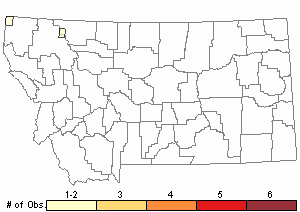
Number of Observations: 4
(Click on the following maps and charts to see full sized version)
Relative Density
Recency
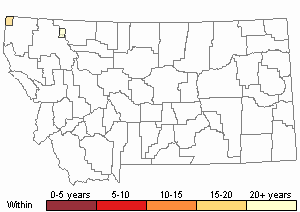

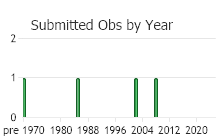
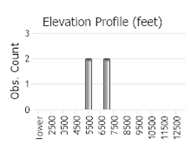 (Observations spanning multiple months or years are excluded from time charts)
Habitat
Turf along drainages and moist slopes in alpine zone.
National Vegetation Classification System Groups Associated with this Species
Alpine
Alpine - Vegetated
Forest and Woodland
Montane - Subalpine Forest and Woodland
Wetland and Riparian
Alpine Riparian and Wetland
Stewardship Responsibility
Threats or Limiting Factors
STATE THREAT SCORE REASON
Threat impact not assigned because threats are not known (MTNHP Threat Assessment 2021).
References
- Literature Cited AboveLegend:
 View Online Publication
- Lesica, P., M.T. Lavin, and P.F. Stickney. 2012. Manual of Montana Vascular Plants. Fort Worth, TX: BRIT Press. viii + 771 p.
 MTNHP Threat Assessment. 2021. State Threat Score Assignment and Assessment of Reported Threats from 2006 to 2021 for State-listed Vascular Plants. Botany Program, Montana Natural Heritage Program, Helena, Montana.
- Additional ReferencesLegend: View Online Publication
Do you know of a citation we're missing?- Lesica, P., M.T. Lavin, and P.F. Stickney. 2022. Manual of Montana Vascular Plants, Second Edition. Fort Worth, TX: BRIT Press. viii + 779 p.
- Lesica, P., P. Husby, and S. V. Cooper. 1998. Noteworthy collections: Montana. Madrono 45:328-330.
- Web Search Engines for Articles on "Running-pine"