View in other NatureServe Network Field Guides
NatureServe
Montana
Utah
Wyoming
Idaho
Wisconsin
British Columbia
South Carolina
Yukon
California
New York
Common Camas - Camassia quamash
Native Species
Global Rank:
G5
State Rank:
S4S5
(see State Rank Reason below)
C-value:
6
Agency Status
USFWS:
USFS:
BLM:
State Rank Reason (see State Rank above)
DRAFT: Requesting feedback on the 2026 revised rank, factors, and State Rank Reason outlined below and in the Conservation Status Rank Report.
Camassia quamash is relatively common in appropriate habitat across western and portions of central Montana. Some populations are large and extensive and overall population levels are robust. No signifcant and widespread threats to the species are known.
General Description
Glabrous perennials from globose bulbs. Stems erect, 20–60 cm. Leaves basal, linear-lanceolate, 2–15 mm wide. Inflorescence a terminal raceme; each flower subtended by a green, linear bract; pedicels 5–10 mm long. Flowers nearly regular, star-shaped, blue; tepals spreading, separate, linear-lanceolate, 15–25 mm long; stamens shorter than tepals; anthers yellow; style 3-lobed. Fruit an ellipsoid, 3-angled capsule 6–12 mm long (
Lesica et al. 2012. Manual of Montana Vascular Plants. BRIT Press. Fort Worth, TX).
Our plants are variety
quamash.
Species Range
Montana Range
Range Descriptions
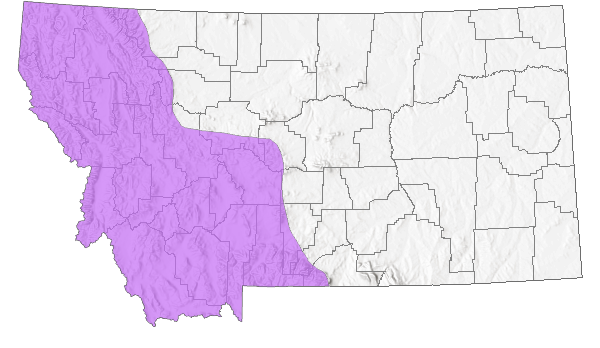
 Native
Range Comments
BC, AB south to CA, UT and WY (Lesica et al. 2012. Manual of Montana Vascular Plants. BRIT Press. Fort Worth, TX).
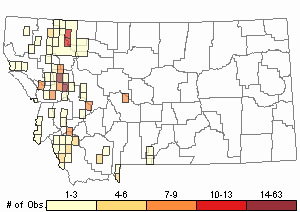
Observations in Montana Natural Heritage Program Database
Number of Observations: 453
(Click on the following maps and charts to see full sized version)
Map Help and Descriptions
Relative Density
Recency
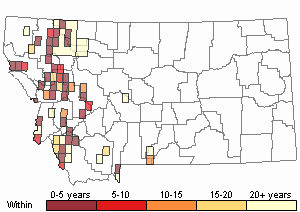
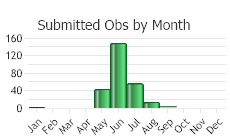
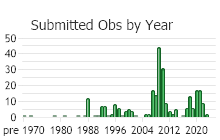
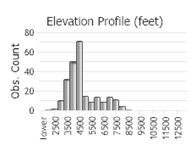 (Observations spanning multiple months or years are excluded from time charts)
Habitat
Ecology
POLLINATORS The following animal species have been reported as pollinators of this plant species or its genus where their geographic ranges overlap:
Bombus griseocollis and
Bombus impatiens (Colla and Dumesh 2010).
Stewardship Responsibility
References
- Literature Cited AboveLegend:
 View Online Publication
 Colla, S.R. and S. Dumesh. 2010. The bumble bees of southern Ontario: notes on natural history and distribution. Journal of the Entomological Society of Ontario 141:39-68.
- Lesica, P., M.T. Lavin, and P.F. Stickney. 2012. Manual of Montana Vascular Plants. Fort Worth, TX: BRIT Press. viii + 771 p.
- Additional ReferencesLegend: View Online Publication
Do you know of a citation we're missing?- Culver, D.R. 1994. Floristic analysis of the Centennial Region, Montana. M.Sc. Thesis. Montana State University, Bozeman. 199 pp.
- Fultz, J.E. 2005. Effects of shelterwood management on flower-visiting insects and their floral resources. M.Sc. Thesis. Bozeman, MT: Montana State University. 163 p.
- Johnson, T. W. 1982. An analysis of pack and saddle stock grazing areas in the Bob Marshall Wilderness. M.Sc.Thesis. Bozeman, MT: Montana State University. 105 p.
- Lesica, P., M.T. Lavin, and P.F. Stickney. 2022. Manual of Montana Vascular Plants, Second Edition. Fort Worth, TX: BRIT Press. viii + 779 p.
- Web Search Engines for Articles on "Common Camas"