View in other NatureServe Network Field Guides
NatureServe
Montana
Utah
Wyoming
Idaho
Wisconsin
British Columbia
South Carolina
Yukon
California
New York
Single-spike Sedge - Carex scirpoidea
Native Species
Global Rank:
G5
State Rank:
S4
(see State Rank Reason below)
C-value:
4
Agency Status
USFWS:
USFS:
BLM:
State Rank Reason (see State Rank above)
DRAFT: Requesting feedback on the 2026 revised rank, factors, and State Rank Reason outlined below and in the Conservation Status Rank Report.
Carex scirpoidea is widespread across higher elevation mountain ranges in western and central Montana. Occurrences are mostly in relatively remote areas, which limits the potential for negative impacts. No significant and widespread threats to the species are known besides potential impacts associated with climate change. Population levels are poorly documented, though are believed to be fairly robust, and trends are unknown though populations have likely been relatively stable in the recent past or experienced only minor declines.
General Description
Dioecious, rhizomatous. Stems erect, 5–40 cm, tufted. Leaves basal and cauline or basal bladeless; blades 1–3 mm wide. Inflorescence a solitary spike; bract inconspicuous. Spikes unisexual, cylindric, 1–4 cm long. Perigynia ovate to elliptic, sometimes flattened, brown to purple above, pilose, 2.5–4 mm long, with a distinct beak 0.5 mm or less long; stigmas 3. Female scales brown to purple with hyaline margins and a pale midvein, sometimes ciliate or puberulent, concealing the perigynia or nearly so. Achene 3-sided, smaller or nearly filling the perigynium (
Lesica et al. 2012. Manual of Montana Vascular Plants. BRIT Press. Fort Worth, TX).
Our plants are subspecies
pseudoscirpoidea (Rydb.) D.A. Dunlop and
scirpoidea.
Species Range
Montana Range
Range Descriptions
 Native
Range Comments
Circumboreal south to CA, NV, UT, CO, MI and NY (Lesica et al. 2012. Manual of Montana Vascular Plants. BRIT Press. Fort Worth, TX).
Observations in Montana Natural Heritage Program Database
Number of Observations: 229
(Click on the following maps and charts to see full sized version)
Relative Density

Recency
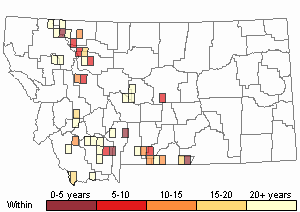
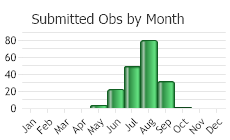
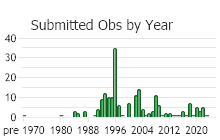
 (Observations spanning multiple months or years are excluded from time charts)
Habitat
Dry ridges, fellfields with gravelly non-calcareous soils (subspecies pseudoscirpoidea) and calcareous soils (subspecies scirpoidea)(Flora N. America, Vol. 23, 2003).
National Vegetation Classification System Groups Associated with this Species
Alpine
Alpine - Sparse and Barren
Alpine - Vegetated
Stewardship Responsibility
References
- Literature Cited AboveLegend:
 View Online Publication
- Lesica, P., M.T. Lavin, and P.F. Stickney. 2012. Manual of Montana Vascular Plants. Fort Worth, TX: BRIT Press. viii + 771 p.
- Additional ReferencesLegend: View Online Publication
Do you know of a citation we're missing? Culver, D.R. 1994. Floristic analysis of the Centennial Region, Montana. M.Sc. Thesis. Montana State University, Bozeman. 199 pp.
- Lesica, P., M.T. Lavin, and P.F. Stickney. 2022. Manual of Montana Vascular Plants, Second Edition. Fort Worth, TX: BRIT Press. viii + 779 p.
- Williams, K.L. 2012. Classification of the grasslands, shrublands, woodlands, forests and alpine vegetation associations of the Custer National Forest portion of the Beartooth Mountains in southcentral Montana. M.Sc. Thesis. Bozeman, MT: Montana State University. 376 p.
- Web Search Engines for Articles on "Single-spike Sedge"