View in other NatureServe Network Field Guides
NatureServe
Montana
Utah
Wyoming
Idaho
Wisconsin
British Columbia
South Carolina
Yukon
California
New York
American Sweetflag - Acorus americanus
Other Names:
Acorus calamus [misapplied name]
State Rank Reason (see State Rank above)
Acorus americanus occurs in Montana, at the edge of its range in North America. Plants have been documented from two general localities in the vicinity of Flathead Lake. Current status of these populations is largely unknown. Acorus americanus has likely been negatively impacted by hydrologic alterations, noxious weeds, and development within these localities.
- Details on Status Ranking and Review
Population Size
Score2-3 - Very Small to Small: Population size is imprecisely known but is believed to be <10,000 individuals.
CommentPopulation size is undocumented but is likely to be very small.
Range Extent
Score3 - Local Endemic or Very Small Montana Range: Generally restricted to an area <10,000 sq. miles (equivalent to the combined area of Phillips and Valley Counties) or <6 Sub-basins (4th code watersheds) Range-wide OR limited to one Sub-basin in Montana
Area of Occupancy
Score3 - Very Low: Generally occurring in 3 or fewer Subwatersheds (6th Code HUC’s).
Environmental Specificity
Score1-2 - Moderate to High.
Trends
Score1-3 - Declining: Species is likely declining though the magnitude of declines is uncertain. Declines may be based upon range extent and/or occupied area in the recent past (approximately 30 years).
CommentTrend data are lacking. However, it would appear likely that declines in the species' distribution and abundance have occurred.
Threats
Score2-3 - High to Very High.
CommentHabitat loss from development, hydrologic alterations and invasive species.
Intrinsic Vulnerability
Score1 - Moderate Vulnerability: Specific biological attributes, unusual life history characteristics or limited reproductive potential makes the species susceptible to extirpation from stochastic events or other adverse impacts to its habitat and slow to recover.
Raw Conservation Status Score
Score
15 to 18 total points scored out of a possible 19.
General Description
PLANTS: A rhizomatous, herbaceous, perennial that is aromatic. Plants reach 60-100 cm in height at maturity. Sources: Lesica et al. 2022; Giblin et al. [eds.] 2018
LEAVES: Basal leaves are 50-100 cm in height, white at the base, green above, and gradually taper to a tip. The leaf surface has a prominent midvein with 1 to 5 additional veins. Blades are erect, folded, flat, linear in shape, and sheathing below. Sources: Lesica et al. 2022; Giblin et al. [eds.] 2018
INFLORESCENCE: Inconspicuous, yellow to brownish flowers that are densely arranged on a narrow cylindrical spike (spadix). The spadix is 4 to 7 cm long, and grows laterally from an erect, leafless flowering stalk (scape), 60-90 cm tall at maturity. Subtending the spadix is an erect, leaf-like sheathing bract (spathe), 15-70 cm tall. Each flower is perfect, containing both male (staminate) and female (pistillate) reproductive structures. Flowers are 2-3 mm long, have 6 brown, separate tepals, 6 stamens, and 1 pistil. Sources: Lesica et al. 2022; Giblin et al. [eds.] 2018
Phenology
Flowering occurs in late July to early August (Thompson in Flora of North America (FNA) 2000).
Diagnostic Characteristics
American Sweetflag is the only member of the family Acoraceae in Montana (Lesica et al. 2022). Perennial, rhizomatous, and robust wetland plants that may be mistaken for American Sweetflag include species of cattail (
Typha) and bulrush (
Schoenoplectus):
American Sweetflag -
Acorus americanus, SOC, native
* Stems: Flowering stem (scape) present.
* Leaves: Vegetative blades flat, folded, 3 to 12 mm wide, green, and sheathing at the base.
* Inflorescence: Perfect flowers are arranged in cylindrical spike that grows lateral on the scape. A subtending leaf-like bract extends upward for 15-70 cm.
* Family: Acoraceae
Broadleaf Cattail –
Typha latifolia, native
* Stems: Flowering stem (scape) present.
* Leaves: Flat and not folded, 6-18 mm wide, pale grayish-green from a whitish film (glaucous), and sheathing at the base.
* Inflorescence: Flowers arranged in a terminal and broader spike-like, cylindrical head. The upper part is light brown, male (staminate), and contiguous with the dark brown, female (pistillate) lower portion. A subtending leaf-like bract is absent.
* Family: Typhaceae
Narrow-leaved Cattail –
Typha angustifolia, likely-native
* Stems: Flowering stem (scape) present.
* Leaves: Flat and not folded, 3-12 mm wide, brighter green, and sheathing at the base. The leaf's underside curves outward (convex).
* Inflorescence: Flowers arranged in a terminal and narrower spike-like, cylindrical head. The upper part is light brown, male (staminate), and separated by at least 5 mm with the dark brown, female (pistillate) lower portion. A subtending leaf-like bract is absent.
* Family: Typhaceae
Hardstem Bulrush –
Schoenoplectus acutus, native
* Stems: Single and roundish.
* Leaves: Blades are reduced to green scales at the base of the stem.
* Inflorescence: Terminal, in which the flowers are arranged in an array of nodding, pedunculate spikelets. Within the spikelet, each flower bears a white to gray scale that shields the stamens and pistil (perfect).
* Family: Cyperaceae
Softstem Bulrush -
Schoenoplectus tabernaemontani, native
* Stems: Single and roundish.
* Leaves: Blades are reduced to green scales at the base of the stem.
* Inflorescence: Terminal, in which the flowers are arranged in an array of nodding, pedunculate spikelets. Within the spikelet, each flower bears a reddish-brown scale that shields the stamens and pistil (perfect).
* Family: Cyperaceae
Nomenclature and Taxonomy
Etymology
The genus Acorus comes from a Latin form of the Greek word akoron, which is assumed to be an ancient plant name (Thompson in FNA 2000).
Species Range
Montana Range
Range Descriptions
 Native
Range Comments
American Sweetflag is found from Alaska to New Foundland and Labrodor south to the states of New England, upper Midwest, eastern Nebraska, eastern South Dakota, northeastern North Dakota, northwestern Montana, northern Idaho, and northeastern Washington. A disjunct population occurs in Virginia (Thompson in FNA 2000).
In Montana, the earliest collected specimen was found in along Flathead Lake in Lake County, Montana (Consortium of Pacific Northwest Herbaria 2026). American Sweetflag is known from Flathead and Lake counties (Lesica et al. 2022).
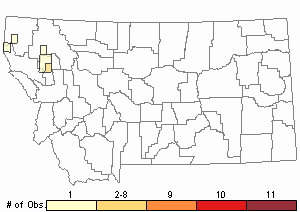
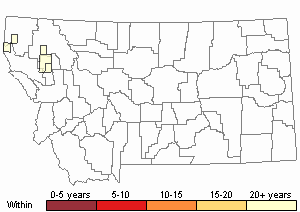
Observations in Montana Natural Heritage Program Database
Number of Observations: 15
(Click on the following maps and charts to see full sized version)
Relative Density
Recency
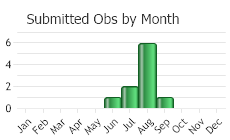
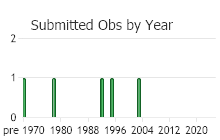
 (Observations spanning multiple months or years are excluded from time charts)
Habitat
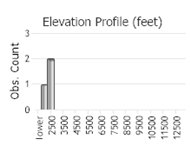
Across American Sweetflag's range, plants occur in shallow waters and wetlands, including ponds, marshes, swamps, and quiet riverbanks or floodplains. (Thompson in FNA 2000). In Montana, American Sweetflag occurs in the shallow water of ponds and marshes at lower elevations (Lesica et al. 2022). Historical collections of this species in Montana are from marshes along lakes and streams, with cattails and bullrushes.
National Vegetation Classification System Groups Associated with this Species
Wetland and Riparian
Wet Meadow and Marsh
Open Water
Open Water
Reproductive Characteristics
Plants reproduce by seed and spread by rhizomes.
FLOWERS
The pistil has a 1 to 3 celled superior ovary (Lesica et al. 2022).
FRUITS
The fruit is a berry that embedded in the spadix (Lesica et al. 2022). The berry is several-seeded, 3-5 mm long, leathery, oblong, and lacks hairs (glabrous).
Management
American Sweetflag grows in relatively stable wet or shallow-water habitats and would be vulnerable to hydrologic changes associated with impoundments or drainage. Its response to nutrient pollution is not known.
Stewardship Responsibility
Threats or Limiting Factors
STATE THREAT SCORE REASON
Reported threats to Montana's populations of American Sweetflag include non-native species and hydrologic alteration to its wetland habitat (MTNHP Threat Assessment 2021). Competition with Reed Canarygrass (Phalaris arundinacea) and Yellowflag Iris (Iris pseudacorus) occurs at some populations. Hydrological alteration of Flathead Lake is a concern at one site where manipulation of the lake level has the potential to either dewater or inundate plants.
References
- Literature Cited AboveLegend:
 View Online Publication
- Flora of North America Editorial Committee (FNA). 2000. Flora of North America north of Mexico. Vol. 22. Magnoliophyta: Alismatidae, Arecidae, Commelinidae (in part), and Zingiberidae. Oxford Univ. Press, New York. xxiii + 352 pp.
 Hitchcock, C.L. and A. Cronquist. 2018. Flora of the Pacific Northwest: An Illustrated Manual. Second Edition. Giblin, D.E., B.S. Legler, P.F. Zika, and R.G. Olmstead (eds). Seattle, WA: University of Washington Press in Association with Burke Museum of Natural History and Culture. 882 p.
- Lesica, P., M.T. Lavin, and P.F. Stickney. 2022. Manual of Montana Vascular Plants, Second Edition. Fort Worth, TX: BRIT Press. viii + 779 p.
- MTNHP Threat Assessment. 2021. State Threat Score Assignment and Assessment of Reported Threats from 2006 to 2021 for State-listed Vascular Plants. Botany Program, Montana Natural Heritage Program, Helena, Montana.
- Packer, J.G. and G.S. Ringius. 1984. The distribution and status of Acorus (Araceae) in Canada. Canadian Journal of Botany 62:2248-2252.
- Additional ReferencesLegend: View Online Publication
Do you know of a citation we're missing?- Lesica, P., M.T. Lavin, and P.F. Stickney. 2012. Manual of Montana Vascular Plants. Fort Worth, TX: BRIT Press. viii + 771 p.
- Web Search Engines for Articles on "American Sweetflag"