View in other NatureServe Network Field Guides
NatureServe
Montana
Utah
Wyoming
Idaho
Wisconsin
British Columbia
South Carolina
Yukon
California
New York
Western Mountain kittentails - Synthyris missurica
State Rank Reason (see State Rank above)
Uncommon in Montana and restricted in distribution to the Bitterroot Mtns. Population sizes are poorly documented and associated information on trends and threats are also lacking.
General Description
Herbage glabrous. Leaf blades orbicular-cordate, 2–6 cm wide, shallowly lobed, crenate. Inflorescence: scape 6–20 cm long, longer than the leaves. Flowers: calyx 1–3 mm long; corolla 3–7 mm long, lobes longer than the tube. Capsule 3–6 mm long, pubescent (
Lesica et al. 2012. Manual of Montana Vascular Plants. BRIT Press. Fort Worth, TX).
Phenology
Flowering late May to early July.
Species Range
Montana Range
Range Descriptions
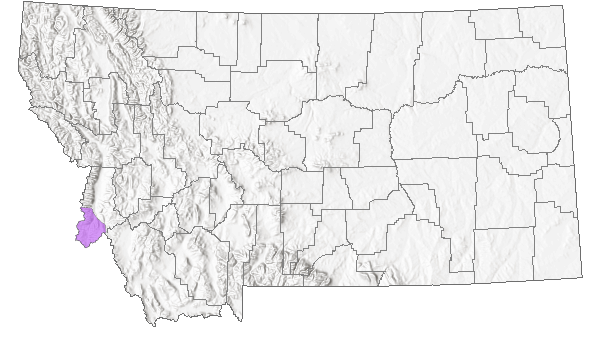
 Native
Range Comments
On hills adjoining Colombia River Gorge through Cascade Range, Washington and Oregon; northeastern Washington and northern Idaho south to Modoc County, northeastern California and south central Idaho.
Observations in Montana Natural Heritage Program Database
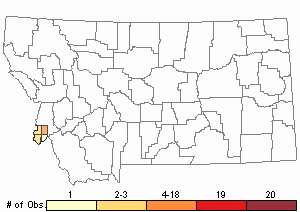
Number of Observations: 25
(Click on the following maps and charts to see full sized version)
Map Help and Descriptions
Relative Density
Recency
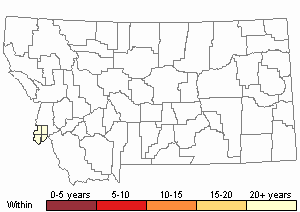

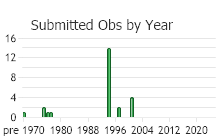
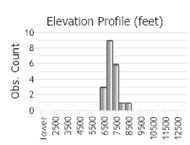 (Observations spanning multiple months or years are excluded from time charts)
Habitat
Open forests and rocky ridges in the montane and subalpine zones.
Stewardship Responsibility
References
- Literature Cited AboveLegend:
 View Online Publication
- Lesica, P., M.T. Lavin, and P.F. Stickney. 2012. Manual of Montana Vascular Plants. Fort Worth, TX: BRIT Press. viii + 771 p.
- Additional ReferencesLegend: View Online Publication
Do you know of a citation we're missing?- Lesica, P., M.T. Lavin, and P.F. Stickney. 2022. Manual of Montana Vascular Plants, Second Edition. Fort Worth, TX: BRIT Press. viii + 779 p.
- Web Search Engines for Articles on "Western Mountain kittentails"