View in other NatureServe Network Field Guides
NatureServe
Montana
Utah
Wyoming
Idaho
Wisconsin
British Columbia
South Carolina
Yukon
California
New York
Small-flower Ipomopsis - Ipomopsis minutiflora
Other Names:
Small-flower Standing-cypress,
Gilia minutiflora, Microgilia minutiflora
State Rank Reason (see State Rank above)
DRAFT: Requesting feedback on the 2026 revised rank, factors, and State Rank Reason outlined below and in the Conservation Status Rank Report.
Ipomopsis minutiflora is extremely rare in the state, being known from only one collection from the Bitterroot Valley in 1993. At that time, 40-50 plants were observed. The occurrence has not been revisited, and its current status is unknown. It is also unknown if the species or its habitat is threatened.
Surveys are greatly needed to relocate and document the current status of the population.
General Description
Small-flower Standing-cypress is an annual with a central stem that is 1-3 dm (4-12) tall, and with branches arising from most leaf axils. The alternate stem leaves are up to 3 cm long and are divided into 3 linear segments below, while above they are simple and linear with entire margins. Basal leaves are lacking. Foliage is glabrous to densely glandular. Small flowers are in the upper leaf axils or solitary at the tips of the numerous ultimate branches. The white or pale blue, tubular corolla is 4-7 mm long and flares to 5 lobes with 5 anthers held just beyond the mouth. The calyx is 5-lobed. The fruit is a rounded capsule with 1-3 seeds.
Diagnostic Characteristics
The plant superficially resembles Epilobium paniculatum but the latter has 4 separate petals. Our other species of Ipomopsis have basal rosettes.
Species Range
Montana Range
Range Descriptions
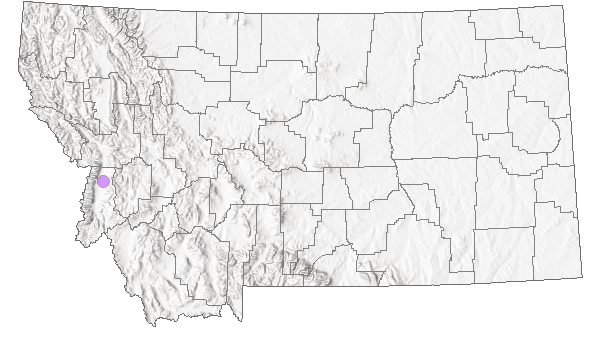
 Native
Range Comments
Ravalli County; BC, MT south to OR and ID (Lesica et al. 2012. Manual of Montana Vascular Plants. BRIT Press. Fort Worth, TX).
Observations in Montana Natural Heritage Program Database
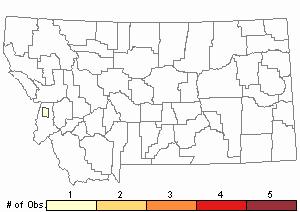
Number of Observations: 2
(Click on the following maps and charts to see full sized version)
Map Help and Descriptions
Relative Density
Recency
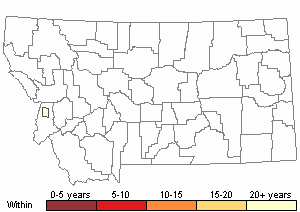
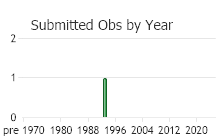
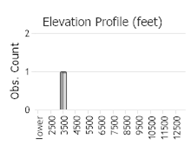 (Observations spanning multiple months or years are excluded from time charts)
Habitat
Open, sparsely vegetated slopes with sagebrush on fine-textured soils in the foothills zone.
National Vegetation Classification System Groups Associated with this Species
Shrubland
Sagebrush Shrubland
Ecology
POLLINATORS The following animal species have been reported as pollinators of this plant species or its genus where their geographic ranges overlap:
Bombus occidentalis (Pyke et al. 2012).
Stewardship Responsibility
Threats or Limiting Factors
STATE THREAT SCORE REASON
Threat impact not assigned because threats are not known (MTNHP Threat Assessment 2021).
References
- Literature Cited AboveLegend:
 View Online Publication
- Lesica, P., M.T. Lavin, and P.F. Stickney. 2012. Manual of Montana Vascular Plants. Fort Worth, TX: BRIT Press. viii + 771 p.
 MTNHP Threat Assessment. 2021. State Threat Score Assignment and Assessment of Reported Threats from 2006 to 2021 for State-listed Vascular Plants. Botany Program, Montana Natural Heritage Program, Helena, Montana.
- Pyke, G.H., D.W. Inouye, and J.D. Thomson. 2012. Local geographic distributions of bumble bees near Crested Butte, Colorado: competition and community structure revisited. Environmental Entomology 41(6): 1332-1349.
- Additional ReferencesLegend: View Online Publication
Do you know of a citation we're missing?- Abrams, L. 1951. Illustrated flora of the Pacific states: Washington, Oregon, and California. Vol. 3. Geraniaceae to Scrophulariaceae. Stanford Univ. Press, Stanford, California. 866 pp.
- Argus, G. W. and K. M. Pryer. 1990. Rare vascular plants in Canada our natural heritage. Canadian Museum of Nature, Ottawa, Canada. 191 pp. plus maps.
- Booth, W. E. and J. C. Wright. 1966. Flora of Montana-Part II: dicotyledons. Montana State University, Bozeman, MT. 305 pp.
- Heidel, B. L. 1996. Noteworthy collections - Montana. Madrono 43(3):436-440.
- Hitchcock, C.L., A. Cronquist, M. Ownbey and J.W. Thompson. 1959. Vascular plants of the Pacific Northwest, Part 4. Ericaceae through Campanulaceae. Seattle, WA and London, UK: University of Washington Press. 510 p.
- Lesica, P., M.T. Lavin, and P.F. Stickney. 2022. Manual of Montana Vascular Plants, Second Edition. Fort Worth, TX: BRIT Press. viii + 779 p.
- Peck, M.E. 1961. A manual of the higher plants of Oregon. 2nd edition. Binsford & Mort, Portland, Oregon. 936 pp.
- Web Search Engines for Articles on "Small-flower Ipomopsis"