View in other NatureServe Network Field Guides
NatureServe
Montana
Utah
Wyoming
Idaho
Wisconsin
British Columbia
South Carolina
Yukon
California
New York
Slender Wintergreen - Gaultheria ovatifolia
State Rank Reason (see State Rank above)
DRAFT: Requesting feedback on the 2026 revised rank, factors, and State Rank Reason outlined below and in the Conservation Status Rank Report.
Gaultheria ovatifolia is a species of the Pacific Northwest that reaches its eastern extent in northwest Montana, where it is an uncommon species of mesic, forested habitats. Occurrences are mostly on publicly managed lands, including many on National Forest lands managed for multiple use. A few sites occur within Glacier National Park. Population levels are uncertain though they may be relatively robust. Population trends are unknown. As the species occurs in both intact forests and on old or abandoned roadbeds, it is unclear whether particular populations are stable, or increasing or decreasing in abundance under recent successional dynamics and disturbance regimes.
Survey and monitoring data are needed to be able to more precisely determine population levels, assess condition and for assessing population trends. If collection of survey and monitoring data shows that populations are likely stable, or if additional populations are located, or if statewide populations are at the larger end of the current estimates, then a rank of S4 is likely appropriate.
General Description
Slender wintergreen is a low shrub with slender, nearly prostrate, hairy stems, 5-20 cm (2-8 in) long. The alternate, mostly glabrous leaves, 2-4 cm (ca. 1 in) long, are egg-shaped with finely toothed margins. Single stalked flowers occur in the leaf axils. Each white flower, 3-5 mm long, has a 5-lobed, urn-shaped corolla and a shorter, brown-hairy, 5-lobed calyx. The fruit is a bright red, globose berry, 6-8 mm wide.
Phenology
Mature fruit in August.
Diagnostic Characteristics
Gaultheria humifusa has a glabrous calyx and leaves usually less than 2 cm long. The species exhibits low levels of fruit production in our area.
Species Range
Montana Range
Range Descriptions

 Native
Observations in Montana Natural Heritage Program Database
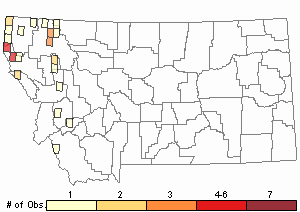
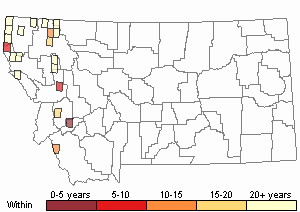
Number of Observations: 42
(Click on the following maps and charts to see full sized version)
Map Help and Descriptions
Relative Density
Recency
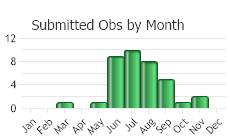
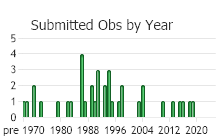
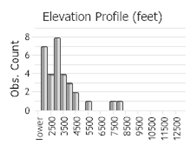 (Observations spanning multiple months or years are excluded from time charts)
Habitat
Moist forests, often dominated by Thuja plicata, of terraces and lower slopes in the valleys and lower montane zone.
Stewardship Responsibility
References
- Additional ReferencesLegend:
 View Online Publication
Do you know of a citation we're missing?- Lesica, P., M.T. Lavin, and P.F. Stickney. 2012. Manual of Montana Vascular Plants. Fort Worth, TX: BRIT Press. viii + 771 p.
- Lesica, P., M.T. Lavin, and P.F. Stickney. 2022. Manual of Montana Vascular Plants, Second Edition. Fort Worth, TX: BRIT Press. viii + 779 p.
 Lorain, C. C. 1988. Floristic history and distribution of coastal disjunct plants of the northern Rocky Mountains. M.S. thesis. College of Forestry, Wildlife, and Range Sciences, University of Idaho, Moscow. 221 pp.
- Web Search Engines for Articles on "Slender Wintergreen"