View in other NatureServe Network Field Guides
NatureServe
Montana
Utah
Wyoming
Idaho
Wisconsin
British Columbia
South Carolina
Yukon
California
New York
Spiny Greasebush - Glossopetalon spinescens
Other Names:
Glossopetalon nevadense
State Rank Reason (see State Rank above)
A peripheral species in Montana where it is only known from one small occurrence on the Bitterroot National Forest. Population is vulnerable to human impacts as it occurs adjacent to a road.
- Details on Status Ranking and Review
Population Size
Score3 - Vey Small: Generally <2,000 individuals.
Range Extent
Score3 - Local Endemic or Very Small Montana Range: Generally restricted to an area <10,000 sq. miles (equivalent to the combined area of Phillips and Valley Counties) or <6 Sub-basins (4th code watersheds) Range-wide OR limited to one Sub-basin in Montana
Area of Occupancy
Score3 - Very Low: Generally occurring in 3 or fewer Subwatersheds (6th Code HUC’s).
Environmental Specificity
Score1 - Moderate: Species is restricted to a specific habitat that is more widely distributed or to several restricted habitats and is typically dependent upon relatively unaltered, good-quality habitat (C Values of 5-7).
Trends
ScoreNA - Rank factor not assessed.
Threats
Score3 - Very High: >70% of the populations are being negatively impacted or are likely to be negatively impacted in the near future by one or more activities or agents that are expected to result in decreased populations and/or decreasing habitat quality and/or quantity.
Intrinsic Vulnerability
Score1 - Moderate Vulnerability: Specific biological attributes, unusual life history characteristics or limited reproductive potential makes the species susceptible to extirpation from stochastic events or other adverse impacts to its habitat and slow to recover.
Raw Conservation Status Score
Score
14 total points scored out of a possible 16 (Rarity factors and threats only).
General Description
Intricately branched, glabrous shrubs. Stems to 2 m high, thorny, ribbed, bearing old petiolar bases, green becoming tan. Leaves alternate, short-petiolate, narrowly oblanceolate, entire, 3–10 mm long; stipules lobed, adnate to the petiole. Flowers solitary at nodes of leaf-like bracts, perfect, perigynous; sepals 5, ovate, 1–2 mm long; petals 5, linear, ca. 3 mm long; stamens 6 to 10; pistil 1; ovary superior. Fruit an asymmetrical-ovoid, ribbed, leathery follicle 3–6 with 1 seed (
Lesica et al. 2012. Manual of Montana Vascular Plants. BRIT Press. Fort Worth, TX).
Montana plants are variety
aridum M.E. Jones
Phenology
Flowering in May or June.
Species Range
Montana Range
Range Descriptions
 Native
Range Comments
OR (Harney and Wallowa cos), WA, ID, TX (Trans-Pecos), CA (south Klamath Ranges, Piute Mtns, Kern County, south High Sierra Nevada, north base of San Bernardino Mts., White and Inyo Mts, Desert Mtns), and northern MX.
Observations in Montana Natural Heritage Program Database
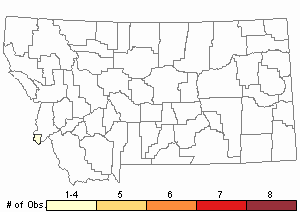
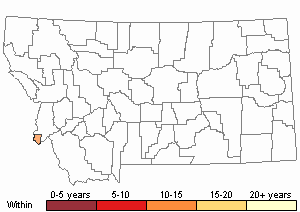
Number of Observations: 4
(Click on the following maps and charts to see full sized version)
Relative Density
Recency
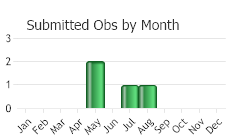
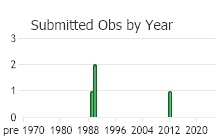
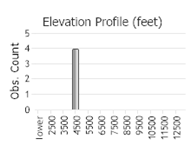 (Observations spanning multiple months or years are excluded from time charts)
Habitat
Rocky canyon walls in the lower montane zone.
National Vegetation Classification System Groups Associated with this Species
Sparse and Barren
Sparse and Barren
Stewardship Responsibility
Threats or Limiting Factors
STATE THREAT SCORE REASON
Reported threats to Montana's population of Spiny Greasebush include disturbance from recreational use and competition with Spotted Knapweed (Centaurea stoebe). The state population is found at a popular climbing site, where it grows in the cracks of a large cliff. Evidence of shelter building using sticks and non-native plant material suggests substantial risk from overlapping stressors concentrated at the Spiny Greasebush population. Additional information is needed to understand the severity of impacts due to reported threats (MTNHP Threat Assessment 2021).
References
- Literature Cited AboveLegend:
 View Online Publication
- Lesica, P., M.T. Lavin, and P.F. Stickney. 2012. Manual of Montana Vascular Plants. Fort Worth, TX: BRIT Press. viii + 771 p.
 MTNHP Threat Assessment. 2021. State Threat Score Assignment and Assessment of Reported Threats from 2006 to 2021 for State-listed Vascular Plants. Botany Program, Montana Natural Heritage Program, Helena, Montana.
- Additional ReferencesLegend: View Online Publication
Do you know of a citation we're missing?- Lesica, P., M.T. Lavin, and P.F. Stickney. 2022. Manual of Montana Vascular Plants, Second Edition. Fort Worth, TX: BRIT Press. viii + 779 p.
- Web Search Engines for Articles on "Spiny Greasebush"