View in other NatureServe Network Field Guides
NatureServe
Montana
Utah
Wyoming
Idaho
Wisconsin
British Columbia
South Carolina
Yukon
California
New York
Wind River Draba - Draba ventosa
State Rank Reason (see State Rank above)
DRAFT: Requesting feedback on the 2026 revised rank, factors, and State Rank Reason outlined below and in the Conservation Status Rank Report.
Draba ventosa is known in Montana from approximately a half dozen sites, and at least four mountain ranges. Population sizes are unknown as are trends. However, populations are likely relatively stable or have experienced only minor declines as the species' alpine habitat is remote and largely intact. Threats to the species are generally unknown, though shifts in climate may negatively impact the species, and it is rated as "Extremely Vulnerable" to climate change as part of an analysis using the CCVI.
Surveys are needed to document population sizes and extent of the known occurrences. Monitoring of a subset of populations is needed to be able to determine potential population trends.
General Description
Wind River draba is a mat-forming perennial with leaf rosettes at the ends of numerous rootcrown branches which are clothed with old leaf bases. The leafless stems are 2-4 cm high and arise from some of the rosettes. The fleshy, narrowly egg-shaped leaves are 5-12 mm long and 2-4 mm wide, have entire margins, and are densely covered with branched hairs. 3-20 stalked flowers are borne at the tops of the stems. Each flower has 4 separate sepals, 4 separate, yellow petals that are 4-5 mm long, and 4 long and 2 short stamens. The style is 1.0-1.5 mm long. The hairy, flattened, egg-shaped capsules are 5-8 mm long and are borne on ascending to spreading stalks that are as long as the capsules.
Phenology
Flowering occurs in late June-July; fruiting in August.
Diagnostic Characteristics
There are many similar appearing, yellow-flowered, mat-forming species of Draba in our area. A technical manual and hand lens or microscope are required for positive identification. In Montana, D. paysonii is the only other yellow-flowered, high-elevation, mat-forming species with tangled hair on the leaves, but its largest leaves average less than 2 mm wide.
Species Range
Montana Range
Range Descriptions
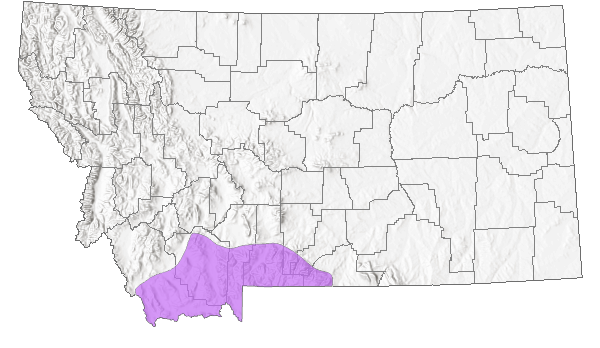
 Native
Range Comments
YT south to UT and CO; known from Madison County (Lesica et al. 2012. Manual of Montana Vascular Plants. BRIT Press. Fort Worth, TX)
Observations in Montana Natural Heritage Program Database
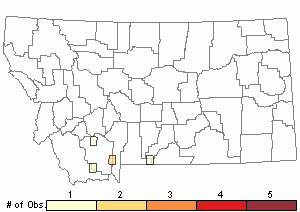
Number of Observations: 6
(Click on the following maps and charts to see full sized version)
Map Help and Descriptions
Relative Density
Recency
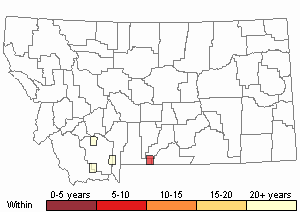
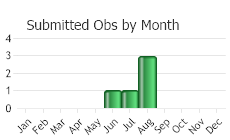
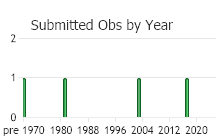
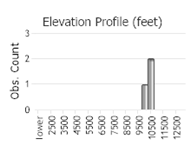 (Observations spanning multiple months or years are excluded from time charts)
Habitat
Draba ventosa occurs in scree and shifting talus of slopes near or above treeline, often but not always on limestone parent material. Associated species include Dryas octopetala, Saxifraga oppositifolia, Antennaria aromatica and Draba oligosperma.
National Vegetation Classification System Groups Associated with this Species
Alpine
Alpine - Sparse and Barren
Alpine - Vegetated
Ecology
Draba ventosa occupies habitats with sparse vegetation suggesting that it is not tolerant of competition.
Management
Wind River draba is found in inaccessible high-elevation sites. There are no immediate anthropogenic threats. However, at least one site is in a historic mining district, so mining could pose a threat in the future.
Stewardship Responsibility
Threats or Limiting Factors
STATE THREAT SCORE REASON
Threat impact not assigned because threats are not known (MTNHP Threat Assessment 2021).
References
- Literature Cited AboveLegend:
 View Online Publication
- Lesica, P., M.T. Lavin, and P.F. Stickney. 2012. Manual of Montana Vascular Plants. Fort Worth, TX: BRIT Press. viii + 771 p.
 MTNHP Threat Assessment. 2021. State Threat Score Assignment and Assessment of Reported Threats from 2006 to 2021 for State-listed Vascular Plants. Botany Program, Montana Natural Heritage Program, Helena, Montana.
- Additional ReferencesLegend: View Online Publication
Do you know of a citation we're missing?- Lesica, P., M.T. Lavin, and P.F. Stickney. 2022. Manual of Montana Vascular Plants, Second Edition. Fort Worth, TX: BRIT Press. viii + 779 p.
- Mulligan, G.A. 1976. The genus Draba in Canada and Alaska: key and summary. Canadian Journal of Botany 54:1386-1393.
- Mulligan, G.A. Cytotaxonomic studies of Draba species of Canada and Alaska: D. Ventosa, D. ruaxes, and D. paysonii. Canadian Journal of Botany 49:1455-1460.
- Vanderhorst, J.P. 1994. Sensitive plant surveys in the Gallatin National Forest, Montana. Unpublished report to the Gallatin National Forest. Montana Natural Heritage Program, Helena, MT. 54 pp.
- Web Search Engines for Articles on "Wind River Draba"