View in other NatureServe Network Field Guides
NatureServe
Montana
Utah
Wyoming
Idaho
Wisconsin
British Columbia
South Carolina
Yukon
California
New York
Few-seeded Bittercress - Cardamine oligosperma var. kamtschatica
Other Names:
Cardamine umbellata
State Rank Reason (see State Rank above)
DRAFT: Requesting feedback on the 2026 revised rank, factors, and State Rank Reason outlined below and in the Conservation Status Rank Report.
Cardamine oligosperma var. kamtschatica is extremely rare in Montana, being known from only 2 collections from Glacier National Park. This is at the southern end of the species' range. Data on population sizes and extent are unavailable, and the location of one collection is imprecisely known. As the data available for the species in Montana is very limited and its habitat is remote and undersurveyed, its status rank is uncertain.
Surveys are needed to document the size and extent of the one location and to attempt to relocate the site of the 2009 collection and document the occurrence if relocated.
General Description
Few-seeded Bittercress is a taprooted annual or bienniel herb with 1 to a few unbranched stems, up to 10 cm tall, which arise from a rosette of basal leaves. The basal leaves are pinnately divided with 2-4 pairs of shallowly lobed, egg-shaped leaflets, while those of the stem are alternate with narrowly lance-shaped leaflets. The foliage is glabrous or sparsely covered with short, straight hairs. The stalked flowers are borne in a compact inflorescence, 1-2 cm long, that branches at the base. Each flower has 4 white petals, 2-4 mm long, 4 shorter sepals, and 4 long and 2 short stamens. The narrow, linear seed capsules (siliques), 15-25 mm long, are borne on spreading to erect stalks, which are 5-15 mm long.
Phenology
Fruiting in August.
Diagnostic Characteristics
C. OLIGOSPERMA VAR OLIGOSPERMA has an inflorescence at least 3 cm long, and the leaflets of the stem leaves are more egg-shaped than those of C. OLIGOSPERMA VAR KAMTSCHATICA. Species of DESCURAINIA also have pinnately compound leaves and linear siliques, but their foliage has branched hairs.
Species Range
Montana Range
Range Descriptions
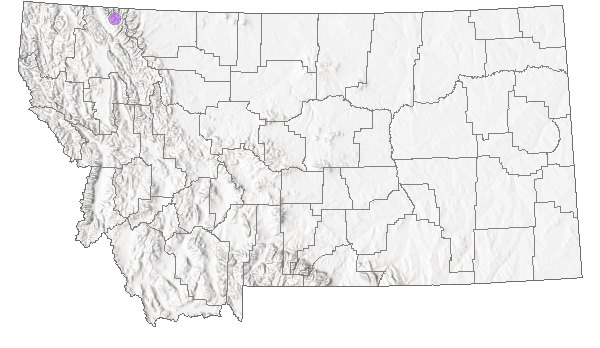
 Native
Range Comments
AK to w. OR; Siberia.
Observations in Montana Natural Heritage Program Database
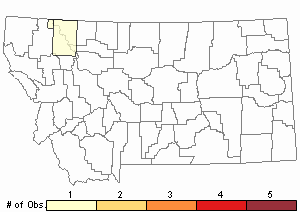
Number of Observations: 2
(Click on the following maps and charts to see full sized version)
Map Help and Descriptions
Relative Density
Recency
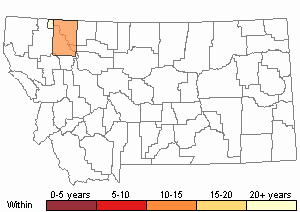
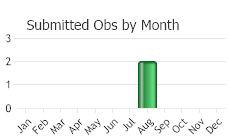
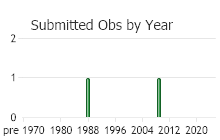
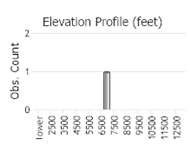 (Observations spanning multiple months or years are excluded from time charts)
Habitat
Moist, sparsely vegetated cliffs and talus slopes at or above timberline.
National Vegetation Classification System Groups Associated with this Species
Alpine
Alpine - Sparse and Barren
Wetland and Riparian
Alpine Riparian and Wetland
Stewardship Responsibility
Threats or Limiting Factors
STATE THREAT SCORE REASON
Threat impact not assigned because threats are not known (MTNHP Threat Assessment 2021).
References
- Literature Cited AboveLegend:
 View Online Publication
 MTNHP Threat Assessment. 2021. State Threat Score Assignment and Assessment of Reported Threats from 2006 to 2021 for State-listed Vascular Plants. Botany Program, Montana Natural Heritage Program, Helena, Montana.
- Additional ReferencesLegend: View Online Publication
Do you know of a citation we're missing?- Lesica, P. 1991. Noteworthy Collections in Montana....
- Lesica, P., M.T. Lavin, and P.F. Stickney. 2012. Manual of Montana Vascular Plants. Fort Worth, TX: BRIT Press. viii + 771 p.
- Lesica, P., M.T. Lavin, and P.F. Stickney. 2022. Manual of Montana Vascular Plants, Second Edition. Fort Worth, TX: BRIT Press. viii + 779 p.
- Web Search Engines for Articles on "Few-seeded Bittercress"