View in other NatureServe Network Field Guides
NatureServe
Montana
Utah
Wyoming
Idaho
Wisconsin
British Columbia
South Carolina
Yukon
California
New York
Parry's Mountain Rabbitbrush - Ericameria parryi var. montana
Other Names:
Chrysothamnus parryi ssp. montanus
State Rank Reason (see State Rank above)
Ericameria parryi variety montana has a worldwide range that spans Idaho and Montana. Of the four known occurrences, only one extends across the Idaho border into Montana. Population data on Ericameria parryi var. montana is over 35 years old. Threats have not been reported and the nature of its remote, alpine habitat presumes that the population may be stable, though its rarity puts the species at very high risk of state extirpation. Climate change including increased ambient temperatures, decreased snowpacks, and increased frequencies and severities of drought could have negative impacts on this single occurrence; however, field-based data is not available.
Surveys that bring forth current information on distributions, population counts, habitat conditions, and threats are greatly needed. Surveys of potentially suitable habitat in the area of the known occurrence are also needed to verify if other occurrences exist.
General Description
Chrysothamnus parryi ssp. montanus is a low growing, branching shrub with stems mostly covered by compacted, feltlike hairs (not always easy to see). It has linear leaves 0.5-1.5 inches long that are somewhat sticky to the touch. The inflorescence has one or a few heads and is overtopped by the uppermost stem leaves. Each head is about 0.5 inch long and usually contains 8-10 yellow disk flowers, but no ray flowers. The bracts forming the base of each head are lance-shaped with hairs spaced along the margins and long, pointed green tips. They overlay each other like shingles on a roof. The seeds have numerous long, thin, stiff hairs at the top.
Phenology
Flowering occurs in August - September.
Diagnostic Characteristics
Chrysothamnus parryi ssp. montanus is a low shrub with white stems, linear, glabrous leaves, the inflorescence overtopped by the uppermost leaves, and involucral bracts aligned in vertical ranks. This set of morphological characters combined with its high-elevation habitat distinguishes it from other similar species.
Species Range
Montana Range
Range Descriptions
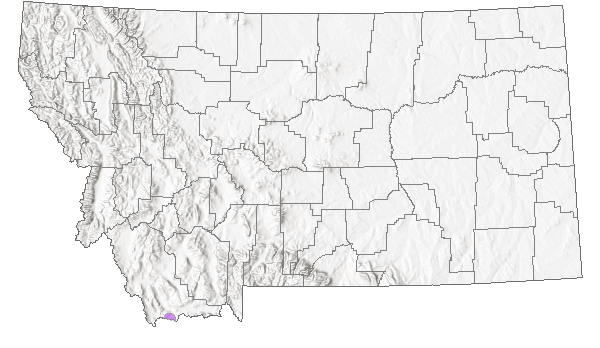
 Native
Range Comments
Ericameria parryi ssp. montanus is a narrow endemic known only from the Red Conglomerate Peaks area, near the Continental Divide, in the southern Beaverhead Range of Idaho and adjacent Montana. Its global distribution extends over an area approximately four miles wide by two miles wide. The four known occurrences are more or less evenly distributed across this limited range (Mancuso and Moseley 1990).
Observations in Montana Natural Heritage Program Database
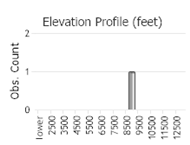
Number of Observations: 1
(Click on the following maps and charts to see full sized version)
Map Help and Descriptions
Relative Density
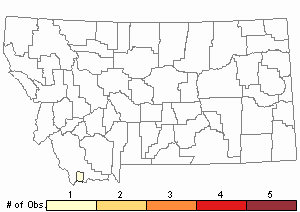
Recency
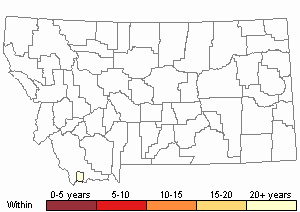

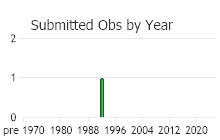
 (Observations spanning multiple months or years are excluded from time charts)
Habitat
Sparsely-vegetated, subalpine grasslands and slopes usually on calcareous, gravelly to rocky soils.
National Vegetation Classification System Groups Associated with this Species
Alpine
Alpine - Sparse and Barren
Alpine - Vegetated
Grassland
Montane - Subalpine Grassland
Ecology
POLLINATORS The following animal species have been reported as pollinators of this plant species or its genus where their geographic ranges overlap:
Bombus bifarius,
Bombus centralis,
Bombus huntii, and
Bombus melanopygus (Williams et al. 2014).
Stewardship Responsibility
Threats or Limiting Factors
Parry's Mountain Rabbitbrush is known from a single occurrence in Montana, in which its rarity puts the species at very high risk of state extirpation. Threats have not been reported though climate change poses a potential risk to the population. The MTNHP conducted a species-level assessment using the Climate Change Vulnerability Index (CCVI) in 2021, which resulted in an Extremely Vulnerable rating to climate change. Climate change including increased ambient temperatures, decreased snowpacks, and increased frequencies and severities of drought could have negative impacts on this single occurrence; however, field-based data is not available.
References
- Literature Cited AboveLegend:
 View Online Publication
 MTNHP Threat Assessment. 2021. State Threat Score Assignment and Assessment of Reported Threats from 2006 to 2021 for State-listed Vascular Plants. Botany Program, Montana Natural Heritage Program, Helena, Montana.
- Williams, P., R. Thorp, L. Richardson, and S. Colla. 2014. Bumble Bees of North America. Princeton, NJ: Princeton University Press. 208 p.
- Additional ReferencesLegend: View Online Publication
Do you know of a citation we're missing?- Anderson, L. C. 1978. New taxa in Chrysothamnus, section Nauseosi (Asteraceae). Phytologia 38(4): 309-320.
- Anderson, L. C. 1986. An overview of the genus Chrysothamnus (Asteraceae). Pages 29-45 in E. D. McArthur and B. L. Welch, compilers, Proceedings- Symposium on the Biology of Artemisia and Chrysothamnus. USDA Forest Service General Technical Report INT-200. Intermountain Research Station, Ogden, UT.
- Lesica, P. 1992. Conservation status of Chrysothamnus parryi ssp. montanus on Beaverhead National Forest, Montana. Montana Natural Heritage Program, Helena. 21 pp.
- Lesica, P., M.T. Lavin, and P.F. Stickney. 2012. Manual of Montana Vascular Plants. Fort Worth, TX: BRIT Press. viii + 771 p.
- Lesica, P., M.T. Lavin, and P.F. Stickney. 2022. Manual of Montana Vascular Plants, Second Edition. Fort Worth, TX: BRIT Press. viii + 779 p.
- Mancuso, M. and R.K. Moseley. 1990. Field investigation of Chrysothamnus parryi ssp. montanus: a Region 4 sensitive species on the Targhee National Forest. Boise, ID: Idaho Department of Fish and Game. 11 p. + appendices.
- U.S. Department of Agriculture, Forest Service. Idaho and Wyoming endangered and sensitive plant field guide. [n.d.]. Ogden, UT: U.S. Department of Agriculture, Forest Service, Intermountain Region. 192 p.
- U.S. Department of Agriculture, Forest Service. Idaho and Wyoming endangered and sensitive plant field guide. [n.d]. Ogden, UT: U.S. Department of Agriculture, Forest Service, Intermountain Region. Pp:86-87.
- Web Search Engines for Articles on "Parry's Mountain Rabbitbrush"