View in other NatureServe Network Field Guides
NatureServe
Montana
Utah
Wyoming
Idaho
Wisconsin
British Columbia
South Carolina
Yukon
California
New York
Single-head Pussytoes - Antennaria monocephala
State Rank Reason (see State Rank above)
DRAFT: Requesting feedback on the 2026 revised rank, factors, and State Rank Reason outlined below and in the Conservation Status Rank Report.
Antennaria monocephala is rare to uncommon on mesic, alpine slopes and ridges. Most occurrences are in remote, alpine areas with many in designated wilderness areas or within Glacier National Park. The remote habitat limits the potential for negative impacts, and no significant and widespread threats to the species are known besides potential impacts associated with climate change. Population levels and trends are unknown.
Climate change may negatively affect this species over the next several decades. However, the timing and magnitude of potential impacts are largely unknown. Although climate change is listed as a potential threat to the species, it does not affect the overall threat rank or scoring, or the final subnational rank.
Survey and monitoring data are needed to be able to determine population levels, assess condition and for assessing population trends. Surveys in potentially suitable habitat are likely to document additional occurrences.
General Description
Forming small clumps from a few-branched caudex; stolons absent. Stems erect, 1–10 cm. Basal leaves oblanceolate, 3–12 mm long, 1-nerved, less hairy above. Stem leaves linear, 4–11 mm long, flagged. Inflorescence a solitary (2 to 3) head; male plants absent. Involucre: female 5–8 mm high. Phyllaries blackish green. Corolla female 2–4 mm long. Pappus none. Achenes ca. 1 mm long, glabrous (
Lesica et al. 2012. Manual of Montana Vascular Plants. BRIT Press. Fort Worth, TX).
Species Range
Montana Range
Range Descriptions
 Native
Range Comments
Alaska and Yukon to Greenland and south in the Rocky Mountains to northwestern Montana and northern Wyoming.
Observations in Montana Natural Heritage Program Database
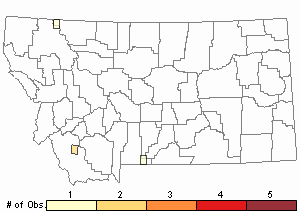
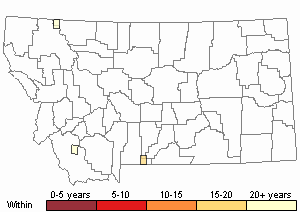
Number of Observations: 18
(Click on the following maps and charts to see full sized version)
Relative Density
Recency

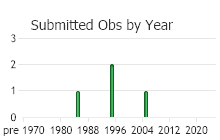
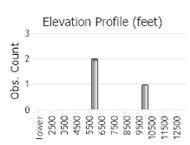 (Observations spanning multiple months or years are excluded from time charts)
Habitat
Alpine slopes and ridges.
Ecology
POLLINATORS The following animal species have been reported as pollinators of this plant species or its genus where their geographic ranges overlap:
Bombus pensylvanicus (Colla and Dumesh 2010).
Stewardship Responsibility
References
- Literature Cited AboveLegend:
 View Online Publication
 Colla, S.R. and S. Dumesh. 2010. The bumble bees of southern Ontario: notes on natural history and distribution. Journal of the Entomological Society of Ontario 141:39-68.
- Lesica, P., M.T. Lavin, and P.F. Stickney. 2012. Manual of Montana Vascular Plants. Fort Worth, TX: BRIT Press. viii + 771 p.
- Additional ReferencesLegend: View Online Publication
Do you know of a citation we're missing?- Lesica, P., M.T. Lavin, and P.F. Stickney. 2022. Manual of Montana Vascular Plants, Second Edition. Fort Worth, TX: BRIT Press. viii + 779 p.
- Web Search Engines for Articles on "Single-head Pussytoes"