View in other NatureServe Network Field Guides
NatureServe
Montana
Utah
Wyoming
Idaho
Wisconsin
British Columbia
South Carolina
Yukon
California
New York
Rydberg's Parsley - Musineon vaginatum
State Rank Reason (see State Rank above)
Musineon vaginatum is a regional endemic of Montana and Wyoming. Plants are found on rocky, limestone or calcareous soils predominantly in the Bridger Mountains, Pryor Mountains, and Bighorn Mountains in Wyoming and perhaps also on the Montana side. Populations are also present in western Montana near Missoula and the northern Bitterroot Valley where they are associated with Pseudotsuga menziesii (Douglas-fir) forests. Overall, the species' habitat appears to largely be intact and in good condition. Threats to the species have not been identified. Shifts in climate may negatively impact Musineon vaginatum over the next decade or longer, particularly from the effects of increased temperatures, and/or increased frequency and severity of droughts. However, impacts from a shifting climate remain unknown.
The conservation status rank of S3S4 indicates uncertainty in rarity, threats, and/or population trends. Surveys that bring forth information on distributions, population counts, habitat quality, and assess for potential threats is greatly needed to determine an accurate state rank. Monitoring of a subset of populations across its state range is also essential for evaluating potential trends.
General Description
Caulescent. Stems prostrate to ascending. 15–30 cm. Herbage glabrous. Leaves alternate; blades ovate in outline, subtripinnate; ultimate segments linear to oblong, 3–25 mm long. Umbels: peduncles 5–25 long, longer than the leaves; rays 5–40 mm long; involucel bracts 2–3 mm long. Flowers yellow or white. Mericarps 3–5 mm long, glabrous or scaberulous; oil tubes 1 to 4 per interval (
Lesica et al. 2012. Manual of Montana Vascular Plants. BRIT Press. Fort Worth, TX).
Species Range
Montana Range
Range Descriptions
 Native
Range Comments
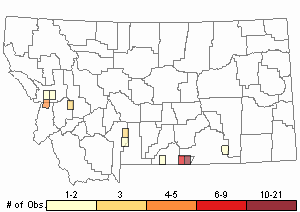
Regional endemic of south-central Montana and north-central Wyoming. Reports from northern Utah (Mathias and Constance 1944) are thought to be based on misidentified specimens.
Observations in Montana Natural Heritage Program Database
Number of Observations: 81
(Click on the following maps and charts to see full sized version)
Relative Density
Recency
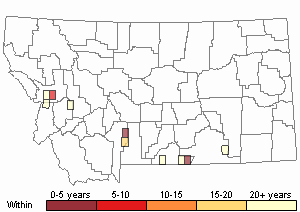

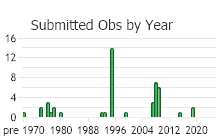
 (Observations spanning multiple months or years are excluded from time charts)
Habitat
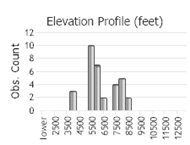
Stony, usually calcareous soil or talus in open, often Douglas-fir forest, woodlands; valleys to subalpine (
Lesica et al. 2012. Manual of Montana Vascular Plants. BRIT Press. Fort Worth, TX).
Stewardship Responsibility
References
- Literature Cited AboveLegend:
 View Online Publication
- Lesica, P., M.T. Lavin, and P.F. Stickney. 2012. Manual of Montana Vascular Plants. Fort Worth, TX: BRIT Press. viii + 771 p.
- Additional ReferencesLegend: View Online Publication
Do you know of a citation we're missing? Jones, W. W. 1901. Preliminary flora of Gallatin County. M.S. Thesis. Bozeman, MT: Montana State College. 78 pp.
- Lesica, P., M.T. Lavin, and P.F. Stickney. 2022. Manual of Montana Vascular Plants, Second Edition. Fort Worth, TX: BRIT Press. viii + 779 p.
- Web Search Engines for Articles on "Rydberg's Parsley"