View in other NatureServe Network Field Guides
NatureServe
Montana
Utah
Wyoming
Idaho
Wisconsin
British Columbia
South Carolina
Yukon
California
New York
A Diatom - Stauroneis smithii
General Description
Morphological Category – Symmetric biraphid
Valves elliptic-lanceolate to rhombic-lanceolate with triundulate margins and short apiculate apices. Pseudoseptum present at each apex. Axial area very narrow and linear, becoming wider near the central area. Central stauros narrow and linear. Raphe filiform with straight and weakly inflated proximal ends.
Striae weakly radiate throughout. Areolae closely spaced, 26-30 in 10 µm.
Size RangeLength 18-28 µm.
Width 5.8-7.7 µm.
Striae in 10 µm 25-30.
Useful Link:
Diatom Glossary [Diatoms of North America website]
Diagnostic Characteristics
Stauroneis smithii is one of the most widespread and easily identified species of Stauroneis in the United States.
Compared to Stauroneis smithii, Stauroneis separanda has smaller valves with more prominent apices. Unlike small valves of Stauroneis smithii, which have smooth margins, small valves of Stauroneis separanda have triundulate margins. Valves of Stauroneis smithii var. incisa have a higher stria density and are larger and less undulate.
Range Comments
Type Locality Austria
Global Distribution Widely distributed.
Western North America
Number of Observations in Montana Diatom Collection Database, 1968-2024 (Bahls): 322
Montana: 230
Observations in Montana Natural Heritage Program Database
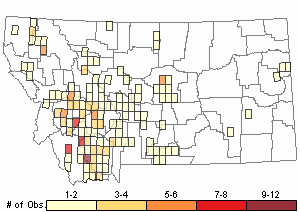
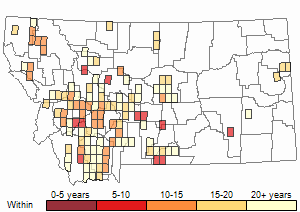
Number of Observations: 240
(Click on the following maps and charts to see full sized version)
Map Help and Descriptions
Relative Density
Recency
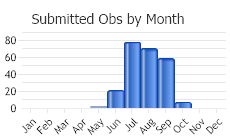
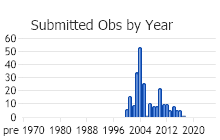
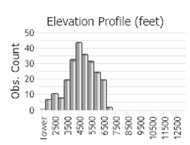 (Observations spanning multiple months or years are excluded from time charts)
Habitat
Mainly rivers and streams; also lakes, ponds and wetlands (Bahls 2021).
Ecology
As an ecological generalist, Stauroneis smithii is widely distributed in a variety of habitats under varied water quality conditions (Bahls 2021). It is seldom found in abundance.
Reproductive Characteristics
Diatoms typically reproduce by cell division (mitosis) and occasionally by meiosis—sexual reproduction in which female and male gametes combine to form a specialized zygote called an auxospore (Amato 2010). Repeated divisions result in cells of a population becoming progressively smaller and smaller. When cells reach a critically small size, sexual reproduction is initiated, resulting in an auxospore and initial cells that are the largest attainable for the species, after which cell division and size reduction resume.
Stewardship Responsibility
Threats or Limiting Factors
None are apparent (Bahls 1968-Present; Bahls 2021).
References
- Literature Cited AboveLegend:
 View Online Publication
 Amato, A. 2010. Diatom reproductive biology: living in a crystal cage. The International Journal of Plant Reproductive Biology 2(1): 1-10.
- Bahls, Loren. 1968-Present. Montana Diatom Collection Database. Missoula, Montana.
- Bahls, Loren. 2021. Diatoms of Montana and Western North America: Catalog and Atlas of Species in the Montana Diatom Collection Volume 1. The Academy of Natural Sciences of Philadelphia Special Publication 24. 508pp.
- Additional ReferencesLegend: View Online Publication
Do you know of a citation we're missing?- Bahls, L. 2026. Stauroneis species and morphospecies from western North America: exploring the limits and limitations of precisely‐defined diatom species Diatoms from western North America 5, Montana Diatom Collection, Missoula. 1–150, 107 plates. ISBN 979‐8‐90417‐243‐5
- Bahls, L.L. 1971. Ecology of the diatom community of the upper East Gallatin River, Montana with in situ experiments on the effect of current velocity on features of the aufwuchs. Ph.D. Dissertation. Bozeman, MT: Montana State University. 145 p.
- Bahls, Loren. 2010. Stauroneis in the Northern Rockies: 50 species of Stauroneis sensu stricto from western Montana, northern Idaho, northeastern Washington and southwestern Alberta, including 16 species described as new. Northwest Diatoms, Volume 4. The Montana Diatom Collection, Helena, 172 pp.
- Foris, W.J. 1976. A comparison of diatoms on horizontal and vertical substrates in Georgetown Lake, Montana. M.Sc. Thesis. Bozeman, MT: Montana State University. 98 p.
- Montana Diatom Collection. 1968-Present. The Montana Diatom Collection at The University of Montana Herbarium (MONTU). Giovanna Bishop, Curator and Collections Manager, MONTU, University of Montana, Missoula, Montana.
- Patrick, R.M. and C.W. Reimer. 1966. The Diatoms of the United States Exclusive of Alaska and Hawaii. Volume 1. Monographs of the Academy of natural Sciences of Philadelphia 13.
- Roeder, T. 1966. Ecology of the diatom communities of the upper Madison River system, Yellowstone National Park. Ph.D. Dissertation. Bozeman, MT: Montana State University. 67 p.
- Web Search Engines for Articles on "A Diatom"