View in other NatureServe Network Field Guides
NatureServe
Montana
Utah
Wyoming
Idaho
Wisconsin
British Columbia
South Carolina
Yukon
California
New York
Taiga Bluet - Coenagrion resolutum
General Description
The Taiga Bluet is found at a wide variety of still-water habitats at higher elevations or northern latitudes. It can probably tolerate a colder climate than any other damselfly in Montana. Considering the types of places it is found it emerges very early in the spring.
Phenology
Adult Flight Season: late-April to July
Diagnostic Characteristics
This is a small damselfly 1 ¼ to 1 ½ inches (31 to 37 mm) long. The males are predominately blue on the sides of the thorax, and the upper side of the abdomen is predominantly black, with a distinctive "U" shaped marking on the upper surface of the 2nd abdominal segment. The blue is paler than for most Bluets (Paulson 2000).
Species Range
Montana Range
Range Descriptions
 Native
Range Comments
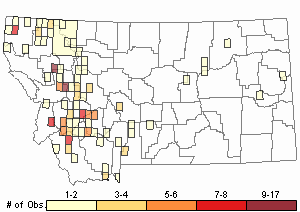
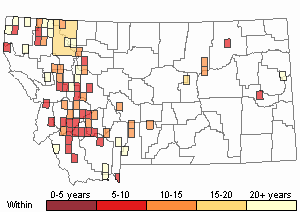
This species is found from Alaska east to Hudson Bay and south to northern California and New York. In Montana it occurs at higher elevations in the west-central and northern parts of the state.
Observations in Montana Natural Heritage Program Database
Number of Observations: 197
(Click on the following maps and charts to see full sized version)
Relative Density
Recency
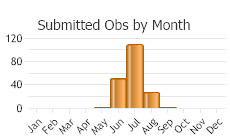
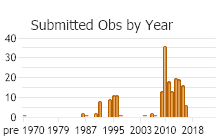
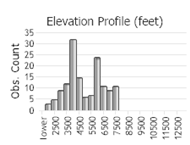 (Observations spanning multiple months or years are excluded from time charts)
Habitat
The habitat of the Taiga Bluet includes marshes and fens of sedge, as well as vegetated ponds, spring-fed pools and streams, and sedge beds of large lakes that are mostly semipermanent (Westfall and May 1996, Nikula et al. 2002, Acorn 2004, Paulson 2009). Unlike the Prairie Bluet (Coenagrion angulatum), which prefers open sunny habitats, the Taiga Bluet selects habitats that are at least partly shaded (Acorn 2004).
National Vegetation Classification System Groups Associated with this Species
Wetland and Riparian
Alkaline - Saline Wetlands
Alpine Riparian and Wetland
Peatland
Riparian and Wetland Forest
Wet Meadow and Marsh
Food Habits
Larvae feed on a wide variety of aquatic insects, such as mosquito larvae, other aquatic fly larvae, mayfly larvae, and freshwater shrimp.
Adult- This damselfly will eat almost any soft-bodied flying insect including mosquitoes, flies, small moths, mayflies, and flying ants or termites.
Reproductive Characteristics
Male Taiga Bluets rapidly patrol through vegetation searching for females. This species tends to stay close to dense vegetation rarely appearing over open water. Oviposition is usually completed by tandem pair on floating and emergent stems just below the waterline (Nikula et al. 2002, Paulson, 2009).
Stewardship Responsibility
References
- Literature Cited AboveLegend:
 View Online Publication
- Acorn, J. 2004. Damselflies of Alberta: flying neon toothpicks in grass. Edmonton, Alberta: University of Alberta Press. 156 pp.
- Paulson, D.R. 2009. Dragonflies and Damselflies of the West. Princeton University Press, Princeton. 535 pp.
 Westfall, M.J., Jr. and M.L. May. 1996. Damselflies of North America. Scientific Publishers, Gainesville, Florida. 649 pp.
- Additional ReferencesLegend: View Online Publication
Do you know of a citation we're missing?- Dunkle, S.W. 2000. Dragonflies through binoculars: A field guide to dragonflies of North America. New York, NY. Oxford University Press. 266 pp.
- Sater, S. 2022. The insects of Sevenmile Creek, a pictorial guide to their diversity and ecology. Undergraduate Thesis. Helena, MT: Carroll College. 242 p.
- Web Search Engines for Articles on "Taiga Bluet"
- Additional Sources of Information Related to "Insects"