View in other NatureServe Network Field Guides
NatureServe
Montana
Utah
Wyoming
Idaho
Wisconsin
British Columbia
South Carolina
Yukon
California
New York
Emma's Dancer - Argia emma
State Rank Reason (see State Rank above)
Emma's Dancer damselfly is currently listed as an "S3S5" species of potential concern in Montana because they are potentially at risk because of limited and/or declining numbers, range and/or habitat, even though it may be abundant in some areas.
General Description
We do not yet have descriptive information on this species. Please try the buttons above to search for information from other sources.
Species Range
Montana Range
Range Descriptions
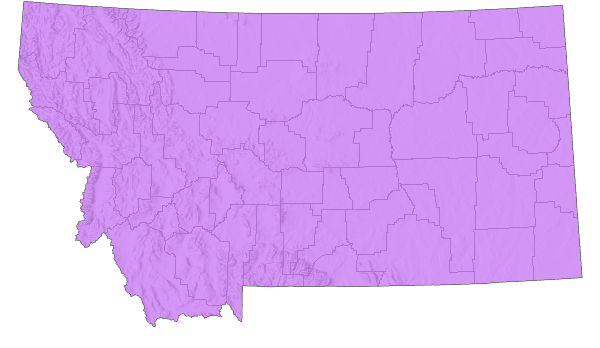
 Native
Range Comments
Primarily a Western U.S species (Westfall and May 1996). Records from Colorado, Utah, southern Oregon, Idaho, Montana, Nevada, western Kansas, Nebraska, south Dakota, east to Iowa, northern Arizona, northern New Mexico, and California. Currently, Emma's Dancers are known from rivers in western, central and eastern areas of the state.
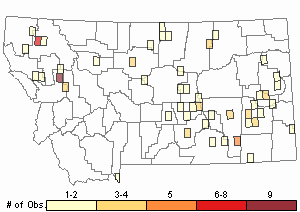
Observations in Montana Natural Heritage Program Database
Number of Observations: 101
(Click on the following maps and charts to see full sized version)
Map Help and Descriptions
Relative Density
Recency
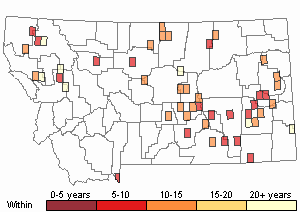
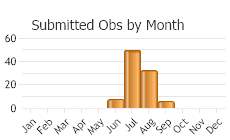
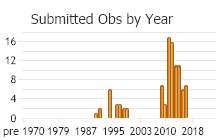
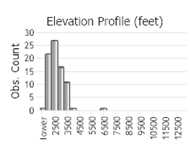 (Observations spanning multiple months or years are excluded from time charts)
Habitat
Emma's Dancers occur in rapid rocky mountain streams and moderate to large rivers with sandy or mud substrates and open or shrubby banks, as well as large lakes with open rocky shores in forested and open landscapes (Westfall and May 1996; Paulson 2009). Miller and Gustafson (1996) have reported them as abundant in cool springs as well.
Larvae Emma's Dancers are apparently difficult to collect as they occupy the entire streambed and are quick to scatter when disturbed (Westfall and May 1996).
National Vegetation Classification System Groups Associated with this Species
Wetland and Riparian
Riparian and Wetland Forest
Riparian Shrubland
Food Habits
Larvae feed on a wide variety of aquatic insects, such as mosquito larvae, other aquatic fly larvae, mayfly larvae, and freshwater shrimp.
Adult- This damselfly will eat almost any soft-bodied flying insect including mosquitoes, flies, small moths, mayflies, and flying ants or termites.
Reproductive Characteristics
Emma's Dancer males are quite common at breeding sites. Females more commonly found in uplands. Pairs likely form away from water and tend to cluster at oviposition sites, where tandem pair lays eggs into floating vegetation, streamside tree rootlets, and emergent shoreline vegetation (Paulson 2009).
Stewardship Responsibility
References
- Literature Cited AboveLegend:
 View Online Publication
 Miller, K.B. and D.L. Gustafson. 1996. Distribution records of the Odonata of Montana. Bulletin of American Odonatology 3(4):75-88.
- Westfall, M.J., Jr. and M.L. May. 1996. Damselflies of North America. Scientific Publishers, Gainesville, Florida. 649 pp.
- Additional ReferencesLegend: View Online Publication
Do you know of a citation we're missing?- Acorn, J. 2004. Damselflies of Alberta: flying neon toothpicks in grass. Edmonton, Alberta: University of Alberta Press. 156 pp.
- Dunkle, S.W. 2000. Dragonflies through binoculars: A field guide to dragonflies of North America. New York, NY. Oxford University Press. 266 pp.
- Kennedy, C.H. 1918. New species of Odonata from the southwestern United States. Part I. Three new Argias. Canad. Entomol. vol. 50, no. 8, 256-261.
- Paulson, D.R. 2009. Dragonflies and Damselflies of the West. Princeton University Press, Princeton. 535 pp.
- Web Search Engines for Articles on "Emma's Dancer"
- Additional Sources of Information Related to "Insects"