View in other NatureServe Network Field Guides
NatureServe
Montana
Utah
Wyoming
Idaho
Wisconsin
British Columbia
South Carolina
Yukon
California
New York
Poison Hemlock Moth - Agonopterix alstroemeriana
Native Species
Global Rank:
GNR
State Rank:
SNR
(see State Rank Reason below)
Agency Status
USFWS:
USFS:
BLM:
State Rank Reason (see State Rank above)
Agonopterix alstroemeriana was accidentally introduced into the USA, and first reported in New York state in 1973 (Winston et al. 2014 and 216). In Europe and the USA, Agonopterix alstroemeriana's only known host plant is Conium maculatum, Poison Hemlock (Pokorny et al. 2018). Conium maculatum is not native to the USA. By 1983, the moth was documented in California, Oregon, and Utah (Winston et al. 2014 and 216). The moth occurs in Montana though information on its distribution and abundance, along with its impact on Conium maculatum plants, is greatly needed. A conservation status rank is not applicable (SNA) because Agonopterix alstroemeriana is a non-native moth in Montana that is not a suitable target for conservation activities.
General Description
Poison Hemlock Moth (Agonopterix alstroemeriana) is a member of the Family Depressariidae.
ADULTS: Speckled brownish-gray moths that have a dark brown spot on each wing. Adults grow to about 10 mm long and have an 18mm wide wingspan. Source: Winston et al. 2016
LARVAE: Early instar larvae are mostly yellow with black head capsules. Later instar larvae are light green with three dark green, longitudinal stripes. Mature larvae grow up to 12 mm long. Pupal cases are reddish-brown. Source: Winston et al. 2016
EGGS: Cylindrical, pale yellow. Source: Winston et al. 2016
Diagnostic Characteristics
Useful & Interactive ResourceLepidoptera of North America, north of Mexico: An annotated list containing geographic ranges and host-plant records (Shropshire and Tallamy 2025).
Species Range
Montana Range
Range Descriptions
 Native
Range Comments
INTRODUCTION [Adapted from Winston et al. 2014 and 2016]
Poison Hemlock Moth was not intentionally introduced into North America as a biocontrol agent. The origin from where it came is unknown. Rather, the moth was first documented in the USA in New York state in 1973. By 1983 the moth was found in California, Oregon, and Utah. The U.S. Department of Agriculture-Animal and Plant Health Inspection Service (USDA-APHIS) is the federal agency responsible for providing testing guidelines and authorizing the importation of biocontrol agents in the USA. Since then, the USDA-APHIS granted redistribution permits which allows the moth to be moved to where Poison Hemlock populations occur.
Since its arrival to the USA, the moth has spread rapidly. It is widespread and abundant in all western states.
Observations in Montana Natural Heritage Program Database
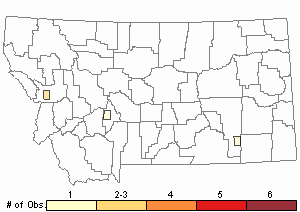
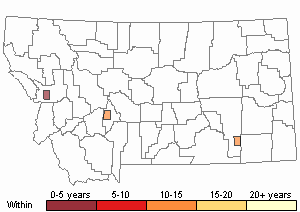
Number of Observations: 7
(Click on the following maps and charts to see full sized version)
Relative Density
Recency
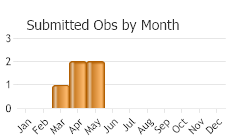
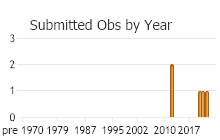
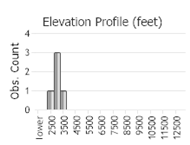 (Observations spanning multiple months or years are excluded from time charts)
Habitat
Specific information about their habitat is unknown (Winston et al. 2014 and 2016).
HOST PLANTPoison Hemlock Moth feeds on Poison Hemlock (
Conium maculatum) plants (Winston et al. 2014 and 2016). The larvae feeds on leaves, buds, immature seeds, stems, and flowers from spring to early summer (Pokorny et al. 2018). Adults who emerge in the summer also feed on leaves, though less than the larvae (Pokorny et al. 2018).
Ecology
DAMAGE TO PLANTS [Adapted from Winston et al. 2014 and 2016]
High populations of Poison Hemlock Moth can severely damage Poison Hemlock plants, resulting in lower seed production and plant mortality. However, stands of Poison Hemlock plants often recover and resume growth after the larvae pupate in mid-summer. Changes to the density of Poison Hemlock stands have not been documented. The overall impact to the plant appears to be limited.
Reproductive Characteristics
LIFE CYCLE [Adapted from Winston et al. 2014 and 2016]
Poison Hemlock Moths produce one generation per year. Adults emerge in early spring to mate. Eggs are oviposited in spring on the undersides of Poison Hemlock leaves. Larvae hatch and feed on leaves, creating tubes of leaf particles. If disturbed, larvae abandon their leaf tubes and drop to the ground. Larvae develop through 5-stages (instars). Late-instar larvae incorporate flower tissue into their tubes. Larvae pupate in the soil. New adults emerge from the soil in mid-summer. Adults overwinter in the soil and plant litter.
Adults are nocturnal. During the day they are in resting places.
Management
BIOLOGICAL CONTROL [Adapted from Winston et al. 2014 and 2016]
Poison Hemlock Moth was accidentally introduced into the USA, but has been permitted by the USDA-APHIS for redistribution to control Poison Hemlock (Conium maculatum) plants. However, its limited impact on stands makes it a low priority for redistribution in the USA. As of 2016, Poison Hemlock Moth is not approved for release in Canada to control Poison Hemlock plants.
Poison Hemlock Moth is recommended to use in places where this insect and other methods are not available to control Poison Hemlock populations. Additional recommendations include:
* Always wear rubber gloves and protective clothing when cutting and handling Poison Hemlock to prevent accidental poisoning and other health risks.
* Hand-collect larvae with the Poison Hemlock foliage in the spring.
* Transfer the larvae with foliage to new sites in groups of 50-100.
* Monitor establishment by observing new larvae on Poison Hemlock foliage in the following spring and summer.
Stewardship Responsibility
References
- Literature Cited AboveLegend:
 View Online Publication
- Pokorny, Monica, Stacy Davis, and Jane Mangold. 2018. Poison Hemlock, Conium maculatum. Montguide MT200013AG. Revised January 2018. Montana State University Extension, Bozeman, Montana.
- Shropshire, K.J. and D.W. Tallamy. 2025. Lepidoptera of North America, north of Mexico: an annotated list containing geographic ranges and host-plant records. Zookeys.1261:101-113.
 Winston, R.L., M Schwarzlander, H.L. Hinz, M.D. Day, M.J.W. Cock, and M.H. Julien, Eds. 2014. Biological Control of Weeds: A World Catalogue of Agents and Their Target Weeds, 5th edition. USDA Forest Service, Forest health Technology Enterprise team, Morgantown, West Virginia. FHTET-2014-04. 838 pp.
- Winston, Rachel L., Carol Bell Randdall, Rosemarie De Clerck-Floate, Alec McClay, Jennifer Andreas, and Mark Schwarzlander. 2016. Field Guide For The Biological Control of Weeds In The Northwest. August 2016 Reprint. FHTET-2014-08. Forest Health Technology Enterprise Team, University of Idaho Extension and USDA Department of Agriculture.
- Web Search Engines for Articles on "Poison Hemlock Moth"
- Additional Sources of Information Related to "Insects"