View in other NatureServe Network Field Guides
NatureServe
Montana
Utah
Wyoming
Idaho
Wisconsin
British Columbia
South Carolina
Yukon
California
New York
Hooded Merganser - Lophodytes cucullatus
State Rank Reason (see State Rank above)
Species breeds in forested wetlands across western and southwestern Montana. Short-term trend is not well studied. Threats are generally low but include loss of mature trees adjacent to waterbodies used for breeding due to fire and harvest.
General Description
The Hooded Merganser is a small (length 46 cm) duck with a thin, serrated bill and a puffy crest. The adult male has a black head with a large white patch on each side, a dark back, brown flanks, and a white chest with two black bars on each side. The adult female is brownish overall, with a yellowish lower mandible. The first-winter male resembles the female. In flight, both sexes show black-and-white inner secondaries (Peterson 1980).
For a comprehensive review of the conservation status, habitat use, and ecology of this and other Montana bird species, please see
Marks et al. 2016, Birds of Montana.Diagnostic Characteristics
They differ from other mergansers in being smaller, having white head patches (males), and by lacking a red bill. They differ from the Bufflehead by lacking white sides.
Species Range
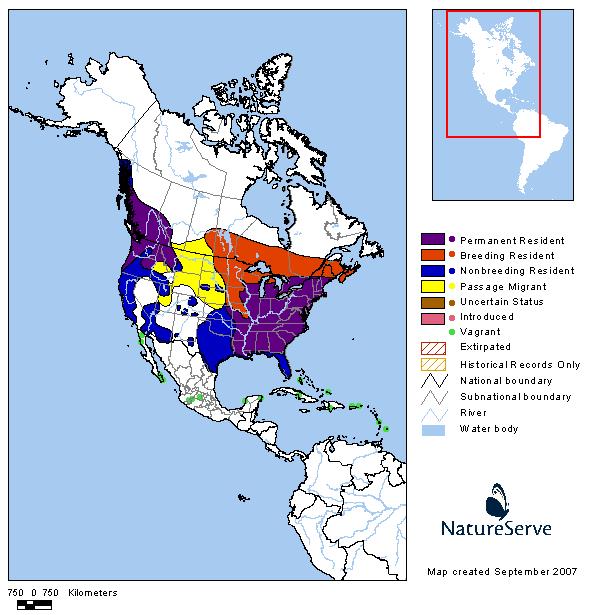
Montana Range
Range Descriptions
Western Hemisphere Range
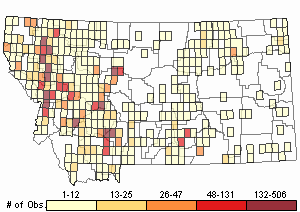
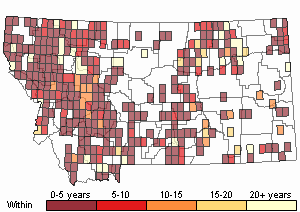
Observations in Montana Natural Heritage Program Database
Number of Observations: 6703
(Click on the following maps and charts to see full sized version)
Relative Density
Recency
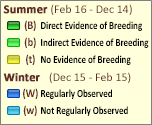
SUMMER (Feb 16 - Dec 14)
Direct Evidence of Breeding
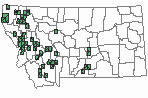
Indirect Evidence of Breeding
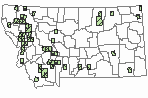
No Evidence of Breeding
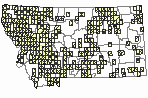
WINTER (Dec 15 - Feb 15)
Regularly Observed
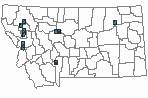
Not Regularly Observed
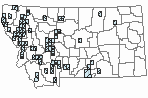
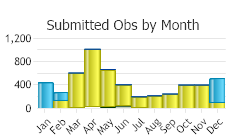
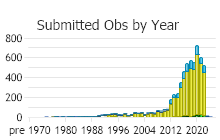
 (Observations spanning multiple months or years are excluded from time charts)
Migration
Montana birds that do not overwinter in the state presumably migrate to the west coast (Skaar personal communication). Migration records are from late February to early April and from September to October.
Habitat
Closely associated with forested wetland systems range-wide; a broad range of breeding habitats includes emergent marshes, small lakes, ponds, beaver wetlands, forested creeks and rivers, and swamps (Dugger et al. 2009). Hooded Mergansers are generally found in river areas bounded by woods and supporting good fish populations associated with clear water (Johnsgard 1992).
National Vegetation Classification System Groups Associated with this Species
Wetland and Riparian
Alkaline - Saline Wetlands
Alpine Riparian and Wetland
Peatland
Riparian and Wetland Forest
Riparian Shrubland
Wet Meadow and Marsh
Food Habits
The Hooded Merganser's diet consists primarily of aquatic insects, fish, and crustaceans (particularly crayfish) (Dugger et al. 2009).
Ecology
Females exhibit strong fidelity to breeding areas (Dugger et al. 2009).
Reproductive Characteristics
The Hooded Merganser is a cavity nester using live or dead trees. Its eggs are unusual in being almost spherical with disproportionately thick shells. The eggs are white in color. The normal clutch size is not greater than 13 (Dugger et al. 2009). Hatching dates near Fortine are for early June. Breeding occurs statewide from late June to the end of July.
Management
Beneficial management could include establishing and maintaining cavity producing trees, and maintaining forested riparian corridors and forests within 1 km of suitable brood habitat (Dugger et al. 2009).
Stewardship Responsibility
References
- Literature Cited AboveLegend:
 View Online Publication
- Johnsgard, P.A. 1992. Birds of the Rocky Mountains with particular reference to national parks in the northern Rocky Mountain region. Lincoln: University of Nebraska Press. xi + 504 pp.
- Marks, J.S., P. Hendricks, and D. Casey. 2016. Birds of Montana. Arrington, VA. Buteo Books. 659 pages.
 Peterson, R.T. 1980. A field guide to the birds east of the Rockies. Houghton Mifflin Company. 383 pp.
- Skaar, P.D. 1969. Birds of the Bozeman latilong: a compilation of data concerning the birds which occur between 45 and 46 N. latitude and 111 and 112 W. longitude, with current lists for Idaho, Montana, Wyoming, impinging Montana counties and Yellowstone National Park. Bozeman, MT. 132 p.
- Additional ReferencesLegend: View Online Publication
Do you know of a citation we're missing?- [WWPC] Washington Water Power Company. 1995. 1994 wildlife report Noxon Rapids and Cabinet Gorge Reservoirs. Washington Water Power Company. Spokane, WA.
- American Ornithologists’ Union [AOU]. 1998. Check-list of North American birds, 7th edition. American Ornithologists’ Union, Washington, D.C. 829 p.
- Cameron, E. S. 1907. The birds of Custer and Dawson counties, Montana. Auk 24(3): 241-270.
- Casey, D. 2000. Partners in Flight Draft Bird Conservation Plan Montana. Version 1.0. 287 pp.
- Confluence Consulting Inc. 2010. Montana Department of Transportation Wetland Mitigation Monitoring Reports (various sites). MDT Helena, MT.
- Dickson, D.C. 1991. Systematic wildlife observations on the Blackfoot-Clearwater Wildlife Management Area. Montana Department of Fish, Wildlife and Parks. Missoula, MT. 14 pp. plus appendices and photographs.
- Dugger, B.D., K.M. Dugger, and L.H. Fredrickson. 1994. Hooded Merganser (Lophodytes cucullatus). Species Account Number 098. The Birds of North America Online (A. Poole, Ed.). Ithaca, NY: Cornell Laboratory of Ornithology; Retrieved 3/25/2008 from The Birds of North America Online database
- Ehrlich, P., D. Dobkin, and D. Wheye. 1988. The birder’s handbook: a field guide to the natural history of North American birds. Simon and Schuster Inc. New York. 785 pp.
- Hays, R., R.L. Eng, and C.V. Davis (preparers). 1984. A list of Montana birds. Helena, MT: MT Dept. of Fish, Wildlife & Parks.
- Johnsgard, P.A. 1979. Birds of the Great Plains: breeding species and their distribution. University of Nebraska Press, Lincoln. 539 pp.
- Joslin, Gayle, and Heidi B. Youmans. 1999. Effects of recreation on Rocky Mountain wildlife: a review for Montana. [Montana]: Montana Chapter of the Wildlife Society.
- Lenard, S., J. Carlson, J. Ellis, C. Jones, and C. Tilly. 2003. P. D. Skaar's Montana bird distribution, 6th edition. Montana Audubon, Helena, MT. 144 pp.
- Montana Bird Distribution Committee. 2012. P.D. Skaar's Montana bird distribution. 7th Edition. Montana Audubon, Helena, Montana. 208 pp. + foldout map.
- MT Fish, Wildlife & Parks. No date. Blackfoot-Clearwater Wildlife Management Area checklist.
- Oechsli, L.M. 2000. Ex-urban development in the Rocky Mountain West: consequences for native vegetation, wildlife diversity, and land-use planning in Big Sky, Montana. M.Sc. Thesis. Montana State University, Bozeman. 73 p.
- Palmer, R.S. 1962. Handbook of North American birds. Volume 1. Loons through flamingos. Yale University Press, New Haven. 567 pp.
- Powder River Eagle Studies, Inc., Gillette, WY., 1999, Spring Creek Mine 1998 Wildlife Monitoring. March 1999.
- Rhodes, O.E., Jr., L.M. Smith and M.H. Smith. 1991. Conservation and genetic resources in waterfowl. Trans. N. Amer. Wildl. & Nat. Res. Conf. 56:462-472.
- Salt, W.R. and J.R. Salt. 1976. The birds of Alberta. Hurtig Publishers, Edmonton, Alberta. xv + 498 pp.
- Sater, S. 2022. The insects of Sevenmile Creek, a pictorial guide to their diversity and ecology. Undergraduate Thesis. Helena, MT: Carroll College. 242 p.
- Sea Duck Joint Venture Management Board. 2001. Sea Duck Joint Venture Strategic Plan: 2001-2006. SDJV Continental Technical Team. Unpubl. report c/o USFWS, Anchorage, AK; CWS, Sackville, New Brunswick. 14 p. plus appendices.
- Sibley, D. 2014. The Sibley guide to birds. Alfred A. Knopf, New York, NY. 598 pp.
- Skaar, P. D., D. L. Flath, and L. S. Thompson. 1985. Montana bird distribution. Montana Academy of Sciences Monograph 3(44): ii-69.
- Stewart, R.E. 1975. Breeding birds of North Dakota. Tri-College Center for Environmental Studies, Fargo, North Dakota. 295 pp.
- Swan River National Wildlife Refuge. 1982. Birds of the Swan River NWR. Kalispell, MT: NW MT Fish and Wildlife Center pamphlet.
- Thompson, L.S. 1981. Circle West wildlife monitoring study: Third annual report. Technical report No. 8. Montana Department of Natural Resources and Conservation. Helena, Montana.
- U.S. Forest Service. 1991. Forest and rangeland birds of the United States: Natural history and habitat use. U.S. Department of Agriculture, Forest Service Agricultural Handbook 688. 625 pages.
- Watts, C.R. and L.C. Eichhorn. 1981. Changes in the birds of central Montana. Proceedings of the Montana Academy of Sciences 40:31-40.
- Western Energy Co., Colstrip, MT., 1981, Western Energy Company Rosebud Mine, Colstrip, Montana: Annual Wildlife Report, 1981.
- Zicus, M.C. 1990. Nesting biology of hooded mergansers using nest boxes. J. Wildl. Manage. 54(4):637-643.
- Web Search Engines for Articles on "Hooded Merganser"
- Additional Sources of Information Related to "Birds"