View in other NatureServe Network Field Guides
NatureServe
Montana
Utah
Wyoming
Idaho
Wisconsin
British Columbia
South Carolina
Yukon
California
New York
Ross's Goose - Anser rossii
Native Species
Global Rank:
G4
State Rank:
S5M
(see State Rank Reason below)
Agency Status
USFWS:
MBTA
USFS:
BLM:
PIF:
State Rank Reason (see State Rank above)
Species is an uncommon migrant through Montana. Populations are increasing and it faces no threats.
General Description
Ross's Goose is the smallest of three varieties of white (snow) geese that breed in North America. White with black primaries. Mean length: male 621.3 mm, female 587.6 mm. Mass: male 1484 g, female 1340 g. Species is monochromatic and sexually dimorphic. Plumage is similar to white morph of Greater and Lesser Snow geese. The relatively short neck of Ross's Goose gives it an abbreviated silhouette. Feather of lore meet base of maxilla forming a straight line instead of a forward curved arc typical of Greater and Lesser Snow Geese. Head, usually lacking an orange ferrous stain frequently found on Greater and Lesser Snow Geese, is diminutive and rounded (Ryder and Alisauskas 1995).
For a comprehensive review of the conservation status, habitat use, and ecology of this and other Montana bird species, please see
Marks et al. 2016, Birds of Montana.Species Range
Montana Range
Range Descriptions
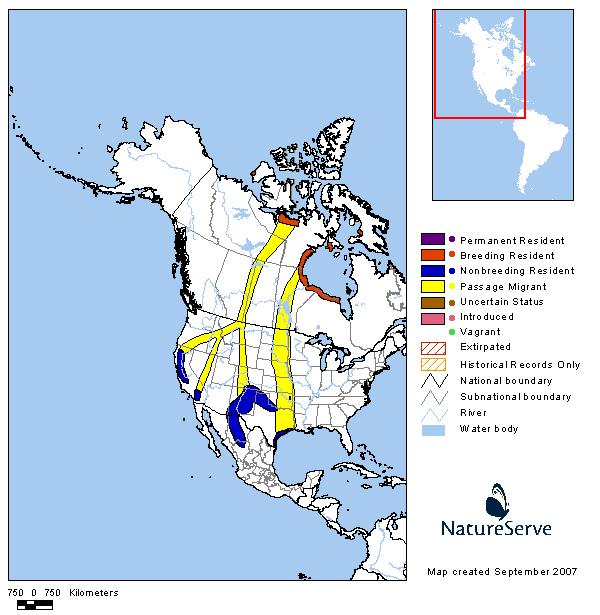
 Migratory
Western Hemisphere Range
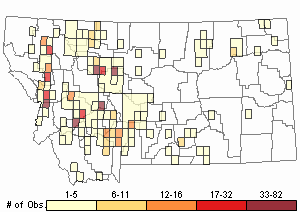
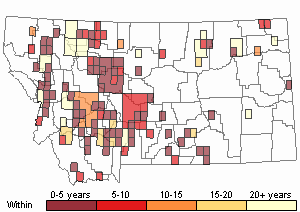
Observations in Montana Natural Heritage Program Database
Number of Observations: 865
(Click on the following maps and charts to see full sized version)
Relative Density
Recency
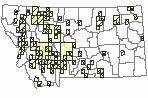
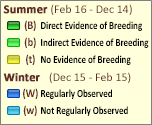
SUMMER (Feb 16 - Dec 14)
Direct Evidence of Breeding
Indirect Evidence of Breeding
No Evidence of Breeding
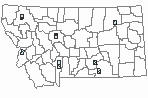
WINTER (Dec 15 - Feb 15)
Regularly Observed
Not Regularly Observed
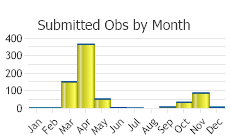
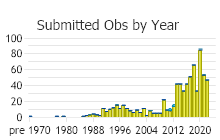
 (Observations spanning multiple months or years are excluded from time charts)
Migration
Most migration occurs through northwest and west-central Montana. Single or small groups of Ross's geese often migrate with Snow Geese. About 20,000 to 40,000 stop at Freezeout Lake Wildlife Management Area each spring and fall; this is approximately 20% of the total world population (Schwitters, personal communication).
Habitat
Low arctic tundra. Currently about 95% of all Ross's Geese nest in the Queen Maud Gulf Migratory Bird Sanctuary in central Canadian Arctic. Landscape is dominated by flat plain or postglacial marine emergence. The main wintering area for the species is presently in the Central Valley of California. It seldom associates with the largest snow goose, Greater Snow Goose; but is often found in the company of the intermediate-sized Lesser Snow Goose. During spring and fall migration feeds and roosts in marshes. In northeast California, uses grain fields and wet meadows for foraging (Ryder and Alisauskas 1995).
National Vegetation Classification System Groups Associated with this Species
Wetland and Riparian
Alkaline - Saline Wetlands
Peatland
Wet Meadow and Marsh
Human Land Use
Agriculture
Food Habits
Strictly vegetarian. Foods taken include grasses, sedges, legumes, and domestic grains (Ryder and Alisauskas 1995).
Reproductive Characteristics
Nests on the ground, preferably in areas with a variety of low vegetation or rock/gravel that provide protections from wind. Eggs are near subelliptical, nonglossy white or light cream colored. Clutch size is 2 to 6 eggs, usually 4. At Arlone and Karrak lakes, laying occurs in first 3 weeks in June, with peak normally in first to second week. Hatching occurs from late June to mid-July, with peak in first to second week in July (Ryder and Alisauskas 1995).
Stewardship Responsibility
References
- Literature Cited AboveLegend:
 View Online Publication
- Marks, J.S., P. Hendricks, and D. Casey. 2016. Birds of Montana. Arrington, VA. Buteo Books. 659 pages.
 Schwitters, Michael T. Choteau, MT. (406)466-2236. Email: schwit@3rivers.net. Personal communication to the Montana Natural Heritage Program.
- Additional ReferencesLegend: View Online Publication
Do you know of a citation we're missing?- American Ornithologists’ Union [AOU]. 1998. Check-list of North American birds, 7th edition. American Ornithologists’ Union, Washington, D.C. 829 p.
- Cameron, E. S. 1907. The birds of Custer and Dawson counties, Montana. Auk 24(3): 241-270.
- Dzubin, A. 1965. A study of migrating RossGeese in western Saskatchewan. Condor 67: 511-534.
- Ehrlich, P., D. Dobkin, and D. Wheye. 1988. The birder’s handbook: a field guide to the natural history of North American birds. Simon and Schuster Inc. New York. 785 pp.
- Hays, R., R.L. Eng, and C.V. Davis (preparers). 1984. A list of Montana birds. Helena, MT: MT Dept. of Fish, Wildlife & Parks.
- Johnsgard, P.A. 1975. Waterfowl of North America. Bloomington, IN: Indiana University Press. 575 p.
- Johnsgard, P.A. 1992. Birds of the Rocky Mountains with particular reference to national parks in the northern Rocky Mountain region. Lincoln: University of Nebraska Press. xi + 504 pp.
- Joslin, Gayle, and Heidi B. Youmans. 1999. Effects of recreation on Rocky Mountain wildlife: a review for Montana. [Montana]: Montana Chapter of the Wildlife Society.
- Land & Water Consulting, Inc., Missoula, MT., 2002, Montana Dept. of Transportation Wetland Mitigation Monitoring Report, Year 2002: Roundup Wetland, Roundup, Montana. Proj. No. 130091.031. February 2003. In 2002 Wetland Mitigation Monitoring Reports, Vol. II.
- Lenard, S., J. Carlson, J. Ellis, C. Jones, and C. Tilly. 2003. P. D. Skaar's Montana bird distribution, 6th edition. Montana Audubon, Helena, MT. 144 pp.
- Lorang, K.D. 1979. Waterfowl and hunter use of Freezeout Lake Game Management Area. M.Sc. Thesis. Bozeman, Montana: Montana State University. 79 p.
- Melinchuk, R. and J.P. Ryder. 1980. The distribution, fall migration routes and survival of RossGoose. Wildfowl 31: 161-171.
- Montana Bird Distribution Committee. 2012. P.D. Skaar's Montana bird distribution. 7th Edition. Montana Audubon, Helena, Montana. 208 pp. + foldout map.
- Oechsli, L.M. 2000. Ex-urban development in the Rocky Mountain West: consequences for native vegetation, wildlife diversity, and land-use planning in Big Sky, Montana. M.Sc. Thesis. Montana State University, Bozeman. 73 p.
- Palmer, R.S. 1962. Handbook of North American birds. Volume 1. Loons through flamingos. Yale University Press, New Haven. 567 pp.
- Ragnal, Wendy, and Troy Brandt, Wetland Services, Helena, MT., 1998, Tucker Crossing Ranch Wetland Mitigation Project for Montana Dept. of Transportation: Highway 93 - Hamilton to Lolo: 1998 - Year Two Monitoring Report - Addendum. In Tucker Crossing Site WS# Lower Clark Fork, Ravalli County. Fin.Dist.1 Admin. Dist.1
- Rhodes, O.E., Jr., L.M. Smith and M.H. Smith. 1991. Conservation and genetic resources in waterfowl. Trans. N. Amer. Wildl. & Nat. Res. Conf. 56:462-472.
- Ryder, J.P. and R.T. Alisauskas. 1995. Ross's Goose (Chen rossii). Species Account Number 162. The Birds of North America Online (A. Poole, Ed.). Ithaca, NY: Cornell Laboratory of Ornithology; Retrieved 3/25/2008 from The Birds of North America Online database
- Saunders, A.A. 1914. The birds of Teton and northern Lewis & Clark counties, Montana. Condor 16:124-144.
- Sibley, D. 2014. The Sibley guide to birds. Alfred A. Knopf, New York, NY. 598 pp.
- Skaar, P. D., D. L. Flath, and L. S. Thompson. 1985. Montana bird distribution. Montana Academy of Sciences Monograph 3(44): ii-69.
- Skaar, P.D. 1969. Birds of the Bozeman latilong: a compilation of data concerning the birds which occur between 45 and 46 N. latitude and 111 and 112 W. longitude, with current lists for Idaho, Montana, Wyoming, impinging Montana counties and Yellowstone National Park. Bozeman, MT. 132 p.
- Swan River National Wildlife Refuge. 1982. Birds of the Swan River NWR. Kalispell, MT: NW MT Fish and Wildlife Center pamphlet.
- Taylor, D.M. and C.H. Trost. 1987. The status of historically rare of unrecorded birds in Idaho. Unpublished manuscript. 68 p.
- U.S. Forest Service. 1991. Forest and rangeland birds of the United States: Natural history and habitat use. U.S. Department of Agriculture, Forest Service Agricultural Handbook 688. 625 pages.
- Watts, C.R. and L.C. Eichhorn. 1981. Changes in the birds of central Montana. Proceedings of the Montana Academy of Sciences 40:31-40.
- Web Search Engines for Articles on "Ross's Goose"
- Additional Sources of Information Related to "Birds"