View in other NatureServe Network Field Guides
NatureServe
Montana
Utah
Wyoming
Idaho
Wisconsin
British Columbia
South Carolina
Yukon
California
New York
Western Larch - Larix occidentalis
Native Species
Global Rank:
G5
State Rank:
S5
(see State Rank Reason below)
C-value:
4
Agency Status
USFWS:
USFS:
BLM:
State Rank Reason (see State Rank above)
Larix occidentalis is a very common tree species of low to moderate elevations in western Montana.
General Description
Large trees to 60 m; older trees without branches for most of their height. Bark of mature trees thick, deeply furrowed, covered with cinnamon-colored plates. Leaves 15 to 30 per spur, 2–5 cm long, 3-angled. Seed cones brown to reddish, 25–40 mm long (
Lesica et al. 2012. Manual of Montana Vascular Plants. BRIT Press. Fort Worth, TX).
Species Range
Montana Range
Range Descriptions
 Native
Range Comments
WA and BC to OR, ID and MT (Lesica et al. 2012. Manual of Montana Vascular Plants. BRIT Press. Fort Worth, TX).
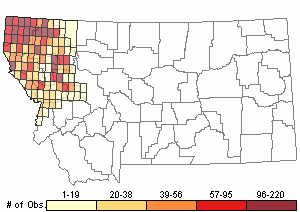
Observations in Montana Natural Heritage Program Database
Number of Observations: 5775
(Click on the following maps and charts to see full sized version)
Relative Density
Recency
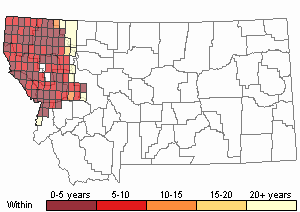

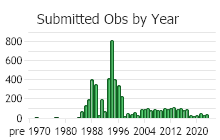
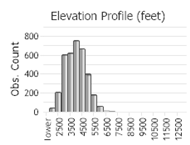 (Observations spanning multiple months or years are excluded from time charts)
Habitat
National Vegetation Classification System Groups Associated with this Species
Forest and Woodland
Low Elevation - Xeric Forest and Woodland
Montane - Subalpine Forest and Woodland
Stewardship Responsibility
References
- Literature Cited AboveLegend:
 View Online Publication
- Lesica, P., M.T. Lavin, and P.F. Stickney. 2012. Manual of Montana Vascular Plants. Fort Worth, TX: BRIT Press. viii + 771 p.
- Additional ReferencesLegend: View Online Publication
Do you know of a citation we're missing? Aldrich, D. F. 1978. Overwintering, springtime development and migration of some Aphidea, including Myzus persicae of Northwestern Montana. M.Sc. Thesis. Bozeman, Montana: Montana State University. 112 p.
- Artley, D. K. 1978. Predicting duff reduction from broadcast burning in western larch/Douglas fir stands. M.S. Thesis, University of Montana, Missoula.
- Burkle L.A., M.P. Simanonok, J.S. Durney, J.A. Myers, and R.T. Belote. 2019. Wildfires influence abundance, diversity, and intraspecific and interspecific trait variation of native bees and flowering plants across burned and unburned landscapes. Frontiers in Ecology and Evolution 7(252):1-14.
- Cope, M.G. 1992. Distribution, habitat selection and survival of transplanted Columbian Sharp-tailed Grouse (Tympanuchus phasianellus columbianus) in the Tobacco Valley, Montana. M.Sc. Thesis. Bozeman, Montana: Montana State University. 60 p.
- Crenshaw, J. G., and B. R. McClelland. 1983. Western larch hald eagle roosts in Glacier National Park, Montana. P. 10 in R. O. Anthony, F. B. Isaacs, and R. W. Frenzel, eds., Proc. of a workshop on habitat management for nesting and roosting bald eagles in the western United States. Oregon Coop. Wildl. Res. Unit, Oregon State University, Corvallis.
- Fogelsong, M.L. 1974. Effects of fluorides on Peromyscus maniculatus in Glacier National Park. M.Sc. Thesis. Bozeman, Montana: Montana State University. 52 p.
- Gaffney, W.S. 1941. The effects of winter elk browsing, South Fork of the Flathead River, Montana. Journal of Wildlife Management 5(4):427-453.
- Hendricks, P. 2005. Surveys for animal species of concern in northwestern Montana. Unpublished report to the Montana Department of Fish, Wildlife & Parks, Montana Natural Heritage Program, Helena, Montana, May 2005. 53 p.
- Holbrook, J.D., J.R. Squires, L.E. Olson, N.J. DeCesare, and R.L. Lawrence. 2017. Understanding and predicting habitat for wildlife conservation: the case of Canada Lynx at the range periphery. Ecosphere 8(9):e01939.
- Johnson, T. W. 1982. An analysis of pack and saddle stock grazing areas in the Bob Marshall Wilderness. M.Sc.Thesis. Bozeman, MT: Montana State University. 105 p.
- Jones, W. W. 1901. Preliminary flora of Gallatin County. M.S. Thesis. Bozeman, MT: Montana State College. 78 pp.
- Klebenow, D.A. 1965. A montane forest winter deer habitat in western Montana. Journal of Wildlife Management 29(1):27-33.
- Kunkel, K. and D.H. Pletscher. 2001. Winter Hunting Patterns of Wolves in and Near Glacier National Park, Montana. The Journal of Wildlife Management 65(3):520-530.
- Lesica, P., M.T. Lavin, and P.F. Stickney. 2022. Manual of Montana Vascular Plants, Second Edition. Fort Worth, TX: BRIT Press. viii + 779 p.
- Little, E.L., Jr. 1979. Checklist of United States trees (native and naturalized). Agriculture Handbook No. 541. U.S. Forest Service, Washington, D.C. 375 pp.
- Morgan, J.T. 1993. Summer habitat use of white-tailed deer on the Tally Lake ranger district, Flathead National Forest. Ph.D. Dissertation. Montana State University, Bozeman. pp. 103.
- Reese, E.G., L.A. Burkle, C.M. Delphia, and T. Griswold. 2018. A list of bees from three locations in the Northern Rockies Ecoregion (NRE) of western Montana. Biodiversity Data Journal 6: e27161.
- Shearer, R. C. 1959. Western larch seed dispersal over clear-cut blocks in northwest Montana. Proceedings Montana Academy of Science 19:130-134.
- Stansberry, B.J. 1991. Distribution, movements, and habitat use during spring, summer, and fall by mule deer in the North Salish Mountains, Montana. M.Sc. Thesis. Bozeman, MT: Montana State University. 64 p.
- Stewart, L.S. 1980. Descriptions of the life cycle, external embryogenesis and thoracic gland development of the cottonwood beetle, Chrysomela semota Brown (Coleoptera-Chyrsomelidae). M.Sc. Thesis. Bozeman, MT: Montana State University. 39 p.
- Tackle, D. 1962. Infiltration in a Western larch -- Douglas fir stand following cutting and slash treatment. USDA Intermountain For. and Range Exp. Sta., Ogden, Utah. Res. Note No. 89. 7 pp.
- Web Search Engines for Articles on "Western Larch"