View in other NatureServe Network Field Guides
NatureServe
Montana
Utah
Wyoming
Idaho
Wisconsin
British Columbia
South Carolina
Yukon
California
New York
Yellow Marsh Saxifrage - Saxifraga hirculus
State Rank Reason (see State Rank above)
DRAFT: Requesting feedback on the 2026 revised rank, factors, and State Rank Reason outlined below and in the Conservation Status Rank Report.
Saxifraga hirculus is very rare in the state, being known from only one collection from 1993 from the Beartooth Plateau. Population sizes are unknown though apprently very small. No significant or probable threats have been identified beyond those posed by climate change, such as warming temperatures and decreased snowpacks. Data to determine trends are unavailable.
Surveys are needed to attempt to relocate the population and, if found, to document the size and extent of the population. Additional occurrences of the species may exist on the Beartooth Plateau, and surveys of potentially suitable in this area are needed.
General Description
Yellow Marsh Saxifrage is a perennial herb with tufted stems that are 6-20 cm tall and arising from a short rhizome or stolon. The clustered, oblong-linear basal leaves are 15-50 mm long, taper to a petiole, and have entire margins. Alternate stem leaves are smaller and lack petioles. Leaves are glabrous, but the stem has curly reddish hairs above. Solitary flowers occur at the stem tips. Each has 5 separate, spreading to reflexed sepals that are 3-5 mm long with spreading hairs on the margin and 5 yellow, narrowly elliptic petals that are 7-13 mm long. The fruit is a red, 5-lobed capsule that is 9-16 mm high.
Phenology
Flowering in August.
Diagnostic Characteristics
Saxifraga chrysantha and S. flagellaris are our other yellow-flowered saxifrages; the former has leaves 3-7 mm long, while the latter has long, sinuous stolons.
Species Range
Montana Range
Range Descriptions
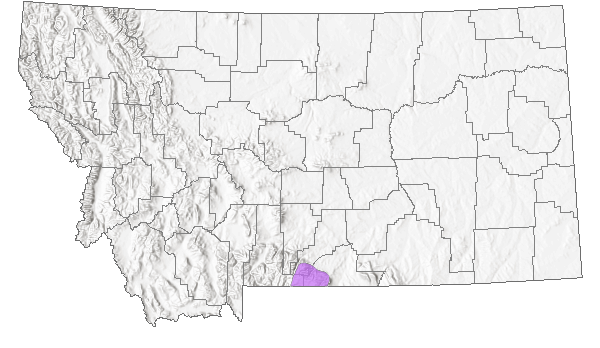
 Native
Range Comments
Circumboreal, south from AK to UT, CO and northern NM (Kartesz in prep. 2012).
Observations in Montana Natural Heritage Program Database
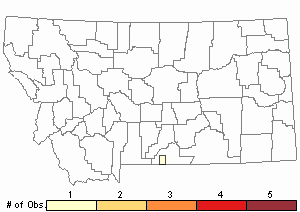
Number of Observations: 1
(Click on the following maps and charts to see full sized version)
Map Help and Descriptions
Relative Density
Recency
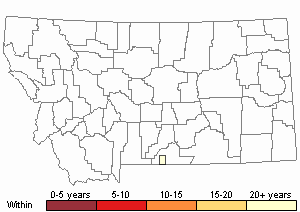
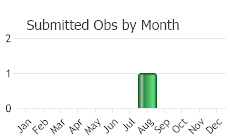
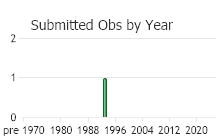
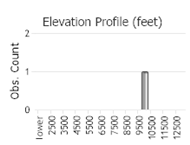 (Observations spanning multiple months or years are excluded from time charts)
Habitat
Wet, organic soil in the alpine zone.
National Vegetation Classification System Groups Associated with this Species
Alpine
Alpine - Vegetated
Wetland and Riparian
Alpine Riparian and Wetland
Wet Meadow and Marsh
Stewardship Responsibility
Threats or Limiting Factors
STATE THREAT SCORE REASON
Threat impact not assigned because threats are not known (MTNHP Threat Assessment 2021).
References
- Literature Cited AboveLegend:
 View Online Publication
 MTNHP Threat Assessment. 2021. State Threat Score Assignment and Assessment of Reported Threats from 2006 to 2021 for State-listed Vascular Plants. Botany Program, Montana Natural Heritage Program, Helena, Montana.
- Additional ReferencesLegend: View Online Publication
Do you know of a citation we're missing?- Lesica, P. and P. F. Stickney. 1994. Noteworthy collections: Montana. Madrono 41:228-231.
- Lesica, P., M.T. Lavin, and P.F. Stickney. 2012. Manual of Montana Vascular Plants. Fort Worth, TX: BRIT Press. viii + 771 p.
- Lesica, P., M.T. Lavin, and P.F. Stickney. 2022. Manual of Montana Vascular Plants, Second Edition. Fort Worth, TX: BRIT Press. viii + 779 p.
- Web Search Engines for Articles on "Yellow Marsh Saxifrage"