View in other NatureServe Network Field Guides
NatureServe
Montana
Utah
Wyoming
Idaho
Wisconsin
British Columbia
South Carolina
Yukon
California
New York
Bush morning-glory - Ipomoea leptophylla
State Rank Reason (see State Rank above)
Ipomoea leptophylla occurs in Montana at the northern edge of the species' range. Plants are considered rare where they have been found in southeastern Montana. Plants are moderately sized with showy flowers, and would not easily be overlooked, or under-collected. Since 1997, only about 7 observations have been reported. For observations made between 1890 and 1978 it remains unknown if populations still exist. Population extents and counts are presumed to be very small, though data is mostly lacking. Potential threats come from several populations that occur near to roads, where there is an increased risk for negative impacts from road maintenance, competition with non-native plant species, herbicide applications, and other activities. As such, the viability of Ipomoea leptophylla appears to be imperiled in Montana.
Surveys that bring forth current data on population parameters, habitat conditions, mapping, and potential threats are needed. Monitoring at a subset of occurrences is necessary to track population trends and assign a more accurate state conservation status rank. Surveys into areas of potential habitat are also necessary to document the species distribution and status in Montana.
General Description
Glabrous perennial with an enlarged root. Stems ascending to erect, 30–100 cm. Leaves short-petiolate; blades linear-lanceolate, entire, 3–12 cm long. Inflorescence few-flowered, axillary cymes; peduncles ca. 1 cm long. Flowers: calyx 5–10 mm long, lobes ovate, the inner longer and wider; corolla lavender, 5–7 cm long; stamens unequal, included. Capsule 10–15 mm long, beaked (
Lesica et al. 2012. Manual of Montana Vascular Plants. BRIT Press. Fort Worth, TX).
Diagnostic Characteristics
This distinctive plant is not easily mistaken for anything else in Montana. It has reddish, funnel-shaped flowers that are several inches long. The stems are woody at the base and creep along the ground. It has the general appearance of a morning glory.
Species Range
Montana Range
Range Descriptions
 Native
Range Comments
MT, SD south to NM and OK (Lesica et al. 2012. Manual of Montana Vascular Plants. BRIT Press. Fort Worth, TX).
Observations in Montana Natural Heritage Program Database
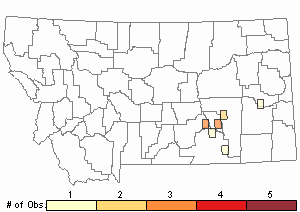
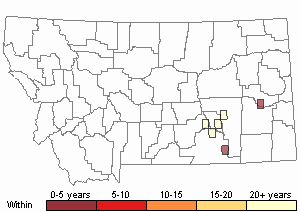
Number of Observations: 16
(Click on the following maps and charts to see full sized version)
Relative Density
Recency


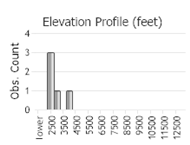 (Observations spanning multiple months or years are excluded from time charts)
Habitat
Open prairie habitats of the Great Plains, particularly in sandy or gravelly soils.
National Vegetation Classification System Groups Associated with this Species
Shrubland
Sagebrush Shrubland
Grassland
Lowland - Prairie Grassland
Ecology
POLLINATORS The following animal species have been reported as pollinators of this plant species or its genus where their geographic ranges overlap:
Bombus vagans,
Bombus pensylvanicus, and
Bombus griseocollis (Colla and Dumesh 2010).
Stewardship Responsibility
Threats or Limiting Factors
Reported threats to Montana's populations of Bush Morning-glory come from populations that occur adjacent to or near roads. Populations near roads can experience a higher risk of negative impacts from road maintenance, competition with non-native plant species, herbicide applications, and other activities. Data to substantiate these reported threats or their scope and severity are not available.
References
- Literature Cited AboveLegend:
 View Online Publication
 Colla, S.R. and S. Dumesh. 2010. The bumble bees of southern Ontario: notes on natural history and distribution. Journal of the Entomological Society of Ontario 141:39-68.
- Lesica, P., M.T. Lavin, and P.F. Stickney. 2012. Manual of Montana Vascular Plants. Fort Worth, TX: BRIT Press. viii + 771 p.
- MTNHP Threat Assessment. 2021. State Threat Score Assignment and Assessment of Reported Threats from 2006 to 2021 for State-listed Vascular Plants. Botany Program, Montana Natural Heritage Program, Helena, Montana.
- Additional ReferencesLegend: View Online Publication
Do you know of a citation we're missing?- Lesica, P., M.T. Lavin, and P.F. Stickney. 2022. Manual of Montana Vascular Plants, Second Edition. Fort Worth, TX: BRIT Press. viii + 779 p.
- Web Search Engines for Articles on "Bush morning-glory"