View in other NatureServe Network Field Guides
NatureServe
Montana
Utah
Wyoming
Idaho
Wisconsin
British Columbia
South Carolina
Yukon
California
New York
Clasping Groundsel - Senecio amplectens
Other Names:
Ligularia amplectens
State Rank Reason (see State Rank above)
Senecio amplectens is extremely rare in Montana where it is known from one occurrence. Plants are found on steep, rocky, alpine habitat along the Beartooth Highway, where they could be negatively impacted by road maintenance and construction activities. The single occurrence in proximity to a disturbance corridor puts Senecio amplectens at greater risk to extirpation in the state.
Monitoring and surveys that bring forth current data on distributions, population counts and viability, habitat conditions, and threats are greatly needed. Surveys in other areas of potential habitat are also greatly needed.
General Description
Clasping Groundsel is a glabrous herb with several lax to ascending stems that are 1-2 dm tall and arising from a short rhizome and fibrous roots. The few narrowly elliptic basal leaves are 5-18 cm long and have petioles and coarsely toothed margins. The alternate stem leaves are similar but smaller upward, and the uppermost lack petioles. Flowers are borne in 1-3 terminal, nodding heads. The heads have a single series of ca. 21 non-overlapping, narrow, pointed, involucral bracts that are 10-15 mm long. Disk flowers are yellow, and the 8-13 yellow rays are 1-2 cm long. The achene is glabrous with a pappus at its summit.
Phenology
Flowering in late July-early August.
Diagnostic Characteristics
Senecio is a large genus, and a technical manual should be consulted for positive identification. The rocky alpine habitat and 1 to a few nodding heads help distinguish this species from others.
Species Range
Montana Range
Range Descriptions
 Native
Range Comments
Known from Carbon County. MT to NV, UT and NM (Lesica et al. 2012. Manual of Montana Vascular Plants. BRIT Press. Fort Worth, TX).
Observations in Montana Natural Heritage Program Database
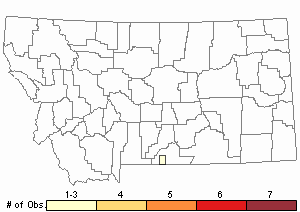
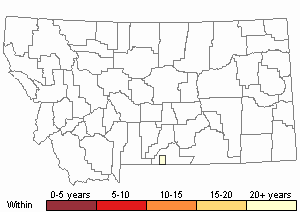
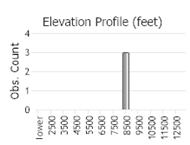
Number of Observations: 3
(Click on the following maps and charts to see full sized version)
Relative Density
Recency
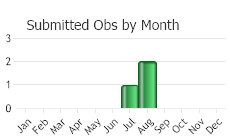
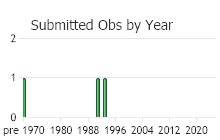
 (Observations spanning multiple months or years are excluded from time charts)
Habitat
Stony, open soil and talus of slopes in or near the alpine zone.
National Vegetation Classification System Groups Associated with this Species
Alpine
Alpine - Sparse and Barren
Alpine - Vegetated
Ecology
POLLINATORS The following animal species have been reported as pollinators of this plant species or its genus where their geographic ranges overlap:
Bombus bifarius,
Bombus flavifrons,
Bombus frigidus,
Bombus huntii,
Bombus melanopygus,
Bombus mixtus,
Bombus sylvicola,
Bombus occidentalis,
Bombus insularis,
Bombus suckleyi,
Bombus flavidus, and
Bombus kirbiellus (Schmitt 1980, Thorp et al. 1983, Mayer et al. 2000, Wilson et al. 2010, Pyke et al. 2012, Koch et al. 2012, Williams et al. 2014).
Stewardship Responsibility
Threats or Limiting Factors
Clasping Groundsel is known from a single occurrence, in which its rarity puts the species at very high risk of state extirpation. The known occurrence is at further risk due to it proximity to the Beartooth Highway and the potential for negative impacts from road maintenance and construction activities. Climate change also poses a potential risk to the state's population. The MTNHP conducted a species-level assessment using the Climate Change Vulnerability Index (CCVI) in 2021, which resulted in an Extremely Vulnerable rating to climate change. Climate change including increased ambient temperatures, decreased snowpacks, and increased frequencies and severities of drought could have negative impacts on this species; however, field-based data on the timing and magnitude from climate change is not available.
References
- Literature Cited AboveLegend:
 View Online Publication
 Koch, J., J. Strange, and P. Williams. 2012. Bumble bees of the western United States. Washington, DC: USDA Forest Service, Pollinator Partnership. 143 p.
- Lesica, P., M.T. Lavin, and P.F. Stickney. 2012. Manual of Montana Vascular Plants. Fort Worth, TX: BRIT Press. viii + 771 p.
- Mayer, D.F., E.R. Miliczky, B.F. Finnigan, and C.A. Johnson. 2000. The bee fauna (Hymenoptera: Apoidea) of southeastern Washington. Journal of the Entomological Society of British Columbia 97: 25-31.
- MTNHP Threat Assessment. 2021. State Threat Score Assignment and Assessment of Reported Threats from 2006 to 2021 for State-listed Vascular Plants. Botany Program, Montana Natural Heritage Program, Helena, Montana.
- Pyke, G.H., D.W. Inouye, and J.D. Thomson. 2012. Local geographic distributions of bumble bees near Crested Butte, Colorado: competition and community structure revisited. Environmental Entomology 41(6): 1332-1349.
- Schmitt, J. 1980. Pollinator foraging behavior and gene dispersal in Senecio (Compositae). Evolution 34: 934-943.
- Thorp, R.W., D.S. Horning, and L.L. Dunning. 1983. Bumble bees and cuckoo bumble bees of California (Hymenoptera: Apidae). Bulletin of the California Insect Survey 23:1-79.
- Williams, P., R. Thorp, L. Richardson, and S. Colla. 2014. Bumble Bees of North America. Princeton, NJ: Princeton University Press. 208 p.
- Wilson, J.S., L.E. Wilson, L.D. Loftis, and T. Griswold. 2010. The montane bee fauna of north central Washington, USA, with floral associations. Western North American Naturalist 70(2): 198-207.
- Additional ReferencesLegend: View Online Publication
Do you know of a citation we're missing?- Lesica, P., M.T. Lavin, and P.F. Stickney. 2022. Manual of Montana Vascular Plants, Second Edition. Fort Worth, TX: BRIT Press. viii + 779 p.
- Web Search Engines for Articles on "Clasping Groundsel"