View in other NatureServe Network Field Guides
NatureServe
Montana
Utah
Wyoming
Idaho
Wisconsin
British Columbia
South Carolina
Yukon
California
New York
Big Belt Wild Parsley - Musineon glaucescens
State Rank Reason (see State Rank above)
Musineon glaucescens is a local endemic of central Montana, where it is considered to be extremely rare. Musineon glaucescens was described in 2019 as a new species to science (Lesica 2019). Populations occur in the Gates of the Mountains Wilderness on the Helena-Lewis and Clark National Forest. Potential threats to its populations and habitat are not known, and it is assumed that its remote locations provide some protections for its persistance. Shifts in climate may negatively impact Musineon glaucescens over the next decade or longer, particularly from the effects of increased temperatures, increased frequency and severity of droughts, and/or decreased snowpack levels. However, impacts from a shifting climate remain unknown.
Surveys of potentially suitable habitat in the vicinity of known occurrences and across the Big Belt Mountains are needed to better understand Musineon glaucescens' distribution, population size, and population trends.
General Description
PLANTS: A thickened tap-rooted, perennial plant that grows prostrate, 10-20cm tall. The simple to branched caudex surmounts the woody taproot. Sources: Lesica 2019; Lesica et al. 2022
LEAVES: Basal and cauline with an alternate arrangement. Leaf blades are ovate in outline, 1-7 cm long by 1-7 cm wide, glabrous, and covered with a whitish-bloom (glaucous). Petioles 1-11cm long, purplish, and dilated. Petioles have sheaths along the stem that are dry, thin, and transparent (scarious). Leaf blades are pinnately divided (compound) into short-stalked leaflets, 5-25 mm long by 5-20 mm wide. Leaflets are further divided, once or twice, into linear-oblanceolate lobes with an abrupt, terminal, and sharp tip (mucronate). Lobes are 1.5-10(12) mm long by 0.5-3.0 mm wide with entire margins and midveins. Sources: Lesica 2019; Lesica et al. 2022
INFLORESCENCE: A compound umbel born on a single peduncle, 4-13 cm long (excludes the leaves). Peduncles are longer than the leaves. Rays of the umbel are 5(13)-15(21) mm long in flower or 15-40 mm long in fruit. Up to 3 involucral bracts occur at the base of the umbel's rays, are linear-attenuate in shape, often purplish, and 2.5-5 mm long. Rays terminate into an umbellet subtended by 3-7 basally united, linear attenuate, involucel bracts, that are 1-3.5 mm long with thin hyaline margins. Umbellets have 6-15 yellow or white flowers. Fruit is of two, 1-seeded, purplish, mericarps joined on their inner sides (schizocarp), and at least 5 mm long at maturity. Sources: Lesica 2019; Lesica et al. 2022
Diagnostic Characteristics
In the western United States, six
Musineon species are recognized. Refer to Lesica (2019) for a botanical key that distinguishes them. Montana has 3
Musineon species in Montana (Lesica et al. 2022).
Big Belt Wild Parsley -
Musineon glaucescens, State Endemic
* Stems: Present; grows from a simple or branched caudex.
* Leaves: 2- or 3- times ternate. Glaucous. Ultimate lobes linear-oblanceolate.
* Fruits: Purplish at maturity, at least 5 mm long.
* Distribution: In Lewis & Clark County, Montana.
* Habitat: On limestone talus in the lower subalpine zone of Montana.
Rydberg's Parsley -
Musineon vaginatum, PSOC, Regional Endemic
* Stems: Present; grows from a simple or branched caudex.
* Leaves: 2- or 3- times ternate. Not glaucous. Ultimate lobes linear.
* Fruits: Beige at maturity, equal to or less than 4.5 mm long.
* Distribution: In west-central and south-central counties of Montana.
* Habitat: Stony soil, often calcareous, in open Douglas-fir (
Pseudotsuga menziesii) forests and woodlands in the valleys to subalpine zones of Montana.
Wild Parsley -
Musineon divaricatum * Stems: Not truly present or obvious (pseudoscape), and often buried by soil.
* Leaves: Once-pinnate. Not glaucous.
* Distribution: In most counties of Montana except not the northwest.
* Habitat: Stony soil of grasslands, sagebrush steppe, and woodlands in the plains and valley zones of Montana.
TAXONOMY & NOMENCLATUREMusineon comes from an ancient Greek name for
Foeniculum, an umbel-forming genus (Giblin et al. [eds.] 2018). The specific epithet
glaucescens refers to the whitish bloom (glaucous) of the leaves (Lesica 2019).
Within the Family Apiaceae,
Musineon belongs to the subfamily Apioideae, which is endemic to western North America (Lesica 2019). Morphological traits that define members of this subfamily share similar diagnostics traits found in unrelated or distantly related species, a product of convergent evolution. Morphologically,
Musineon glaucescens closely resembles
M. vaginatum in having biternate to triternate leaves and similar inflorescence. They differ in fruit size, lobe shape of the leaflets, and the presence or absence of glaucous leaves. Because of these morphological similarities, Lesica placed this newly recognized species into the genus
Musineon, though he realized this could be a temporary classification (Lesica 2019).
Phylogenetic studies of the subfamily Apioideae demonstrate that morphological and genetic traits might not match well (Lesica 2019). Preliminary analysis of nuclear ribosomal DNA and chloroplast DNA markers, places
Musineon glaucescens into the same clade with
M. divaricatum and
M. vaginatum along with members of
Tauschia,
Cymopterus,
Aletes, and
Harbouria genera. Based only on a single sampled specimen,
Musineon glaucescens was found to be a sister of
Taushia texana and not
M. vaginatum. It is possible that the differences in traits between
Musineon glaucescens and
M. vaginatum reflect habitat, and not genetics (Lesica 2019; see also the Ecology subsection). More research is needed.
Species Range
Montana Range
Range Descriptions
 Native
Range Comments
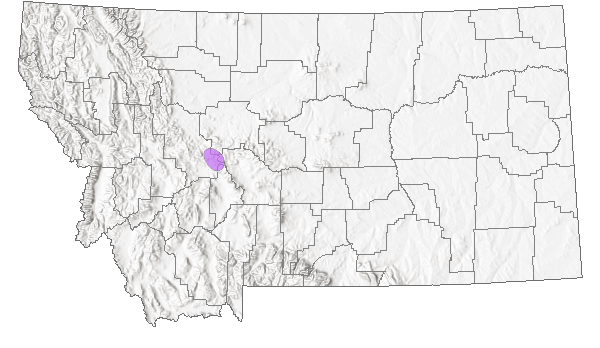
On a global scale, Big Belt Wild Parsley only occurs in the state of Montana within the United States of America [state endemic] (Lesica 2019). Populations have been found on Candle Mountain and Willow Mountain, about 3 miles apart, in the Belt Mountains on Lewis & Clark County, on the Lewis & Clark National Forest of central Montana (Lesica 2019).
Observations in Montana Natural Heritage Program Database
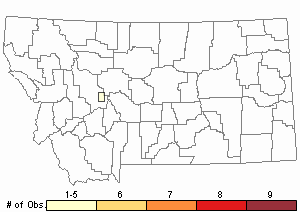
Number of Observations: 6
(Click on the following maps and charts to see full sized version)
Map Help and Descriptions
Relative Density
Recency
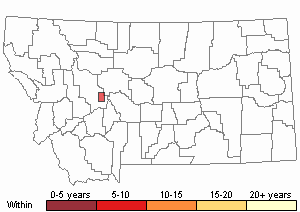


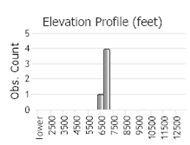 (Observations spanning multiple months or years are excluded from time charts)
Habitat
Plants grow on shifting to stable limestone talus within the lower subalpine zone (Lesica 2019; Lesica et al. 2022). Slopes are warm and support sparse vegetation (Lesica 2019). Commonly associated species include: Agropyron spicatum, Artemisia michauxiana, Lomatium cous, and Penstemon attenuatus.
Ecology
Lesica (2019) theorized that the warm, talus slope environment – and not the genetics - in which Musineon glaucescens grows could reflect the differences observed in morphological traits with the similar Musineon vaginatum. Drought stress has been conjectured as an explanation for producing glaucous leaves (Guo et al. 2016). Larger fruits could be a product of a more stressful germination condition (Harper 1977). In contrast, the broader lobes of Musineon glaucescens would often be associated with a more mesic environment.
Reproductive Characteristics
Plants reproduce by seed.
FLOWERS
Sepals: Obscure with rounded marginal teeth. Petals: 5, separate, dull yellow to white, fading to off-white or pinkish, about 1 mm long, and obovate in shape with an incurved tip and sometimes a short claw. Stamens: 5, spreading. Anthers, 0.3-0.5mm long. Filaments 0.5-2.0 mm long. Pistil: Singular, inferior, with a 2-chambered ovary (locules). Each chamber terminates into 1 style, 0.7-1.5 mm long, but lacks the swollen base – does not form a stylopodium. The styles diverge from each other.
Flowers of the umbellet can have both stamens and pistil (perfect) or have only stamens (imperfect) in the following arrangements: 1) outer flowers with both stamens and pistil (perfect) and inner flowers of only stamens, 2) all flowers with only stamens, or 3) all flowers with both stamens and pistil
FRUITS
Schizocarp: Two, 1-seeded mericarps joined on their inner sides. Narrowly ellipsoid, and partially roundish, 4-7 mm long by 1.5-4 mm wide. 1-9 shizocarps per umbellet. Mericarp: (4)5-7 mm long, glabrous or roughened (scaberulous). Ribs mostly prominent. Between the ribs are 1-4 oil tubes.
Stewardship Responsibility
Threats or Limiting Factors
Threats to the populations and habitat of Musineon glaucescens are not known.
References
- Literature Cited AboveLegend:
 View Online Publication
 Fitter, H.A. and R.K.M. Hay. 1981. Environmental physiology of plants. Academic Press, London, United Kingdom.
- Guo, J., Xu, W., X. Uu, H. Shen, H. Li, D. Cheng, A. Liu, J. Liu, C. Liu, S. Zhao, and J. Song. 2016. Cuticular wax accumulation is associated with drought tolerance in wheat near-isogenic lines. Front. Pl. Sci. 7: 1-01.
- Harper, J. L. 1977. Population biology of plants. Academic Press, New York, NY.
- Hitchcock, C.L. and A. Cronquist. 2018. Flora of the Pacific Northwest: An Illustrated Manual. Second Edition. Giblin, D.E., B.S. Legler, P.F. Zika, and R.G. Olmstead (eds). Seattle, WA: University of Washington Press in Association with Burke Museum of Natural History and Culture. 882 p.
- Lesica, P., M.T. Lavin, and P.F. Stickney. 2022. Manual of Montana Vascular Plants, Second Edition. Fort Worth, TX: BRIT Press. viii + 779 p.
- Lesica, Peter. 2019. Musineon glaucescens (Apicaeae), A New Species From Central Montana, U.S.A. J. bot. Res. Inst. Texas 13(1):1-6
- Web Search Engines for Articles on "Big Belt Wild Parsley"