View in other NatureServe Network Field Guides
NatureServe
Montana
Utah
Wyoming
Idaho
Wisconsin
British Columbia
South Carolina
Yukon
California
New York
American Golden-Plover - Pluvialis dominica
General Description
Species very similar to Pacific Golden-Plover; different in size. Head, neck, and upper breast grayish color. Obvious sexual dimorphism in most American Golden-Plovers. In males, white stripe on neck terminates on upper breast; black flanks. Males have white and yellow spots on back. Females less colorful, less mottled and darker.
For a comprehensive review of the conservation status, habitat use, and ecology of this and other Montana bird species, please see
Marks et al. 2016, Birds of Montana.Species Range
Montana Range
Range Descriptions
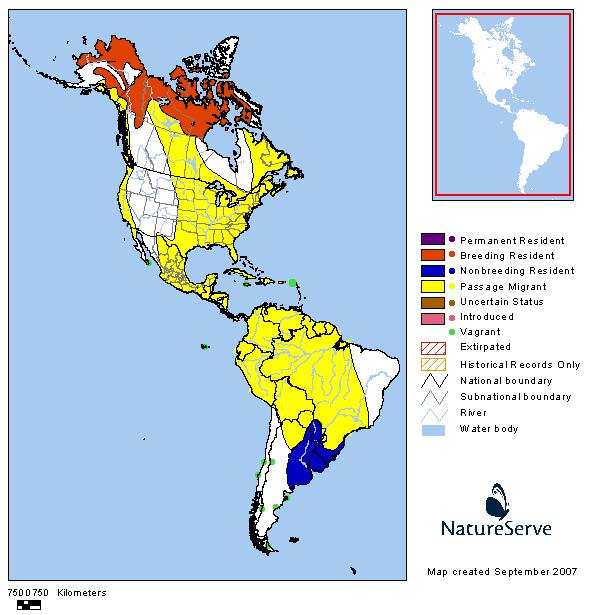
 Migratory
Western Hemisphere Range
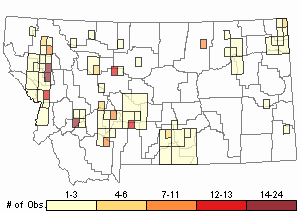
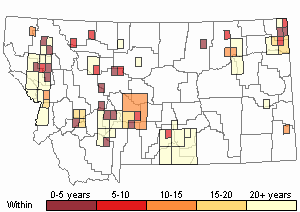
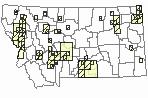
Observations in Montana Natural Heritage Program Database
Number of Observations: 252
(Click on the following maps and charts to see full sized version)
Relative Density
Recency
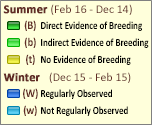
SUMMER (Feb 16 - Dec 14)
Direct Evidence of Breeding
Indirect Evidence of Breeding
No Evidence of Breeding
WINTER (Dec 15 - Feb 15)
Regularly Observed
Not Regularly Observed
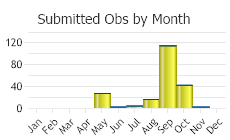
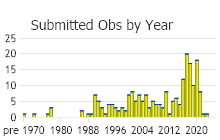
 (Observations spanning multiple months or years are excluded from time charts)
Migration
Montana is between the main migration paths of the Pacific coast and the midwest.
Habitat
Migrants are usually found along lakes or reservoirs or on agricultural lands, often on plowed or recently burned fields (Johnsgard 1986).
Ecological Communities Associated with this Species
Wetland and Riparian
Alkaline - Saline Wetlands
Alpine Riparian and Wetland
Peatland
Riparian and Wetland Forest
Riparian Shrubland
Wet Meadow and Marsh
Human Land Use
Agriculture
Food Habits
Diet consists of mainly terrestrial and marine invertebrates, along with berries, leaves, and seeds.
Reproductive Characteristics
Nests mainly built in tundra vegetation. Eggs laid in late May to early June. Single brood of four eggs incubated for 26 to 27 days.
Stewardship Responsibility
References
- Literature Cited AboveLegend:
 View Online Publication
 Johnsgard, P.A. 1986. Birds of the Rocky Mountains: with particular reference to national parks in the northern Rocky Mountain region. Colorado Associated University Press, Boulder, CO.
- Marks, J.S., P. Hendricks, and D. Casey. 2016. Birds of Montana. Arrington, VA. Buteo Books. 659 pages.
- Additional ReferencesLegend: View Online Publication
Do you know of a citation we're missing?- American Ornithologists’ Union [AOU]. 1998. Check-list of North American birds, 7th edition. American Ornithologists’ Union, Washington, D.C. 829 p.
- Cameron, E. S. 1907. The birds of Custer and Dawson counties, Montana. Auk 24(3): 241-270.
- Ehrlich, P., D. Dobkin, and D. Wheye. 1988. The birder’s handbook: a field guide to the natural history of North American birds. Simon and Schuster Inc. New York. 785 pp.
- Hayman, P., J. Marchant, and T. Prater. 1986. Shorebirds: an identification guide to the waders of the world. Houghton Mifflin Co., Boston. 412 pp.
- Hays, R., R.L. Eng, and C.V. Davis (preparers). 1984. A list of Montana birds. Helena, MT: MT Dept. of Fish, Wildlife & Parks.
- Johnsgard, P. 1981. The Plovers, Sandpipers, and Snipes of the World. University of Nebraska Press, Lincoln, Nebraska. 493 pp.
- Johnsgard, P.A. 1992. Birds of the Rocky Mountains with particular reference to national parks in the northern Rocky Mountain region. Lincoln: University of Nebraska Press. xi + 504 pp.
- Johnson, Oscar W., and Peter G. Connors. 1996. American Golden-plover (Pluvialis dominica). Species Account Number 201. The Birds of North America Online (A. Poole, Ed.). Ithaca, NY: Cornell Laboratory of Ornithology; Retrieved 3/25/2008 from The Birds of North America Online database
- Joslin, Gayle, and Heidi B. Youmans. 1999. Effects of recreation on Rocky Mountain wildlife: a review for Montana. [Montana]: Montana Chapter of the Wildlife Society.
- Lenard, S., J. Carlson, J. Ellis, C. Jones, and C. Tilly. 2003. P. D. Skaar's Montana bird distribution, 6th edition. Montana Audubon, Helena, MT. 144 pp.
- Montana Bird Distribution Committee. 2012. P.D. Skaar's Montana bird distribution. 7th Edition. Montana Audubon, Helena, Montana. 208 pp. + foldout map.
- Sibley, D. 2014. The Sibley guide to birds. Alfred A. Knopf, New York, NY. 598 pp.
- Skaar, P. D., D. L. Flath, and L. S. Thompson. 1985. Montana bird distribution. Montana Academy of Sciences Monograph 3(44): ii-69.
- Skaar, P.D. 1969. Birds of the Bozeman latilong: a compilation of data concerning the birds which occur between 45 and 46 N. latitude and 111 and 112 W. longitude, with current lists for Idaho, Montana, Wyoming, impinging Montana counties and Yellowstone National Park. Bozeman, MT. 132 p.
- U.S. Forest Service. 1991. Forest and rangeland birds of the United States: Natural history and habitat use. U.S. Department of Agriculture, Forest Service Agricultural Handbook 688. 625 pages.
- Watts, C.R. and L.C. Eichhorn. 1981. Changes in the birds of central Montana. Proceedings of the Montana Academy of Sciences 40:31-40.
- Web Search Engines for Articles on "American Golden-Plover"
- Additional Sources of Information Related to "Birds"