View in other NatureServe Network Field Guides
NatureServe
Montana
Utah
Wyoming
Idaho
Wisconsin
British Columbia
South Carolina
Yukon
California
New York
Snowy Owl - Bubo scandiacus
General Description
Round-headed, eyes yellow, bill black. Feet heavily feathered. Lacks true facial disk. A distinctive white owl with varying degrees of dark brown spotting and barring. Adult males are almost pure white, although they have up to three tail bands. Adult females are distinctly barred throughout, although white still dominates. Females usually have from four to six tail bands. Immatures are very heavily barred throughout, and dark spotting may dominate the overall plumage. Intensity of dark spotting varies with the sex of the immatures; females are the darkest. An easy owl to recognize. SIZE: 20 to 27 inches. WEIGHT: 59 to 70 ounces (3.5 to 4.5 pounds). VOICE: The Snowy Owl is virtually silent during nonbreeding seasons. During the breeding season males have a loud, booming "hoo, hoo" given as a territorial advertisement or mating call. Females rarely hoot. The attack call is a guttural "
krufff-guh-guh-guk". When excited it may emit a loud "
hooo-uh, hooo-uh, hooo-uh, wuh-wuh-wuh". Other sounds are dog-like barks, rattling cackles, shrieks, hissing, and bill-snapping. Nestlings "
cheep" up to 2 weeks of age, then hiss and squeal.
For a comprehensive review of the conservation status, habitat use, and ecology of this and other Montana bird species, please see
Marks et al. 2016, Birds of Montana.Diagnostic Characteristics
The Barn Owl has brown eyes, a white bill, and a heart-shaped facial disk. Also, they are rusty or tawny colored dorsally. The Short-eared Owl may also be confused; however, its overall color gives a golden/brown appearance and it is much smaller.
Species Range
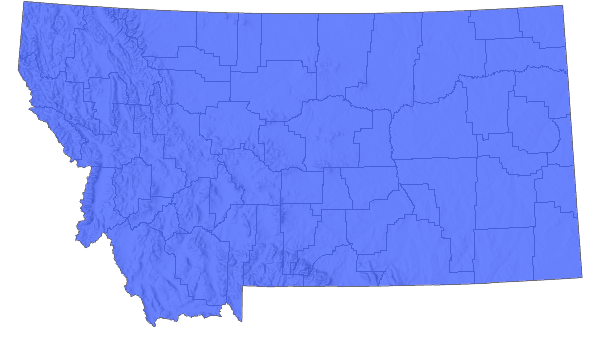
Montana Range
Range Descriptions
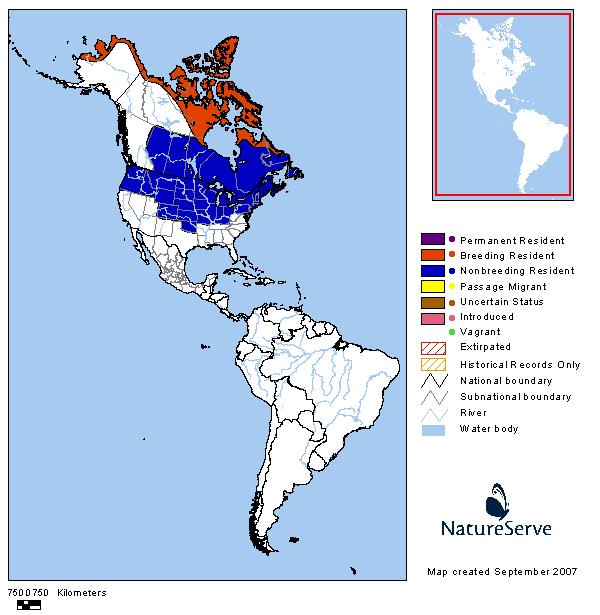
 Western Hemisphere Range
Observations in Montana Natural Heritage Program Database
Number of Observations: 1280
(Click on the following maps and charts to see full sized version)
Map Help and Descriptions
Relative Density

Recency
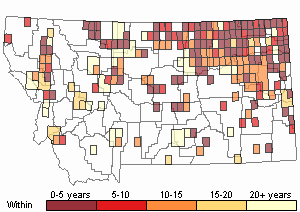
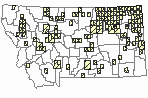
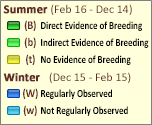
SUMMER (Feb 16 - Dec 14)
Direct Evidence of Breeding
Indirect Evidence of Breeding
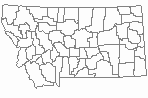
No Evidence of Breeding
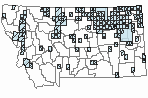
WINTER (Dec 15 - Feb 15)
Regularly Observed
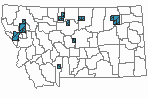
Not Regularly Observed
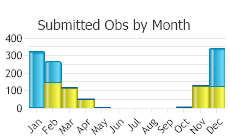
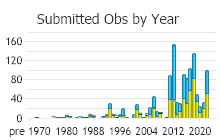
 (Observations spanning multiple months or years are excluded from time charts)
Migration
Migratory, but adults tend to remain farther north.
Habitat
Breeds on Arctic tundra. Winters primarily on open plains, and in coastal and agricultural areas.
National Vegetation Classification System Groups Associated with this Species
Forest and Woodland
Low Elevation - Xeric Forest and Woodland
Montane - Subalpine Forest and Woodland
Shrubland
Arid - Saline Shrubland
Sagebrush Shrubland
Grassland
Lowland - Prairie Grassland
Montane - Subalpine Grassland
Sparse and Barren
Sparse and Barren
Wetland and Riparian
Alkaline - Saline Wetlands
Peatland
Riparian and Wetland Forest
Wet Meadow and Marsh
Recently Disturbed or Modified
Introduced Vegetation
Recently Burned
Human Land Use
Agriculture
Developed
Food Habits
Primarily voles and lemmings, although capable of taking ptarmigan, ducks, geese, hares, and rabbits.
Reproductive Characteristics
Begins breeding in May or June. Nests on the ground. Clutch size four to nine. Incubation 32 days. Young fledge at 50 to 60 days.
Stewardship Responsibility
References
- Literature Cited AboveLegend:
 View Online Publication
- Marks, J.S., P. Hendricks, and D. Casey. 2016. Birds of Montana. Arrington, VA. Buteo Books. 659 pages.
- Additional ReferencesLegend: View Online Publication
Do you know of a citation we're missing?- American Ornithologists’ Union [AOU]. 1998. Check-list of North American birds, 7th edition. American Ornithologists’ Union, Washington, D.C. 829 p.
- Bird Conservancy of the Rockies. 2017. Pocket Guide to Northern Prairie Birds. Brighton, CO: Bird Conservancy of the Rockies. 98 p.
- Cameron, E. S. 1907. The birds of Custer and Dawson counties, Montana. Auk 24(3): 241-270.
 Decker Coal Co., 1981, Wildlife survey. July 7, 1981. In North Decker 5-Year Permit Application. Vol. III. Rule 26.4.304(12-14).
- Ehrlich, P., D. Dobkin, and D. Wheye. 1988. The birder’s handbook: a field guide to the natural history of North American birds. Simon and Schuster Inc. New York. 785 pp.
- Hays, R., R.L. Eng, and C.V. Davis (preparers). 1984. A list of Montana birds. Helena, MT: MT Dept. of Fish, Wildlife & Parks.
- Johnsgard, P.A. 1992. Birds of the Rocky Mountains with particular reference to national parks in the northern Rocky Mountain region. Lincoln: University of Nebraska Press. xi + 504 pp.
- Joslin, Gayle, and Heidi B. Youmans. 1999. Effects of recreation on Rocky Mountain wildlife: a review for Montana. [Montana]: Montana Chapter of the Wildlife Society.
- Lenard, S., J. Carlson, J. Ellis, C. Jones, and C. Tilly. 2003. P. D. Skaar's Montana bird distribution, 6th edition. Montana Audubon, Helena, MT. 144 pp.
- Montana Bird Distribution Committee. 2012. P.D. Skaar's Montana bird distribution. 7th Edition. Montana Audubon, Helena, Montana. 208 pp. + foldout map.
- Oechsli, L.M. 2000. Ex-urban development in the Rocky Mountain West: consequences for native vegetation, wildlife diversity, and land-use planning in Big Sky, Montana. M.Sc. Thesis. Montana State University, Bozeman. 73 p.
- Parmelee, D.F. 1992. Snowy Owl (Bubo scandiacus). Species Account Number 010. The Birds of North America Online (A. Poole, Ed.). Ithaca, NY: Cornell Laboratory of Ornithology; Retrieved 3/25/2008 from The Birds of North America Online database
- Saunders, A.A. 1914. The birds of Teton and northern Lewis & Clark counties, Montana. Condor 16:124-144.
- Sibley, D. 2014. The Sibley guide to birds. Alfred A. Knopf, New York, NY. 598 pp.
- Skaar, P. D., D. L. Flath, and L. S. Thompson. 1985. Montana bird distribution. Montana Academy of Sciences Monograph 3(44): ii-69.
- Skaar, P.D. 1969. Birds of the Bozeman latilong: a compilation of data concerning the birds which occur between 45 and 46 N. latitude and 111 and 112 W. longitude, with current lists for Idaho, Montana, Wyoming, impinging Montana counties and Yellowstone National Park. Bozeman, MT. 132 p.
- Thompson, L.S. 1981. Circle West wildlife monitoring study: Third annual report. Technical report No. 8. Montana Department of Natural Resources and Conservation. Helena, Montana.
- U.S. Forest Service. 1991. Forest and rangeland birds of the United States: Natural history and habitat use. U.S. Department of Agriculture, Forest Service Agricultural Handbook 688. 625 pages.
- Waage, Bruce C., 1993, Western Energy Company Rosebud Mine, Colstrip, Montana: Annual Wildlife Monitoring Report; 1993 Field Season. April 1993.
- Watts, C.R. and L.C. Eichhorn. 1981. Changes in the birds of central Montana. Proceedings of the Montana Academy of Sciences 40:31-40.
- Web Search Engines for Articles on "Snowy Owl"
- Additional Sources of Information Related to "Birds"