View in other NatureServe Network Field Guides
NatureServe
Montana
Utah
Wyoming
Idaho
Wisconsin
British Columbia
South Carolina
Yukon
California
New York
Whitehouse's Emerald - Somatochlora whitehousei
General Description
Somatochlora whitehousei is a small, dark species with a dark-brown triangular patch at the base of the hindwing, and a black face with yellow on the sides (Bryan 2008), distributed across Canada and known from only two sites in the US (Washington and Montana). Although generally uncommon, it is found in small to moderate-sized ponds and bogs with abundant vegetation (mosses, sedges, buckbean, and algae). Like other members of its genus, habitat disturbance and alteration are the greatest immediate threats to this species. Specific activities that alter fen habitat include peat mining, wetland grazing, manipulation of water levels, and recreation. Continued protection and management of bog/fen habitat is essential to the preservation of this ecologically unique species.
Diagnostic Characteristics
Like others in the family Corduliidae, eyes are contiguous and emerald green, anal loop of the hindwing is distinctive (somewhat foot-shaped, but with little development of the toe). Somatochlora is distinguished from the other genera in this family by the metallic, dark-green abdomen and the pointed (as opposed to forked) inferior anal appendage at the tip of the male abdomen. Somatochlora whitehousei is a small, dark species with a dark-brown triangular patch at the base of the hindwing, and a black face with yellow on the sides. The brassy green thorax has a single pale lateral stripe (Bryan 2008).
Species Range
Montana Range
Range Descriptions
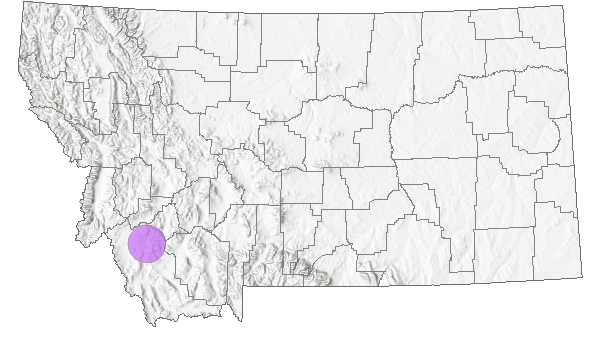
 Native
Range Comments
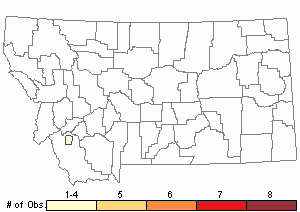
Currently there is only a single known location for this species in Montana (Skull Creek Meadows, Beaverhead County).
Observations in Montana Natural Heritage Program Database
Number of Observations: 4
(Click on the following maps and charts to see full sized version)
Map Help and Descriptions
Relative Density
Recency
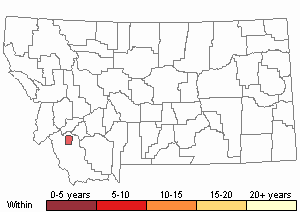
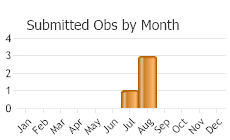
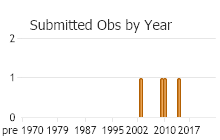
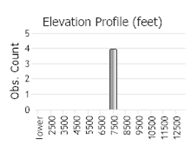 (Observations spanning multiple months or years are excluded from time charts)
Habitat
The Whitehouse's Emerald prefers sedge fens, small boggy pools and open ponds with abundant sedge vegetation having clear water and soft muddy bottom as breeding habitat (Dunkle 2000, Paulson 2009).
National Vegetation Classification System Groups Associated with this Species
Wetland and Riparian
Alkaline - Saline Wetlands
Alpine Riparian and Wetland
Peatland
Riparian and Wetland Forest
Wet Meadow and Marsh
Food Habits
Larvae feed on a wide variety of aquatic insects, such as mosquito larvae, other aquatic fly larvae, mayfly larvae, and freshwater shrimp. They will also eat very small fish and tadpoles.
Adult- The dragonfly will eat almost any soft-bodied flying insect including mosquitoes, flies, small moths, mayflies, and flying ants or termites.
Reproductive Characteristics
Male Whitehouse's Emeralds patrol seemingly at random over the open water then drop to the surface of the water looking for femeles. Females oviposit in slow flight through dense vegetation tapping the open water or small moss patches at edge of pools with their abdomens (Dunkle 2000, Paulson 2009).
Stewardship Responsibility
References
- Literature Cited AboveLegend:
 View Online Publication
- Bryan, N. 2008. “Whitehouse's Emerald, Somatochlora whitehousei” Talk About Wildlife. 24 Oct. 2008 .
- Dunkle, S.W. 2000. Dragonflies through binoculars: A field guide to dragonflies of North America. New York, NY. Oxford University Press. 266 pp.
- Paulson, D.R. 2009. Dragonflies and Damselflies of the West. Princeton University Press, Princeton. 535 pp.
- Web Search Engines for Articles on "Whitehouse's Emerald"
- Additional Sources of Information Related to "Insects"