View in other NatureServe Network Field Guides
NatureServe
Montana
Utah
Wyoming
Idaho
Wisconsin
British Columbia
South Carolina
Yukon
California
New York
- Home - Return Home
- Kingdom - Animals - Animalia
- Phylum - Spiders, Insects, and Crustaceans - Arthropoda
- Class - Insects - Insecta
- Order - Dragonflies / Damselflies - Odonata
- Family - Darner Dragonflies - Aeshnidae
- Species - Lance-tipped Darner - Aeshna constricta
Lance-tipped Darner - Aeshna constricta
State Rank Reason (see State Rank above)
The Lance-tipped Darner is currently ranked S1S3 as a "potential species of concern" in Montana because it is potentially at risk of extirpation in the state due to limited and/or declining numbers, range and/or habitat, even though it may be abundant in some areas.
General Description
The Lance-tipped Darner is a member of the family Aeshnidae. Darners are among the largest and fastest-flying North American dragonflies, 2 1/4-4 3/4" (57-120 mm) long. These brilliant blue, green, or brown insects have large, clear wings spanning up to 5 7/8". Their compound eyes meet on top of the head. The female hovers above water usually attached or guarded by the male and, using a well-developed ovipositor for slicing into emergent plants, thrusts eggs one at a time in the stems. Preferred habitat includes open, shallow marshy ponds, including some that are temporary, as well as the edges of larger open lakes, bogs, and slow streams. Wetland systems: Western Emergent Marsh, Northern Rocky Mountain Wooded Vernal Pool and the Rocky Mountain Subalpine-Montane Fen, Great Plains Open Freshwater Depressional Wetland, Great Plains Prairie Pothole
Species Range
Montana Range
Range Descriptions
 Native
Range Comments
This species has a widespread range across much of North America, except in the deep south. In Montana, distribution is state-wide within the preferred habitats.
Observations in Montana Natural Heritage Program Database
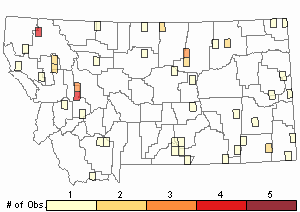
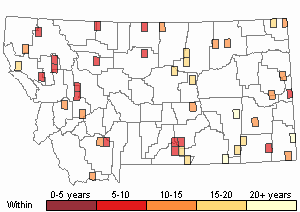
Number of Observations: 59
(Click on the following maps and charts to see full sized version)
Relative Density
Recency

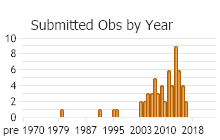
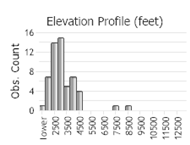 (Observations spanning multiple months or years are excluded from time charts)
Habitat
Lance-tipped Darners inhabit open, shallow marshy ponds, including some that are temporary, as well as the edges of larger open lakes, bogs, and slow streams. Many of the ponds selected for breeding dry up during the year (Dunkle 2000, Paulson 2009). They hunt, often in swarms, over marshes and fields and tend to perch vertically on low vegetation and shrubs, but will also perch on trees and branches (Dunkle 2000, Paulson 2009).
Ecological Communities Associated with this Species
Wetland and Riparian
Alkaline - Saline Wetlands
Alpine Riparian and Wetland
Peatland
Riparian and Wetland Forest
Riparian Shrubland
Wet Meadow and Marsh
Food Habits
Larvae feed on a wide variety of aquatic insects, such as mosquito larvae, other aquatic fly larvae, mayfly larvae, and freshwater shrimp. They will also eat very small fish and tadpoles.
Adult- The dragonfly will eat almost any soft-bodied flying insect including mosquitoes, flies, small moths, mayflies, and flying ants or termites.
Reproductive Characteristics
Male Lance-tipped Darners are territorial and patrol small areas along the shoreline or through semi-open vegetation, but flight is slower with less hovering compared to the Canada Darner (Aeshna canadensis). Females oviposit slowly and selectively on the stems of cattails (Typha spp.) and sweetflag (Acorus americanus) often well above the surface of the water in areas that tend to dry out. (Dunkle 2000, Paulson 2009).
Stewardship Responsibility
Threats or Limiting Factors
Drought is a significant threat to this species as it selects wetlands and ponds for breeding that dry up during the year. In drought years, many of these habitats will already be dried up and breeding locations become scarce.
References
- Literature Cited AboveLegend:
 View Online Publication
 Miller, K.B. and D.L. Gustafson. 1996. Distribution records of the Odonata of Montana. Bulletin of American Odonatology 3(4):75-88.
- Additional ReferencesLegend: View Online Publication
Do you know of a citation we're missing?- Dunkle, S.W. 2000. Dragonflies through binoculars: A field guide to dragonflies of North America. New York, NY. Oxford University Press. 266 pp.
- Paulson, D.R. 2009. Dragonflies and Damselflies of the West. Princeton University Press, Princeton. 535 pp.
- Web Search Engines for Articles on "Lance-tipped Darner"
- Additional Sources of Information Related to "Insects"